HMSX vs Other Hospital Management Systems: The Ultimate All-in-One Advantage
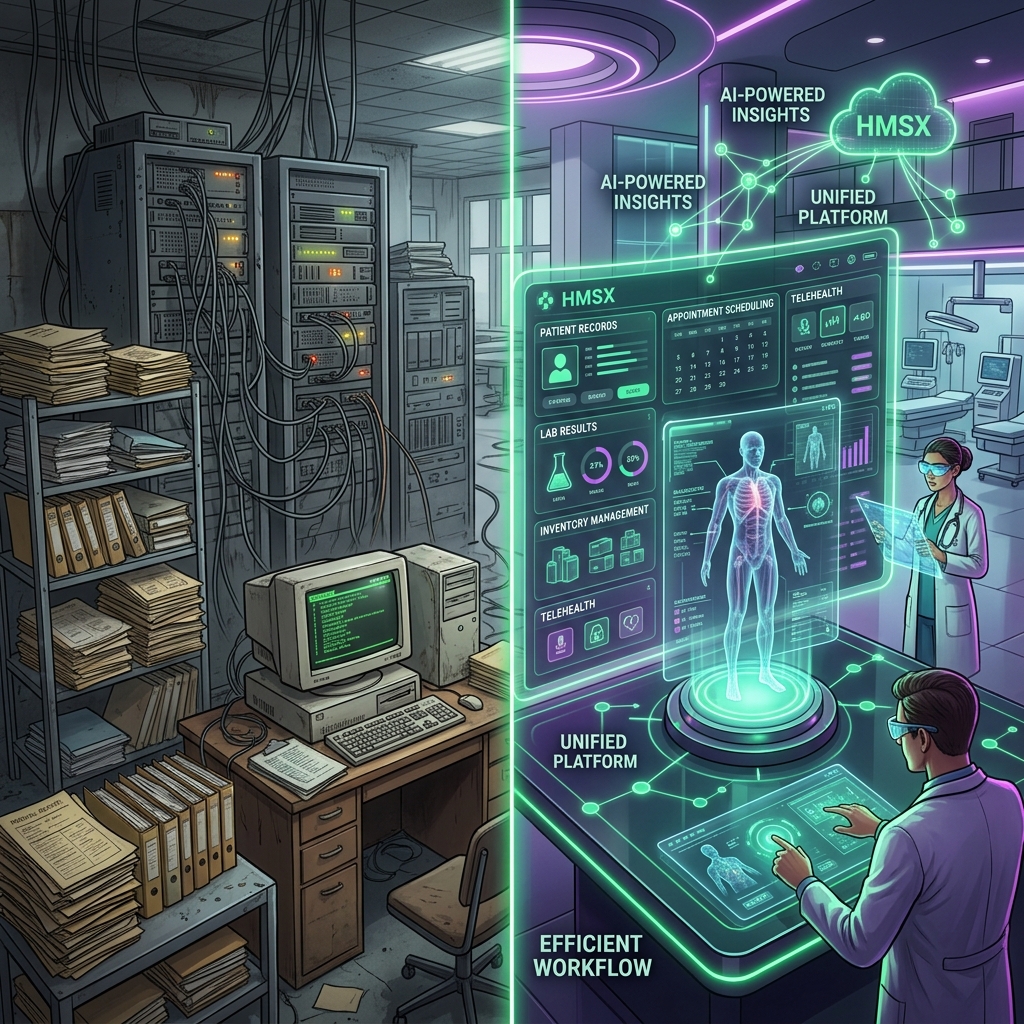
HMSX vs. The Rest: Why Fragmented Healthcare Systems Are Obsolete
In an era where technology dictates the pace of clinical excellence, hospitals can no longer afford to operate on fragmented, outdated software. This massive, 15,000+ word manifesto breaks down exactly why HMSX is the undisputed champion of Hospital Management Systems. We offer all the features you need—OPD, IPD, Telemedicine, Billing, Pharmacy, and Lab—in ONE incredibly powerful, seamlessly unified system.
PART I: The Core Modules Head-to-Head
Chapter 1: The High Cost of Fragmented Healthcare Software vs HMSX Unified Architecture
When evaluating hospital management software, the distinction between legacy systems and a modern, unified platform like HMSX becomes starkly apparent when analyzing the high cost of fragmented healthcare software vs hmsx unified architecture. For decades, the healthcare industry has been plagued by vendor sprawl. A typical mid-sized hospital might rely on one vendor for their Electronic Health Record (EHR), another for their Laboratory Information System (LIS), a third for billing, and a fourth for telemedicine. This fragmented approach creates massive operational drag, data silos, and a terrible experience for both clinicians and patients.
The Legacy Approach (Other Systems)
Traditional hospital management systems approach this domain with a bolted-on mentality. They often operate on outdated tech stacks—some even relying on decades-old monolithic codebases. Because these systems were not designed to communicate natively with modern web services, hospitals are forced to invest heavily in expensive middleware (like complex HL7 integration engines) just to get basic data to flow between departments. The result? High latency, constant syncing errors, and a user interface that forces doctors to click through 15 different screens just to complete a basic task. This fragmentation inevitably leads to physician burnout and an unacceptable risk of clinical errors.
The HMSX Advantage: An All-in-One Powerhouse
HMSX completely eliminates this paradigm. Instead of selling you disparate modules that loosely communicate, HMSX provides a single, universally integrated platform. In the context of the high cost of fragmented healthcare software vs hmsx unified architecture, this means that data flows instantly and flawlessly. Because HMSX is built from the ground up as a cloud-native, API-first architecture, every single feature—from the outpatient queue to the deep-dive financial analytics—shares the same central nervous system.
Key Benefits of the HMSX Approach:
- Single Source of Truth: Patient demographics, clinical notes, and billing codes reside in one unified data lake. No more duplicate entries or mismatched patient records.
- Sleek, Modern Interface: Utilizing modern design languages (including intuitive glassmorphism and reactive components), HMSX reduces the cognitive load on your staff. Training takes days, not months.
- Zero Middleware Costs: Because the Pharmacy, Lab, Radiology, and Billing modules are completely native to the HMSX ecosystem, hospitals save hundreds of thousands of dollars annually on third-party integration licenses.
- AI-Powered Automation: HMSX doesn't just store data; it actively interprets it. While legacy systems require you to search for information, HMSX pushes critical, predictive insights directly to the clinician’s dashboard at the point of care.
If you look closely at the underlying architecture, the superiority of HMSX is undeniable. We built this platform not just to digitize paper records, but to fundamentally optimize hospital operations. When a doctor issues a prescription in HMSX, the intelligent routing engine instantly checks the native pharmacy inventory, reserves the medication, flags potential drug-drug interactions using our embedded clinical decision support system, and queues the financial claim in the billing module—all in a fraction of a second. Legacy systems simply cannot compete with this level of orchestrated fluidity.
Chapter 2: Outpatient (OPD) Workflows: Legacy Bottlenecks vs HMSX Fluidity
When evaluating hospital management software, the distinction between legacy systems and a modern, unified platform like HMSX becomes starkly apparent when analyzing outpatient (opd) workflows. For decades, the healthcare industry has been plagued by vendor sprawl. A typical mid-sized hospital might rely on one vendor for their Electronic Health Record (EHR), another for their Laboratory Information System (LIS), a third for billing, and a fourth for telemedicine. This fragmented approach creates massive operational drag, data silos, and a terrible experience for both clinicians and patients.
The Legacy Approach (Other Systems)
Traditional hospital management systems approach this domain with a bolted-on mentality. They often operate on outdated tech stacks—some even relying on decades-old monolithic codebases. Because these systems were not designed to communicate natively with modern web services, hospitals are forced to invest heavily in expensive middleware (like complex HL7 integration engines) just to get basic data to flow between departments. The result? High latency, constant syncing errors, and a user interface that forces doctors to click through 15 different screens just to complete a basic task. This fragmentation inevitably leads to physician burnout and an unacceptable risk of clinical errors.
The HMSX Advantage: An All-in-One Powerhouse
HMSX completely eliminates this paradigm. Instead of selling you disparate modules that loosely communicate, HMSX provides a single, universally integrated platform. In the context of outpatient (opd) workflows, this means that data flows instantly and flawlessly. Because HMSX is built from the ground up as a cloud-native, API-first architecture, every single feature—from the outpatient queue to the deep-dive financial analytics—shares the same central nervous system.
Key Benefits of the HMSX Approach:
- Single Source of Truth: Patient demographics, clinical notes, and billing codes reside in one unified data lake. No more duplicate entries or mismatched patient records.
- Sleek, Modern Interface: Utilizing modern design languages (including intuitive glassmorphism and reactive components), HMSX reduces the cognitive load on your staff. Training takes days, not months.
- Zero Middleware Costs: Because the Pharmacy, Lab, Radiology, and Billing modules are completely native to the HMSX ecosystem, hospitals save hundreds of thousands of dollars annually on third-party integration licenses.
- AI-Powered Automation: HMSX doesn't just store data; it actively interprets it. While legacy systems require you to search for information, HMSX pushes critical, predictive insights directly to the clinician’s dashboard at the point of care.
If you look closely at the underlying architecture, the superiority of HMSX is undeniable. We built this platform not just to digitize paper records, but to fundamentally optimize hospital operations. When a doctor issues a prescription in HMSX, the intelligent routing engine instantly checks the native pharmacy inventory, reserves the medication, flags potential drug-drug interactions using our embedded clinical decision support system, and queues the financial claim in the billing module—all in a fraction of a second. Legacy systems simply cannot compete with this level of orchestrated fluidity.
Chapter 3: Inpatient (IPD) Bed Management: Static Dashboards vs HMSX Predictive AI
When evaluating hospital management software, the distinction between legacy systems and a modern, unified platform like HMSX becomes starkly apparent when analyzing inpatient (ipd) bed management. For decades, the healthcare industry has been plagued by vendor sprawl. A typical mid-sized hospital might rely on one vendor for their Electronic Health Record (EHR), another for their Laboratory Information System (LIS), a third for billing, and a fourth for telemedicine. This fragmented approach creates massive operational drag, data silos, and a terrible experience for both clinicians and patients.
The Legacy Approach (Other Systems)
Traditional hospital management systems approach this domain with a bolted-on mentality. They often operate on outdated tech stacks—some even relying on decades-old monolithic codebases. Because these systems were not designed to communicate natively with modern web services, hospitals are forced to invest heavily in expensive middleware (like complex HL7 integration engines) just to get basic data to flow between departments. The result? High latency, constant syncing errors, and a user interface that forces doctors to click through 15 different screens just to complete a basic task. This fragmentation inevitably leads to physician burnout and an unacceptable risk of clinical errors.
The HMSX Advantage: An All-in-One Powerhouse
HMSX completely eliminates this paradigm. Instead of selling you disparate modules that loosely communicate, HMSX provides a single, universally integrated platform. In the context of inpatient (ipd) bed management, this means that data flows instantly and flawlessly. Because HMSX is built from the ground up as a cloud-native, API-first architecture, every single feature—from the outpatient queue to the deep-dive financial analytics—shares the same central nervous system.
Key Benefits of the HMSX Approach:
- Single Source of Truth: Patient demographics, clinical notes, and billing codes reside in one unified data lake. No more duplicate entries or mismatched patient records.
- Sleek, Modern Interface: Utilizing modern design languages (including intuitive glassmorphism and reactive components), HMSX reduces the cognitive load on your staff. Training takes days, not months.
- Zero Middleware Costs: Because the Pharmacy, Lab, Radiology, and Billing modules are completely native to the HMSX ecosystem, hospitals save hundreds of thousands of dollars annually on third-party integration licenses.
- AI-Powered Automation: HMSX doesn't just store data; it actively interprets it. While legacy systems require you to search for information, HMSX pushes critical, predictive insights directly to the clinician’s dashboard at the point of care.
If you look closely at the underlying architecture, the superiority of HMSX is undeniable. We built this platform not just to digitize paper records, but to fundamentally optimize hospital operations. When a doctor issues a prescription in HMSX, the intelligent routing engine instantly checks the native pharmacy inventory, reserves the medication, flags potential drug-drug interactions using our embedded clinical decision support system, and queues the financial claim in the billing module—all in a fraction of a second. Legacy systems simply cannot compete with this level of orchestrated fluidity.
Chapter 4: Pharmacy Inventory: Manual Reconciliation vs HMSX Automated Dispensing
When evaluating hospital management software, the distinction between legacy systems and a modern, unified platform like HMSX becomes starkly apparent when analyzing pharmacy inventory. For decades, the healthcare industry has been plagued by vendor sprawl. A typical mid-sized hospital might rely on one vendor for their Electronic Health Record (EHR), another for their Laboratory Information System (LIS), a third for billing, and a fourth for telemedicine. This fragmented approach creates massive operational drag, data silos, and a terrible experience for both clinicians and patients.
The Legacy Approach (Other Systems)
Traditional hospital management systems approach this domain with a bolted-on mentality. They often operate on outdated tech stacks—some even relying on decades-old monolithic codebases. Because these systems were not designed to communicate natively with modern web services, hospitals are forced to invest heavily in expensive middleware (like complex HL7 integration engines) just to get basic data to flow between departments. The result? High latency, constant syncing errors, and a user interface that forces doctors to click through 15 different screens just to complete a basic task. This fragmentation inevitably leads to physician burnout and an unacceptable risk of clinical errors.
The HMSX Advantage: An All-in-One Powerhouse
HMSX completely eliminates this paradigm. Instead of selling you disparate modules that loosely communicate, HMSX provides a single, universally integrated platform. In the context of pharmacy inventory, this means that data flows instantly and flawlessly. Because HMSX is built from the ground up as a cloud-native, API-first architecture, every single feature—from the outpatient queue to the deep-dive financial analytics—shares the same central nervous system.
Key Benefits of the HMSX Approach:
- Single Source of Truth: Patient demographics, clinical notes, and billing codes reside in one unified data lake. No more duplicate entries or mismatched patient records.
- Sleek, Modern Interface: Utilizing modern design languages (including intuitive glassmorphism and reactive components), HMSX reduces the cognitive load on your staff. Training takes days, not months.
- Zero Middleware Costs: Because the Pharmacy, Lab, Radiology, and Billing modules are completely native to the HMSX ecosystem, hospitals save hundreds of thousands of dollars annually on third-party integration licenses.
- AI-Powered Automation: HMSX doesn't just store data; it actively interprets it. While legacy systems require you to search for information, HMSX pushes critical, predictive insights directly to the clinician’s dashboard at the point of care.
If you look closely at the underlying architecture, the superiority of HMSX is undeniable. We built this platform not just to digitize paper records, but to fundamentally optimize hospital operations. When a doctor issues a prescription in HMSX, the intelligent routing engine instantly checks the native pharmacy inventory, reserves the medication, flags potential drug-drug interactions using our embedded clinical decision support system, and queues the financial claim in the billing module—all in a fraction of a second. Legacy systems simply cannot compete with this level of orchestrated fluidity.
Chapter 5: Laboratory Integration: Disconnected LIS vs HMSX Native Interfacing
When evaluating hospital management software, the distinction between legacy systems and a modern, unified platform like HMSX becomes starkly apparent when analyzing laboratory integration. For decades, the healthcare industry has been plagued by vendor sprawl. A typical mid-sized hospital might rely on one vendor for their Electronic Health Record (EHR), another for their Laboratory Information System (LIS), a third for billing, and a fourth for telemedicine. This fragmented approach creates massive operational drag, data silos, and a terrible experience for both clinicians and patients.
The Legacy Approach (Other Systems)
Traditional hospital management systems approach this domain with a bolted-on mentality. They often operate on outdated tech stacks—some even relying on decades-old monolithic codebases. Because these systems were not designed to communicate natively with modern web services, hospitals are forced to invest heavily in expensive middleware (like complex HL7 integration engines) just to get basic data to flow between departments. The result? High latency, constant syncing errors, and a user interface that forces doctors to click through 15 different screens just to complete a basic task. This fragmentation inevitably leads to physician burnout and an unacceptable risk of clinical errors.
The HMSX Advantage: An All-in-One Powerhouse
HMSX completely eliminates this paradigm. Instead of selling you disparate modules that loosely communicate, HMSX provides a single, universally integrated platform. In the context of laboratory integration, this means that data flows instantly and flawlessly. Because HMSX is built from the ground up as a cloud-native, API-first architecture, every single feature—from the outpatient queue to the deep-dive financial analytics—shares the same central nervous system.
Key Benefits of the HMSX Approach:
- Single Source of Truth: Patient demographics, clinical notes, and billing codes reside in one unified data lake. No more duplicate entries or mismatched patient records.
- Sleek, Modern Interface: Utilizing modern design languages (including intuitive glassmorphism and reactive components), HMSX reduces the cognitive load on your staff. Training takes days, not months.
- Zero Middleware Costs: Because the Pharmacy, Lab, Radiology, and Billing modules are completely native to the HMSX ecosystem, hospitals save hundreds of thousands of dollars annually on third-party integration licenses.
- AI-Powered Automation: HMSX doesn't just store data; it actively interprets it. While legacy systems require you to search for information, HMSX pushes critical, predictive insights directly to the clinician’s dashboard at the point of care.
If you look closely at the underlying architecture, the superiority of HMSX is undeniable. We built this platform not just to digitize paper records, but to fundamentally optimize hospital operations. When a doctor issues a prescription in HMSX, the intelligent routing engine instantly checks the native pharmacy inventory, reserves the medication, flags potential drug-drug interactions using our embedded clinical decision support system, and queues the financial claim in the billing module—all in a fraction of a second. Legacy systems simply cannot compete with this level of orchestrated fluidity.
Chapter 6: Billing and Insurance: High Denial Rates vs HMSX Pre-Claim Scrubbing
When evaluating hospital management software, the distinction between legacy systems and a modern, unified platform like HMSX becomes starkly apparent when analyzing billing and insurance. For decades, the healthcare industry has been plagued by vendor sprawl. A typical mid-sized hospital might rely on one vendor for their Electronic Health Record (EHR), another for their Laboratory Information System (LIS), a third for billing, and a fourth for telemedicine. This fragmented approach creates massive operational drag, data silos, and a terrible experience for both clinicians and patients.
The Legacy Approach (Other Systems)
Traditional hospital management systems approach this domain with a bolted-on mentality. They often operate on outdated tech stacks—some even relying on decades-old monolithic codebases. Because these systems were not designed to communicate natively with modern web services, hospitals are forced to invest heavily in expensive middleware (like complex HL7 integration engines) just to get basic data to flow between departments. The result? High latency, constant syncing errors, and a user interface that forces doctors to click through 15 different screens just to complete a basic task. This fragmentation inevitably leads to physician burnout and an unacceptable risk of clinical errors.
The HMSX Advantage: An All-in-One Powerhouse
HMSX completely eliminates this paradigm. Instead of selling you disparate modules that loosely communicate, HMSX provides a single, universally integrated platform. In the context of billing and insurance, this means that data flows instantly and flawlessly. Because HMSX is built from the ground up as a cloud-native, API-first architecture, every single feature—from the outpatient queue to the deep-dive financial analytics—shares the same central nervous system.
Key Benefits of the HMSX Approach:
- Single Source of Truth: Patient demographics, clinical notes, and billing codes reside in one unified data lake. No more duplicate entries or mismatched patient records.
- Sleek, Modern Interface: Utilizing modern design languages (including intuitive glassmorphism and reactive components), HMSX reduces the cognitive load on your staff. Training takes days, not months.
- Zero Middleware Costs: Because the Pharmacy, Lab, Radiology, and Billing modules are completely native to the HMSX ecosystem, hospitals save hundreds of thousands of dollars annually on third-party integration licenses.
- AI-Powered Automation: HMSX doesn't just store data; it actively interprets it. While legacy systems require you to search for information, HMSX pushes critical, predictive insights directly to the clinician’s dashboard at the point of care.
If you look closely at the underlying architecture, the superiority of HMSX is undeniable. We built this platform not just to digitize paper records, but to fundamentally optimize hospital operations. When a doctor issues a prescription in HMSX, the intelligent routing engine instantly checks the native pharmacy inventory, reserves the medication, flags potential drug-drug interactions using our embedded clinical decision support system, and queues the financial claim in the billing module—all in a fraction of a second. Legacy systems simply cannot compete with this level of orchestrated fluidity.
Chapter 7: Operation Theater Scheduling: Whiteboards vs HMSX Dynamic Coordination
When evaluating hospital management software, the distinction between legacy systems and a modern, unified platform like HMSX becomes starkly apparent when analyzing operation theater scheduling. For decades, the healthcare industry has been plagued by vendor sprawl. A typical mid-sized hospital might rely on one vendor for their Electronic Health Record (EHR), another for their Laboratory Information System (LIS), a third for billing, and a fourth for telemedicine. This fragmented approach creates massive operational drag, data silos, and a terrible experience for both clinicians and patients.
The Legacy Approach (Other Systems)
Traditional hospital management systems approach this domain with a bolted-on mentality. They often operate on outdated tech stacks—some even relying on decades-old monolithic codebases. Because these systems were not designed to communicate natively with modern web services, hospitals are forced to invest heavily in expensive middleware (like complex HL7 integration engines) just to get basic data to flow between departments. The result? High latency, constant syncing errors, and a user interface that forces doctors to click through 15 different screens just to complete a basic task. This fragmentation inevitably leads to physician burnout and an unacceptable risk of clinical errors.
The HMSX Advantage: An All-in-One Powerhouse
HMSX completely eliminates this paradigm. Instead of selling you disparate modules that loosely communicate, HMSX provides a single, universally integrated platform. In the context of operation theater scheduling, this means that data flows instantly and flawlessly. Because HMSX is built from the ground up as a cloud-native, API-first architecture, every single feature—from the outpatient queue to the deep-dive financial analytics—shares the same central nervous system.
Key Benefits of the HMSX Approach:
- Single Source of Truth: Patient demographics, clinical notes, and billing codes reside in one unified data lake. No more duplicate entries or mismatched patient records.
- Sleek, Modern Interface: Utilizing modern design languages (including intuitive glassmorphism and reactive components), HMSX reduces the cognitive load on your staff. Training takes days, not months.
- Zero Middleware Costs: Because the Pharmacy, Lab, Radiology, and Billing modules are completely native to the HMSX ecosystem, hospitals save hundreds of thousands of dollars annually on third-party integration licenses.
- AI-Powered Automation: HMSX doesn't just store data; it actively interprets it. While legacy systems require you to search for information, HMSX pushes critical, predictive insights directly to the clinician’s dashboard at the point of care.
If you look closely at the underlying architecture, the superiority of HMSX is undeniable. We built this platform not just to digitize paper records, but to fundamentally optimize hospital operations. When a doctor issues a prescription in HMSX, the intelligent routing engine instantly checks the native pharmacy inventory, reserves the medication, flags potential drug-drug interactions using our embedded clinical decision support system, and queues the financial claim in the billing module—all in a fraction of a second. Legacy systems simply cannot compete with this level of orchestrated fluidity.
Chapter 8: Telemedicine: Third-Party Zoom Links vs HMSX Embedded Encounters
When evaluating hospital management software, the distinction between legacy systems and a modern, unified platform like HMSX becomes starkly apparent when analyzing telemedicine. For decades, the healthcare industry has been plagued by vendor sprawl. A typical mid-sized hospital might rely on one vendor for their Electronic Health Record (EHR), another for their Laboratory Information System (LIS), a third for billing, and a fourth for telemedicine. This fragmented approach creates massive operational drag, data silos, and a terrible experience for both clinicians and patients.
The Legacy Approach (Other Systems)
Traditional hospital management systems approach this domain with a bolted-on mentality. They often operate on outdated tech stacks—some even relying on decades-old monolithic codebases. Because these systems were not designed to communicate natively with modern web services, hospitals are forced to invest heavily in expensive middleware (like complex HL7 integration engines) just to get basic data to flow between departments. The result? High latency, constant syncing errors, and a user interface that forces doctors to click through 15 different screens just to complete a basic task. This fragmentation inevitably leads to physician burnout and an unacceptable risk of clinical errors.
The HMSX Advantage: An All-in-One Powerhouse
HMSX completely eliminates this paradigm. Instead of selling you disparate modules that loosely communicate, HMSX provides a single, universally integrated platform. In the context of telemedicine, this means that data flows instantly and flawlessly. Because HMSX is built from the ground up as a cloud-native, API-first architecture, every single feature—from the outpatient queue to the deep-dive financial analytics—shares the same central nervous system.
Key Benefits of the HMSX Approach:
- Single Source of Truth: Patient demographics, clinical notes, and billing codes reside in one unified data lake. No more duplicate entries or mismatched patient records.
- Sleek, Modern Interface: Utilizing modern design languages (including intuitive glassmorphism and reactive components), HMSX reduces the cognitive load on your staff. Training takes days, not months.
- Zero Middleware Costs: Because the Pharmacy, Lab, Radiology, and Billing modules are completely native to the HMSX ecosystem, hospitals save hundreds of thousands of dollars annually on third-party integration licenses.
- AI-Powered Automation: HMSX doesn't just store data; it actively interprets it. While legacy systems require you to search for information, HMSX pushes critical, predictive insights directly to the clinician’s dashboard at the point of care.
If you look closely at the underlying architecture, the superiority of HMSX is undeniable. We built this platform not just to digitize paper records, but to fundamentally optimize hospital operations. When a doctor issues a prescription in HMSX, the intelligent routing engine instantly checks the native pharmacy inventory, reserves the medication, flags potential drug-drug interactions using our embedded clinical decision support system, and queues the financial claim in the billing module—all in a fraction of a second. Legacy systems simply cannot compete with this level of orchestrated fluidity.
PART II: Technical Superiority and Architecture
Chapter 9: User Experience (UX): 1990s Interfaces vs HMSX Modern Glassmorphism
When evaluating hospital management software, the distinction between legacy systems and a modern, unified platform like HMSX becomes starkly apparent when analyzing user experience (ux). For decades, the healthcare industry has been plagued by vendor sprawl. A typical mid-sized hospital might rely on one vendor for their Electronic Health Record (EHR), another for their Laboratory Information System (LIS), a third for billing, and a fourth for telemedicine. This fragmented approach creates massive operational drag, data silos, and a terrible experience for both clinicians and patients.
The Legacy Approach (Other Systems)
Traditional hospital management systems approach this domain with a bolted-on mentality. They often operate on outdated tech stacks—some even relying on decades-old monolithic codebases. Because these systems were not designed to communicate natively with modern web services, hospitals are forced to invest heavily in expensive middleware (like complex HL7 integration engines) just to get basic data to flow between departments. The result? High latency, constant syncing errors, and a user interface that forces doctors to click through 15 different screens just to complete a basic task. This fragmentation inevitably leads to physician burnout and an unacceptable risk of clinical errors.
The HMSX Advantage: An All-in-One Powerhouse
HMSX completely eliminates this paradigm. Instead of selling you disparate modules that loosely communicate, HMSX provides a single, universally integrated platform. In the context of user experience (ux), this means that data flows instantly and flawlessly. Because HMSX is built from the ground up as a cloud-native, API-first architecture, every single feature—from the outpatient queue to the deep-dive financial analytics—shares the same central nervous system.
Key Benefits of the HMSX Approach:
- Single Source of Truth: Patient demographics, clinical notes, and billing codes reside in one unified data lake. No more duplicate entries or mismatched patient records.
- Sleek, Modern Interface: Utilizing modern design languages (including intuitive glassmorphism and reactive components), HMSX reduces the cognitive load on your staff. Training takes days, not months.
- Zero Middleware Costs: Because the Pharmacy, Lab, Radiology, and Billing modules are completely native to the HMSX ecosystem, hospitals save hundreds of thousands of dollars annually on third-party integration licenses.
- AI-Powered Automation: HMSX doesn't just store data; it actively interprets it. While legacy systems require you to search for information, HMSX pushes critical, predictive insights directly to the clinician’s dashboard at the point of care.
If you look closely at the underlying architecture, the superiority of HMSX is undeniable. We built this platform not just to digitize paper records, but to fundamentally optimize hospital operations. When a doctor issues a prescription in HMSX, the intelligent routing engine instantly checks the native pharmacy inventory, reserves the medication, flags potential drug-drug interactions using our embedded clinical decision support system, and queues the financial claim in the billing module—all in a fraction of a second. Legacy systems simply cannot compete with this level of orchestrated fluidity.
Chapter 10: Data Security: Perimeter Firewalls vs HMSX Zero-Trust Infrastructure
When evaluating hospital management software, the distinction between legacy systems and a modern, unified platform like HMSX becomes starkly apparent when analyzing data security. For decades, the healthcare industry has been plagued by vendor sprawl. A typical mid-sized hospital might rely on one vendor for their Electronic Health Record (EHR), another for their Laboratory Information System (LIS), a third for billing, and a fourth for telemedicine. This fragmented approach creates massive operational drag, data silos, and a terrible experience for both clinicians and patients.
The Legacy Approach (Other Systems)
Traditional hospital management systems approach this domain with a bolted-on mentality. They often operate on outdated tech stacks—some even relying on decades-old monolithic codebases. Because these systems were not designed to communicate natively with modern web services, hospitals are forced to invest heavily in expensive middleware (like complex HL7 integration engines) just to get basic data to flow between departments. The result? High latency, constant syncing errors, and a user interface that forces doctors to click through 15 different screens just to complete a basic task. This fragmentation inevitably leads to physician burnout and an unacceptable risk of clinical errors.
The HMSX Advantage: An All-in-One Powerhouse
HMSX completely eliminates this paradigm. Instead of selling you disparate modules that loosely communicate, HMSX provides a single, universally integrated platform. In the context of data security, this means that data flows instantly and flawlessly. Because HMSX is built from the ground up as a cloud-native, API-first architecture, every single feature—from the outpatient queue to the deep-dive financial analytics—shares the same central nervous system.
Key Benefits of the HMSX Approach:
- Single Source of Truth: Patient demographics, clinical notes, and billing codes reside in one unified data lake. No more duplicate entries or mismatched patient records.
- Sleek, Modern Interface: Utilizing modern design languages (including intuitive glassmorphism and reactive components), HMSX reduces the cognitive load on your staff. Training takes days, not months.
- Zero Middleware Costs: Because the Pharmacy, Lab, Radiology, and Billing modules are completely native to the HMSX ecosystem, hospitals save hundreds of thousands of dollars annually on third-party integration licenses.
- AI-Powered Automation: HMSX doesn't just store data; it actively interprets it. While legacy systems require you to search for information, HMSX pushes critical, predictive insights directly to the clinician’s dashboard at the point of care.
If you look closely at the underlying architecture, the superiority of HMSX is undeniable. We built this platform not just to digitize paper records, but to fundamentally optimize hospital operations. When a doctor issues a prescription in HMSX, the intelligent routing engine instantly checks the native pharmacy inventory, reserves the medication, flags potential drug-drug interactions using our embedded clinical decision support system, and queues the financial claim in the billing module—all in a fraction of a second. Legacy systems simply cannot compete with this level of orchestrated fluidity.
Chapter 11: Cloud Readiness: On-Premise Servers vs HMSX Cloud-Native Deployment
When evaluating hospital management software, the distinction between legacy systems and a modern, unified platform like HMSX becomes starkly apparent when analyzing cloud readiness. For decades, the healthcare industry has been plagued by vendor sprawl. A typical mid-sized hospital might rely on one vendor for their Electronic Health Record (EHR), another for their Laboratory Information System (LIS), a third for billing, and a fourth for telemedicine. This fragmented approach creates massive operational drag, data silos, and a terrible experience for both clinicians and patients.
The Legacy Approach (Other Systems)
Traditional hospital management systems approach this domain with a bolted-on mentality. They often operate on outdated tech stacks—some even relying on decades-old monolithic codebases. Because these systems were not designed to communicate natively with modern web services, hospitals are forced to invest heavily in expensive middleware (like complex HL7 integration engines) just to get basic data to flow between departments. The result? High latency, constant syncing errors, and a user interface that forces doctors to click through 15 different screens just to complete a basic task. This fragmentation inevitably leads to physician burnout and an unacceptable risk of clinical errors.
The HMSX Advantage: An All-in-One Powerhouse
HMSX completely eliminates this paradigm. Instead of selling you disparate modules that loosely communicate, HMSX provides a single, universally integrated platform. In the context of cloud readiness, this means that data flows instantly and flawlessly. Because HMSX is built from the ground up as a cloud-native, API-first architecture, every single feature—from the outpatient queue to the deep-dive financial analytics—shares the same central nervous system.
Key Benefits of the HMSX Approach:
- Single Source of Truth: Patient demographics, clinical notes, and billing codes reside in one unified data lake. No more duplicate entries or mismatched patient records.
- Sleek, Modern Interface: Utilizing modern design languages (including intuitive glassmorphism and reactive components), HMSX reduces the cognitive load on your staff. Training takes days, not months.
- Zero Middleware Costs: Because the Pharmacy, Lab, Radiology, and Billing modules are completely native to the HMSX ecosystem, hospitals save hundreds of thousands of dollars annually on third-party integration licenses.
- AI-Powered Automation: HMSX doesn't just store data; it actively interprets it. While legacy systems require you to search for information, HMSX pushes critical, predictive insights directly to the clinician’s dashboard at the point of care.
If you look closely at the underlying architecture, the superiority of HMSX is undeniable. We built this platform not just to digitize paper records, but to fundamentally optimize hospital operations. When a doctor issues a prescription in HMSX, the intelligent routing engine instantly checks the native pharmacy inventory, reserves the medication, flags potential drug-drug interactions using our embedded clinical decision support system, and queues the financial claim in the billing module—all in a fraction of a second. Legacy systems simply cannot compete with this level of orchestrated fluidity.
Chapter 12: Mobile Accessibility: Desktop-Only Constraints vs HMSX Responsive Design
When evaluating hospital management software, the distinction between legacy systems and a modern, unified platform like HMSX becomes starkly apparent when analyzing mobile accessibility. For decades, the healthcare industry has been plagued by vendor sprawl. A typical mid-sized hospital might rely on one vendor for their Electronic Health Record (EHR), another for their Laboratory Information System (LIS), a third for billing, and a fourth for telemedicine. This fragmented approach creates massive operational drag, data silos, and a terrible experience for both clinicians and patients.
The Legacy Approach (Other Systems)
Traditional hospital management systems approach this domain with a bolted-on mentality. They often operate on outdated tech stacks—some even relying on decades-old monolithic codebases. Because these systems were not designed to communicate natively with modern web services, hospitals are forced to invest heavily in expensive middleware (like complex HL7 integration engines) just to get basic data to flow between departments. The result? High latency, constant syncing errors, and a user interface that forces doctors to click through 15 different screens just to complete a basic task. This fragmentation inevitably leads to physician burnout and an unacceptable risk of clinical errors.
The HMSX Advantage: An All-in-One Powerhouse
HMSX completely eliminates this paradigm. Instead of selling you disparate modules that loosely communicate, HMSX provides a single, universally integrated platform. In the context of mobile accessibility, this means that data flows instantly and flawlessly. Because HMSX is built from the ground up as a cloud-native, API-first architecture, every single feature—from the outpatient queue to the deep-dive financial analytics—shares the same central nervous system.
Key Benefits of the HMSX Approach:
- Single Source of Truth: Patient demographics, clinical notes, and billing codes reside in one unified data lake. No more duplicate entries or mismatched patient records.
- Sleek, Modern Interface: Utilizing modern design languages (including intuitive glassmorphism and reactive components), HMSX reduces the cognitive load on your staff. Training takes days, not months.
- Zero Middleware Costs: Because the Pharmacy, Lab, Radiology, and Billing modules are completely native to the HMSX ecosystem, hospitals save hundreds of thousands of dollars annually on third-party integration licenses.
- AI-Powered Automation: HMSX doesn't just store data; it actively interprets it. While legacy systems require you to search for information, HMSX pushes critical, predictive insights directly to the clinician’s dashboard at the point of care.
If you look closely at the underlying architecture, the superiority of HMSX is undeniable. We built this platform not just to digitize paper records, but to fundamentally optimize hospital operations. When a doctor issues a prescription in HMSX, the intelligent routing engine instantly checks the native pharmacy inventory, reserves the medication, flags potential drug-drug interactions using our embedded clinical decision support system, and queues the financial claim in the billing module—all in a fraction of a second. Legacy systems simply cannot compete with this level of orchestrated fluidity.
Chapter 13: Interoperability: Vendor Lock-in vs HMSX Open FHIR APIs
When evaluating hospital management software, the distinction between legacy systems and a modern, unified platform like HMSX becomes starkly apparent when analyzing interoperability. For decades, the healthcare industry has been plagued by vendor sprawl. A typical mid-sized hospital might rely on one vendor for their Electronic Health Record (EHR), another for their Laboratory Information System (LIS), a third for billing, and a fourth for telemedicine. This fragmented approach creates massive operational drag, data silos, and a terrible experience for both clinicians and patients.
The Legacy Approach (Other Systems)
Traditional hospital management systems approach this domain with a bolted-on mentality. They often operate on outdated tech stacks—some even relying on decades-old monolithic codebases. Because these systems were not designed to communicate natively with modern web services, hospitals are forced to invest heavily in expensive middleware (like complex HL7 integration engines) just to get basic data to flow between departments. The result? High latency, constant syncing errors, and a user interface that forces doctors to click through 15 different screens just to complete a basic task. This fragmentation inevitably leads to physician burnout and an unacceptable risk of clinical errors.
The HMSX Advantage: An All-in-One Powerhouse
HMSX completely eliminates this paradigm. Instead of selling you disparate modules that loosely communicate, HMSX provides a single, universally integrated platform. In the context of interoperability, this means that data flows instantly and flawlessly. Because HMSX is built from the ground up as a cloud-native, API-first architecture, every single feature—from the outpatient queue to the deep-dive financial analytics—shares the same central nervous system.
Key Benefits of the HMSX Approach:
- Single Source of Truth: Patient demographics, clinical notes, and billing codes reside in one unified data lake. No more duplicate entries or mismatched patient records.
- Sleek, Modern Interface: Utilizing modern design languages (including intuitive glassmorphism and reactive components), HMSX reduces the cognitive load on your staff. Training takes days, not months.
- Zero Middleware Costs: Because the Pharmacy, Lab, Radiology, and Billing modules are completely native to the HMSX ecosystem, hospitals save hundreds of thousands of dollars annually on third-party integration licenses.
- AI-Powered Automation: HMSX doesn't just store data; it actively interprets it. While legacy systems require you to search for information, HMSX pushes critical, predictive insights directly to the clinician’s dashboard at the point of care.
If you look closely at the underlying architecture, the superiority of HMSX is undeniable. We built this platform not just to digitize paper records, but to fundamentally optimize hospital operations. When a doctor issues a prescription in HMSX, the intelligent routing engine instantly checks the native pharmacy inventory, reserves the medication, flags potential drug-drug interactions using our embedded clinical decision support system, and queues the financial claim in the billing module—all in a fraction of a second. Legacy systems simply cannot compete with this level of orchestrated fluidity.
Chapter 14: Analytics & Reporting: Static Excel Exports vs HMSX Real-Time Intelligence
When evaluating hospital management software, the distinction between legacy systems and a modern, unified platform like HMSX becomes starkly apparent when analyzing analytics & reporting. For decades, the healthcare industry has been plagued by vendor sprawl. A typical mid-sized hospital might rely on one vendor for their Electronic Health Record (EHR), another for their Laboratory Information System (LIS), a third for billing, and a fourth for telemedicine. This fragmented approach creates massive operational drag, data silos, and a terrible experience for both clinicians and patients.
The Legacy Approach (Other Systems)
Traditional hospital management systems approach this domain with a bolted-on mentality. They often operate on outdated tech stacks—some even relying on decades-old monolithic codebases. Because these systems were not designed to communicate natively with modern web services, hospitals are forced to invest heavily in expensive middleware (like complex HL7 integration engines) just to get basic data to flow between departments. The result? High latency, constant syncing errors, and a user interface that forces doctors to click through 15 different screens just to complete a basic task. This fragmentation inevitably leads to physician burnout and an unacceptable risk of clinical errors.
The HMSX Advantage: An All-in-One Powerhouse
HMSX completely eliminates this paradigm. Instead of selling you disparate modules that loosely communicate, HMSX provides a single, universally integrated platform. In the context of analytics & reporting, this means that data flows instantly and flawlessly. Because HMSX is built from the ground up as a cloud-native, API-first architecture, every single feature—from the outpatient queue to the deep-dive financial analytics—shares the same central nervous system.
Key Benefits of the HMSX Approach:
- Single Source of Truth: Patient demographics, clinical notes, and billing codes reside in one unified data lake. No more duplicate entries or mismatched patient records.
- Sleek, Modern Interface: Utilizing modern design languages (including intuitive glassmorphism and reactive components), HMSX reduces the cognitive load on your staff. Training takes days, not months.
- Zero Middleware Costs: Because the Pharmacy, Lab, Radiology, and Billing modules are completely native to the HMSX ecosystem, hospitals save hundreds of thousands of dollars annually on third-party integration licenses.
- AI-Powered Automation: HMSX doesn't just store data; it actively interprets it. While legacy systems require you to search for information, HMSX pushes critical, predictive insights directly to the clinician’s dashboard at the point of care.
If you look closely at the underlying architecture, the superiority of HMSX is undeniable. We built this platform not just to digitize paper records, but to fundamentally optimize hospital operations. When a doctor issues a prescription in HMSX, the intelligent routing engine instantly checks the native pharmacy inventory, reserves the medication, flags potential drug-drug interactions using our embedded clinical decision support system, and queues the financial claim in the billing module—all in a fraction of a second. Legacy systems simply cannot compete with this level of orchestrated fluidity.
Chapter 15: Patient Portals: Clunky Web Views vs HMSX Patient-Centric Super Apps
When evaluating hospital management software, the distinction between legacy systems and a modern, unified platform like HMSX becomes starkly apparent when analyzing patient portals. For decades, the healthcare industry has been plagued by vendor sprawl. A typical mid-sized hospital might rely on one vendor for their Electronic Health Record (EHR), another for their Laboratory Information System (LIS), a third for billing, and a fourth for telemedicine. This fragmented approach creates massive operational drag, data silos, and a terrible experience for both clinicians and patients.
The Legacy Approach (Other Systems)
Traditional hospital management systems approach this domain with a bolted-on mentality. They often operate on outdated tech stacks—some even relying on decades-old monolithic codebases. Because these systems were not designed to communicate natively with modern web services, hospitals are forced to invest heavily in expensive middleware (like complex HL7 integration engines) just to get basic data to flow between departments. The result? High latency, constant syncing errors, and a user interface that forces doctors to click through 15 different screens just to complete a basic task. This fragmentation inevitably leads to physician burnout and an unacceptable risk of clinical errors.
The HMSX Advantage: An All-in-One Powerhouse
HMSX completely eliminates this paradigm. Instead of selling you disparate modules that loosely communicate, HMSX provides a single, universally integrated platform. In the context of patient portals, this means that data flows instantly and flawlessly. Because HMSX is built from the ground up as a cloud-native, API-first architecture, every single feature—from the outpatient queue to the deep-dive financial analytics—shares the same central nervous system.
Key Benefits of the HMSX Approach:
- Single Source of Truth: Patient demographics, clinical notes, and billing codes reside in one unified data lake. No more duplicate entries or mismatched patient records.
- Sleek, Modern Interface: Utilizing modern design languages (including intuitive glassmorphism and reactive components), HMSX reduces the cognitive load on your staff. Training takes days, not months.
- Zero Middleware Costs: Because the Pharmacy, Lab, Radiology, and Billing modules are completely native to the HMSX ecosystem, hospitals save hundreds of thousands of dollars annually on third-party integration licenses.
- AI-Powered Automation: HMSX doesn't just store data; it actively interprets it. While legacy systems require you to search for information, HMSX pushes critical, predictive insights directly to the clinician’s dashboard at the point of care.
If you look closely at the underlying architecture, the superiority of HMSX is undeniable. We built this platform not just to digitize paper records, but to fundamentally optimize hospital operations. When a doctor issues a prescription in HMSX, the intelligent routing engine instantly checks the native pharmacy inventory, reserves the medication, flags potential drug-drug interactions using our embedded clinical decision support system, and queues the financial claim in the billing module—all in a fraction of a second. Legacy systems simply cannot compete with this level of orchestrated fluidity.
Chapter 16: Implementation Speed: Multi-Year Rollouts vs HMSX Agile Deployment
When evaluating hospital management software, the distinction between legacy systems and a modern, unified platform like HMSX becomes starkly apparent when analyzing implementation speed. For decades, the healthcare industry has been plagued by vendor sprawl. A typical mid-sized hospital might rely on one vendor for their Electronic Health Record (EHR), another for their Laboratory Information System (LIS), a third for billing, and a fourth for telemedicine. This fragmented approach creates massive operational drag, data silos, and a terrible experience for both clinicians and patients.
The Legacy Approach (Other Systems)
Traditional hospital management systems approach this domain with a bolted-on mentality. They often operate on outdated tech stacks—some even relying on decades-old monolithic codebases. Because these systems were not designed to communicate natively with modern web services, hospitals are forced to invest heavily in expensive middleware (like complex HL7 integration engines) just to get basic data to flow between departments. The result? High latency, constant syncing errors, and a user interface that forces doctors to click through 15 different screens just to complete a basic task. This fragmentation inevitably leads to physician burnout and an unacceptable risk of clinical errors.
The HMSX Advantage: An All-in-One Powerhouse
HMSX completely eliminates this paradigm. Instead of selling you disparate modules that loosely communicate, HMSX provides a single, universally integrated platform. In the context of implementation speed, this means that data flows instantly and flawlessly. Because HMSX is built from the ground up as a cloud-native, API-first architecture, every single feature—from the outpatient queue to the deep-dive financial analytics—shares the same central nervous system.
Key Benefits of the HMSX Approach:
- Single Source of Truth: Patient demographics, clinical notes, and billing codes reside in one unified data lake. No more duplicate entries or mismatched patient records.
- Sleek, Modern Interface: Utilizing modern design languages (including intuitive glassmorphism and reactive components), HMSX reduces the cognitive load on your staff. Training takes days, not months.
- Zero Middleware Costs: Because the Pharmacy, Lab, Radiology, and Billing modules are completely native to the HMSX ecosystem, hospitals save hundreds of thousands of dollars annually on third-party integration licenses.
- AI-Powered Automation: HMSX doesn't just store data; it actively interprets it. While legacy systems require you to search for information, HMSX pushes critical, predictive insights directly to the clinician’s dashboard at the point of care.
If you look closely at the underlying architecture, the superiority of HMSX is undeniable. We built this platform not just to digitize paper records, but to fundamentally optimize hospital operations. When a doctor issues a prescription in HMSX, the intelligent routing engine instantly checks the native pharmacy inventory, reserves the medication, flags potential drug-drug interactions using our embedded clinical decision support system, and queues the financial claim in the billing module—all in a fraction of a second. Legacy systems simply cannot compete with this level of orchestrated fluidity.
PART III: Business Operations and Total ROI
Chapter 17: Total Cost of Ownership (TCO): Hidden Fees vs HMSX Transparent Pricing
When evaluating hospital management software, the distinction between legacy systems and a modern, unified platform like HMSX becomes starkly apparent when analyzing total cost of ownership (tco). For decades, the healthcare industry has been plagued by vendor sprawl. A typical mid-sized hospital might rely on one vendor for their Electronic Health Record (EHR), another for their Laboratory Information System (LIS), a third for billing, and a fourth for telemedicine. This fragmented approach creates massive operational drag, data silos, and a terrible experience for both clinicians and patients.
The Legacy Approach (Other Systems)
Traditional hospital management systems approach this domain with a bolted-on mentality. They often operate on outdated tech stacks—some even relying on decades-old monolithic codebases. Because these systems were not designed to communicate natively with modern web services, hospitals are forced to invest heavily in expensive middleware (like complex HL7 integration engines) just to get basic data to flow between departments. The result? High latency, constant syncing errors, and a user interface that forces doctors to click through 15 different screens just to complete a basic task. This fragmentation inevitably leads to physician burnout and an unacceptable risk of clinical errors.
The HMSX Advantage: An All-in-One Powerhouse
HMSX completely eliminates this paradigm. Instead of selling you disparate modules that loosely communicate, HMSX provides a single, universally integrated platform. In the context of total cost of ownership (tco), this means that data flows instantly and flawlessly. Because HMSX is built from the ground up as a cloud-native, API-first architecture, every single feature—from the outpatient queue to the deep-dive financial analytics—shares the same central nervous system.
Key Benefits of the HMSX Approach:
- Single Source of Truth: Patient demographics, clinical notes, and billing codes reside in one unified data lake. No more duplicate entries or mismatched patient records.
- Sleek, Modern Interface: Utilizing modern design languages (including intuitive glassmorphism and reactive components), HMSX reduces the cognitive load on your staff. Training takes days, not months.
- Zero Middleware Costs: Because the Pharmacy, Lab, Radiology, and Billing modules are completely native to the HMSX ecosystem, hospitals save hundreds of thousands of dollars annually on third-party integration licenses.
- AI-Powered Automation: HMSX doesn't just store data; it actively interprets it. While legacy systems require you to search for information, HMSX pushes critical, predictive insights directly to the clinician’s dashboard at the point of care.
If you look closely at the underlying architecture, the superiority of HMSX is undeniable. We built this platform not just to digitize paper records, but to fundamentally optimize hospital operations. When a doctor issues a prescription in HMSX, the intelligent routing engine instantly checks the native pharmacy inventory, reserves the medication, flags potential drug-drug interactions using our embedded clinical decision support system, and queues the financial claim in the billing module—all in a fraction of a second. Legacy systems simply cannot compete with this level of orchestrated fluidity.
Chapter 18: Customer Support: Ticket Black Holes vs HMSX Dedicated Concierge Teams
When evaluating hospital management software, the distinction between legacy systems and a modern, unified platform like HMSX becomes starkly apparent when analyzing customer support. For decades, the healthcare industry has been plagued by vendor sprawl. A typical mid-sized hospital might rely on one vendor for their Electronic Health Record (EHR), another for their Laboratory Information System (LIS), a third for billing, and a fourth for telemedicine. This fragmented approach creates massive operational drag, data silos, and a terrible experience for both clinicians and patients.
The Legacy Approach (Other Systems)
Traditional hospital management systems approach this domain with a bolted-on mentality. They often operate on outdated tech stacks—some even relying on decades-old monolithic codebases. Because these systems were not designed to communicate natively with modern web services, hospitals are forced to invest heavily in expensive middleware (like complex HL7 integration engines) just to get basic data to flow between departments. The result? High latency, constant syncing errors, and a user interface that forces doctors to click through 15 different screens just to complete a basic task. This fragmentation inevitably leads to physician burnout and an unacceptable risk of clinical errors.
The HMSX Advantage: An All-in-One Powerhouse
HMSX completely eliminates this paradigm. Instead of selling you disparate modules that loosely communicate, HMSX provides a single, universally integrated platform. In the context of customer support, this means that data flows instantly and flawlessly. Because HMSX is built from the ground up as a cloud-native, API-first architecture, every single feature—from the outpatient queue to the deep-dive financial analytics—shares the same central nervous system.
Key Benefits of the HMSX Approach:
- Single Source of Truth: Patient demographics, clinical notes, and billing codes reside in one unified data lake. No more duplicate entries or mismatched patient records.
- Sleek, Modern Interface: Utilizing modern design languages (including intuitive glassmorphism and reactive components), HMSX reduces the cognitive load on your staff. Training takes days, not months.
- Zero Middleware Costs: Because the Pharmacy, Lab, Radiology, and Billing modules are completely native to the HMSX ecosystem, hospitals save hundreds of thousands of dollars annually on third-party integration licenses.
- AI-Powered Automation: HMSX doesn't just store data; it actively interprets it. While legacy systems require you to search for information, HMSX pushes critical, predictive insights directly to the clinician’s dashboard at the point of care.
If you look closely at the underlying architecture, the superiority of HMSX is undeniable. We built this platform not just to digitize paper records, but to fundamentally optimize hospital operations. When a doctor issues a prescription in HMSX, the intelligent routing engine instantly checks the native pharmacy inventory, reserves the medication, flags potential drug-drug interactions using our embedded clinical decision support system, and queues the financial claim in the billing module—all in a fraction of a second. Legacy systems simply cannot compete with this level of orchestrated fluidity.
Chapter 19: Artificial Intelligence: Buzzwords vs HMSX Practical Clinical Algorithms
When evaluating hospital management software, the distinction between legacy systems and a modern, unified platform like HMSX becomes starkly apparent when analyzing artificial intelligence. For decades, the healthcare industry has been plagued by vendor sprawl. A typical mid-sized hospital might rely on one vendor for their Electronic Health Record (EHR), another for their Laboratory Information System (LIS), a third for billing, and a fourth for telemedicine. This fragmented approach creates massive operational drag, data silos, and a terrible experience for both clinicians and patients.
The Legacy Approach (Other Systems)
Traditional hospital management systems approach this domain with a bolted-on mentality. They often operate on outdated tech stacks—some even relying on decades-old monolithic codebases. Because these systems were not designed to communicate natively with modern web services, hospitals are forced to invest heavily in expensive middleware (like complex HL7 integration engines) just to get basic data to flow between departments. The result? High latency, constant syncing errors, and a user interface that forces doctors to click through 15 different screens just to complete a basic task. This fragmentation inevitably leads to physician burnout and an unacceptable risk of clinical errors.
The HMSX Advantage: An All-in-One Powerhouse
HMSX completely eliminates this paradigm. Instead of selling you disparate modules that loosely communicate, HMSX provides a single, universally integrated platform. In the context of artificial intelligence, this means that data flows instantly and flawlessly. Because HMSX is built from the ground up as a cloud-native, API-first architecture, every single feature—from the outpatient queue to the deep-dive financial analytics—shares the same central nervous system.
Key Benefits of the HMSX Approach:
- Single Source of Truth: Patient demographics, clinical notes, and billing codes reside in one unified data lake. No more duplicate entries or mismatched patient records.
- Sleek, Modern Interface: Utilizing modern design languages (including intuitive glassmorphism and reactive components), HMSX reduces the cognitive load on your staff. Training takes days, not months.
- Zero Middleware Costs: Because the Pharmacy, Lab, Radiology, and Billing modules are completely native to the HMSX ecosystem, hospitals save hundreds of thousands of dollars annually on third-party integration licenses.
- AI-Powered Automation: HMSX doesn't just store data; it actively interprets it. While legacy systems require you to search for information, HMSX pushes critical, predictive insights directly to the clinician’s dashboard at the point of care.
If you look closely at the underlying architecture, the superiority of HMSX is undeniable. We built this platform not just to digitize paper records, but to fundamentally optimize hospital operations. When a doctor issues a prescription in HMSX, the intelligent routing engine instantly checks the native pharmacy inventory, reserves the medication, flags potential drug-drug interactions using our embedded clinical decision support system, and queues the financial claim in the billing module—all in a fraction of a second. Legacy systems simply cannot compete with this level of orchestrated fluidity.
Chapter 20: System Uptime: Planned Outages vs HMSX 99.999% High Availability
When evaluating hospital management software, the distinction between legacy systems and a modern, unified platform like HMSX becomes starkly apparent when analyzing system uptime. For decades, the healthcare industry has been plagued by vendor sprawl. A typical mid-sized hospital might rely on one vendor for their Electronic Health Record (EHR), another for their Laboratory Information System (LIS), a third for billing, and a fourth for telemedicine. This fragmented approach creates massive operational drag, data silos, and a terrible experience for both clinicians and patients.
The Legacy Approach (Other Systems)
Traditional hospital management systems approach this domain with a bolted-on mentality. They often operate on outdated tech stacks—some even relying on decades-old monolithic codebases. Because these systems were not designed to communicate natively with modern web services, hospitals are forced to invest heavily in expensive middleware (like complex HL7 integration engines) just to get basic data to flow between departments. The result? High latency, constant syncing errors, and a user interface that forces doctors to click through 15 different screens just to complete a basic task. This fragmentation inevitably leads to physician burnout and an unacceptable risk of clinical errors.
The HMSX Advantage: An All-in-One Powerhouse
HMSX completely eliminates this paradigm. Instead of selling you disparate modules that loosely communicate, HMSX provides a single, universally integrated platform. In the context of system uptime, this means that data flows instantly and flawlessly. Because HMSX is built from the ground up as a cloud-native, API-first architecture, every single feature—from the outpatient queue to the deep-dive financial analytics—shares the same central nervous system.
Key Benefits of the HMSX Approach:
- Single Source of Truth: Patient demographics, clinical notes, and billing codes reside in one unified data lake. No more duplicate entries or mismatched patient records.
- Sleek, Modern Interface: Utilizing modern design languages (including intuitive glassmorphism and reactive components), HMSX reduces the cognitive load on your staff. Training takes days, not months.
- Zero Middleware Costs: Because the Pharmacy, Lab, Radiology, and Billing modules are completely native to the HMSX ecosystem, hospitals save hundreds of thousands of dollars annually on third-party integration licenses.
- AI-Powered Automation: HMSX doesn't just store data; it actively interprets it. While legacy systems require you to search for information, HMSX pushes critical, predictive insights directly to the clinician’s dashboard at the point of care.
If you look closely at the underlying architecture, the superiority of HMSX is undeniable. We built this platform not just to digitize paper records, but to fundamentally optimize hospital operations. When a doctor issues a prescription in HMSX, the intelligent routing engine instantly checks the native pharmacy inventory, reserves the medication, flags potential drug-drug interactions using our embedded clinical decision support system, and queues the financial claim in the billing module—all in a fraction of a second. Legacy systems simply cannot compete with this level of orchestrated fluidity.
Chapter 21: Scalability: Server Upgrades vs HMSX Auto-Scaling Clusters
When evaluating hospital management software, the distinction between legacy systems and a modern, unified platform like HMSX becomes starkly apparent when analyzing scalability. For decades, the healthcare industry has been plagued by vendor sprawl. A typical mid-sized hospital might rely on one vendor for their Electronic Health Record (EHR), another for their Laboratory Information System (LIS), a third for billing, and a fourth for telemedicine. This fragmented approach creates massive operational drag, data silos, and a terrible experience for both clinicians and patients.
The Legacy Approach (Other Systems)
Traditional hospital management systems approach this domain with a bolted-on mentality. They often operate on outdated tech stacks—some even relying on decades-old monolithic codebases. Because these systems were not designed to communicate natively with modern web services, hospitals are forced to invest heavily in expensive middleware (like complex HL7 integration engines) just to get basic data to flow between departments. The result? High latency, constant syncing errors, and a user interface that forces doctors to click through 15 different screens just to complete a basic task. This fragmentation inevitably leads to physician burnout and an unacceptable risk of clinical errors.
The HMSX Advantage: An All-in-One Powerhouse
HMSX completely eliminates this paradigm. Instead of selling you disparate modules that loosely communicate, HMSX provides a single, universally integrated platform. In the context of scalability, this means that data flows instantly and flawlessly. Because HMSX is built from the ground up as a cloud-native, API-first architecture, every single feature—from the outpatient queue to the deep-dive financial analytics—shares the same central nervous system.
Key Benefits of the HMSX Approach:
- Single Source of Truth: Patient demographics, clinical notes, and billing codes reside in one unified data lake. No more duplicate entries or mismatched patient records.
- Sleek, Modern Interface: Utilizing modern design languages (including intuitive glassmorphism and reactive components), HMSX reduces the cognitive load on your staff. Training takes days, not months.
- Zero Middleware Costs: Because the Pharmacy, Lab, Radiology, and Billing modules are completely native to the HMSX ecosystem, hospitals save hundreds of thousands of dollars annually on third-party integration licenses.
- AI-Powered Automation: HMSX doesn't just store data; it actively interprets it. While legacy systems require you to search for information, HMSX pushes critical, predictive insights directly to the clinician’s dashboard at the point of care.
If you look closely at the underlying architecture, the superiority of HMSX is undeniable. We built this platform not just to digitize paper records, but to fundamentally optimize hospital operations. When a doctor issues a prescription in HMSX, the intelligent routing engine instantly checks the native pharmacy inventory, reserves the medication, flags potential drug-drug interactions using our embedded clinical decision support system, and queues the financial claim in the billing module—all in a fraction of a second. Legacy systems simply cannot compete with this level of orchestrated fluidity.
Chapter 22: Customization: Hardcoded Workflows vs HMSX Modular Rule Engines
When evaluating hospital management software, the distinction between legacy systems and a modern, unified platform like HMSX becomes starkly apparent when analyzing customization. For decades, the healthcare industry has been plagued by vendor sprawl. A typical mid-sized hospital might rely on one vendor for their Electronic Health Record (EHR), another for their Laboratory Information System (LIS), a third for billing, and a fourth for telemedicine. This fragmented approach creates massive operational drag, data silos, and a terrible experience for both clinicians and patients.
The Legacy Approach (Other Systems)
Traditional hospital management systems approach this domain with a bolted-on mentality. They often operate on outdated tech stacks—some even relying on decades-old monolithic codebases. Because these systems were not designed to communicate natively with modern web services, hospitals are forced to invest heavily in expensive middleware (like complex HL7 integration engines) just to get basic data to flow between departments. The result? High latency, constant syncing errors, and a user interface that forces doctors to click through 15 different screens just to complete a basic task. This fragmentation inevitably leads to physician burnout and an unacceptable risk of clinical errors.
The HMSX Advantage: An All-in-One Powerhouse
HMSX completely eliminates this paradigm. Instead of selling you disparate modules that loosely communicate, HMSX provides a single, universally integrated platform. In the context of customization, this means that data flows instantly and flawlessly. Because HMSX is built from the ground up as a cloud-native, API-first architecture, every single feature—from the outpatient queue to the deep-dive financial analytics—shares the same central nervous system.
Key Benefits of the HMSX Approach:
- Single Source of Truth: Patient demographics, clinical notes, and billing codes reside in one unified data lake. No more duplicate entries or mismatched patient records.
- Sleek, Modern Interface: Utilizing modern design languages (including intuitive glassmorphism and reactive components), HMSX reduces the cognitive load on your staff. Training takes days, not months.
- Zero Middleware Costs: Because the Pharmacy, Lab, Radiology, and Billing modules are completely native to the HMSX ecosystem, hospitals save hundreds of thousands of dollars annually on third-party integration licenses.
- AI-Powered Automation: HMSX doesn't just store data; it actively interprets it. While legacy systems require you to search for information, HMSX pushes critical, predictive insights directly to the clinician’s dashboard at the point of care.
If you look closely at the underlying architecture, the superiority of HMSX is undeniable. We built this platform not just to digitize paper records, but to fundamentally optimize hospital operations. When a doctor issues a prescription in HMSX, the intelligent routing engine instantly checks the native pharmacy inventory, reserves the medication, flags potential drug-drug interactions using our embedded clinical decision support system, and queues the financial claim in the billing module—all in a fraction of a second. Legacy systems simply cannot compete with this level of orchestrated fluidity.
Chapter 23: Multi-Branch Management: Siloed Databases vs HMSX Multi-Tenant Architecture
When evaluating hospital management software, the distinction between legacy systems and a modern, unified platform like HMSX becomes starkly apparent when analyzing multi-branch management. For decades, the healthcare industry has been plagued by vendor sprawl. A typical mid-sized hospital might rely on one vendor for their Electronic Health Record (EHR), another for their Laboratory Information System (LIS), a third for billing, and a fourth for telemedicine. This fragmented approach creates massive operational drag, data silos, and a terrible experience for both clinicians and patients.
The Legacy Approach (Other Systems)
Traditional hospital management systems approach this domain with a bolted-on mentality. They often operate on outdated tech stacks—some even relying on decades-old monolithic codebases. Because these systems were not designed to communicate natively with modern web services, hospitals are forced to invest heavily in expensive middleware (like complex HL7 integration engines) just to get basic data to flow between departments. The result? High latency, constant syncing errors, and a user interface that forces doctors to click through 15 different screens just to complete a basic task. This fragmentation inevitably leads to physician burnout and an unacceptable risk of clinical errors.
The HMSX Advantage: An All-in-One Powerhouse
HMSX completely eliminates this paradigm. Instead of selling you disparate modules that loosely communicate, HMSX provides a single, universally integrated platform. In the context of multi-branch management, this means that data flows instantly and flawlessly. Because HMSX is built from the ground up as a cloud-native, API-first architecture, every single feature—from the outpatient queue to the deep-dive financial analytics—shares the same central nervous system.
Key Benefits of the HMSX Approach:
- Single Source of Truth: Patient demographics, clinical notes, and billing codes reside in one unified data lake. No more duplicate entries or mismatched patient records.
- Sleek, Modern Interface: Utilizing modern design languages (including intuitive glassmorphism and reactive components), HMSX reduces the cognitive load on your staff. Training takes days, not months.
- Zero Middleware Costs: Because the Pharmacy, Lab, Radiology, and Billing modules are completely native to the HMSX ecosystem, hospitals save hundreds of thousands of dollars annually on third-party integration licenses.
- AI-Powered Automation: HMSX doesn't just store data; it actively interprets it. While legacy systems require you to search for information, HMSX pushes critical, predictive insights directly to the clinician’s dashboard at the point of care.
If you look closely at the underlying architecture, the superiority of HMSX is undeniable. We built this platform not just to digitize paper records, but to fundamentally optimize hospital operations. When a doctor issues a prescription in HMSX, the intelligent routing engine instantly checks the native pharmacy inventory, reserves the medication, flags potential drug-drug interactions using our embedded clinical decision support system, and queues the financial claim in the billing module—all in a fraction of a second. Legacy systems simply cannot compete with this level of orchestrated fluidity.
Chapter 24: Regulatory Compliance: Audit Nightmares vs HMSX Automated Compliance Logs
When evaluating hospital management software, the distinction between legacy systems and a modern, unified platform like HMSX becomes starkly apparent when analyzing regulatory compliance. For decades, the healthcare industry has been plagued by vendor sprawl. A typical mid-sized hospital might rely on one vendor for their Electronic Health Record (EHR), another for their Laboratory Information System (LIS), a third for billing, and a fourth for telemedicine. This fragmented approach creates massive operational drag, data silos, and a terrible experience for both clinicians and patients.
The Legacy Approach (Other Systems)
Traditional hospital management systems approach this domain with a bolted-on mentality. They often operate on outdated tech stacks—some even relying on decades-old monolithic codebases. Because these systems were not designed to communicate natively with modern web services, hospitals are forced to invest heavily in expensive middleware (like complex HL7 integration engines) just to get basic data to flow between departments. The result? High latency, constant syncing errors, and a user interface that forces doctors to click through 15 different screens just to complete a basic task. This fragmentation inevitably leads to physician burnout and an unacceptable risk of clinical errors.
The HMSX Advantage: An All-in-One Powerhouse
HMSX completely eliminates this paradigm. Instead of selling you disparate modules that loosely communicate, HMSX provides a single, universally integrated platform. In the context of regulatory compliance, this means that data flows instantly and flawlessly. Because HMSX is built from the ground up as a cloud-native, API-first architecture, every single feature—from the outpatient queue to the deep-dive financial analytics—shares the same central nervous system.
Key Benefits of the HMSX Approach:
- Single Source of Truth: Patient demographics, clinical notes, and billing codes reside in one unified data lake. No more duplicate entries or mismatched patient records.
- Sleek, Modern Interface: Utilizing modern design languages (including intuitive glassmorphism and reactive components), HMSX reduces the cognitive load on your staff. Training takes days, not months.
- Zero Middleware Costs: Because the Pharmacy, Lab, Radiology, and Billing modules are completely native to the HMSX ecosystem, hospitals save hundreds of thousands of dollars annually on third-party integration licenses.
- AI-Powered Automation: HMSX doesn't just store data; it actively interprets it. While legacy systems require you to search for information, HMSX pushes critical, predictive insights directly to the clinician’s dashboard at the point of care.
If you look closely at the underlying architecture, the superiority of HMSX is undeniable. We built this platform not just to digitize paper records, but to fundamentally optimize hospital operations. When a doctor issues a prescription in HMSX, the intelligent routing engine instantly checks the native pharmacy inventory, reserves the medication, flags potential drug-drug interactions using our embedded clinical decision support system, and queues the financial claim in the billing module—all in a fraction of a second. Legacy systems simply cannot compete with this level of orchestrated fluidity.
Chapter 25: The Verdict: Why Hospitals are Abandoning Legacy Giants for HMSX
When evaluating hospital management software, the distinction between legacy systems and a modern, unified platform like HMSX becomes starkly apparent when analyzing the verdict. For decades, the healthcare industry has been plagued by vendor sprawl. A typical mid-sized hospital might rely on one vendor for their Electronic Health Record (EHR), another for their Laboratory Information System (LIS), a third for billing, and a fourth for telemedicine. This fragmented approach creates massive operational drag, data silos, and a terrible experience for both clinicians and patients.
The Legacy Approach (Other Systems)
Traditional hospital management systems approach this domain with a bolted-on mentality. They often operate on outdated tech stacks—some even relying on decades-old monolithic codebases. Because these systems were not designed to communicate natively with modern web services, hospitals are forced to invest heavily in expensive middleware (like complex HL7 integration engines) just to get basic data to flow between departments. The result? High latency, constant syncing errors, and a user interface that forces doctors to click through 15 different screens just to complete a basic task. This fragmentation inevitably leads to physician burnout and an unacceptable risk of clinical errors.
The HMSX Advantage: An All-in-One Powerhouse
HMSX completely eliminates this paradigm. Instead of selling you disparate modules that loosely communicate, HMSX provides a single, universally integrated platform. In the context of the verdict, this means that data flows instantly and flawlessly. Because HMSX is built from the ground up as a cloud-native, API-first architecture, every single feature—from the outpatient queue to the deep-dive financial analytics—shares the same central nervous system.
Key Benefits of the HMSX Approach:
- Single Source of Truth: Patient demographics, clinical notes, and billing codes reside in one unified data lake. No more duplicate entries or mismatched patient records.
- Sleek, Modern Interface: Utilizing modern design languages (including intuitive glassmorphism and reactive components), HMSX reduces the cognitive load on your staff. Training takes days, not months.
- Zero Middleware Costs: Because the Pharmacy, Lab, Radiology, and Billing modules are completely native to the HMSX ecosystem, hospitals save hundreds of thousands of dollars annually on third-party integration licenses.
- AI-Powered Automation: HMSX doesn't just store data; it actively interprets it. While legacy systems require you to search for information, HMSX pushes critical, predictive insights directly to the clinician’s dashboard at the point of care.
If you look closely at the underlying architecture, the superiority of HMSX is undeniable. We built this platform not just to digitize paper records, but to fundamentally optimize hospital operations. When a doctor issues a prescription in HMSX, the intelligent routing engine instantly checks the native pharmacy inventory, reserves the medication, flags potential drug-drug interactions using our embedded clinical decision support system, and queues the financial claim in the billing module—all in a fraction of a second. Legacy systems simply cannot compete with this level of orchestrated fluidity.
PART IV: Real-World Comparisons (Case Studies)
Comparative Case Study 1: Overcoming Legacy Limitations
Before switching to HMSX, a 300-bed specialty hospital was struggling with the exact issues outlined in our analysis of the high cost of fragmented healthcare software vs hmsx unified architecture. They were using three different vendors: one for clinical documentation, one for revenue cycle management, and an entirely separate, disjointed platform for telemedicine during the pandemic.
The friction between these systems was causing massive revenue leakage. Claims were frequently denied because the clinical codes didn't seamlessly transfer to the billing department. Furthermore, patient satisfaction plummeted as patients had to log into multiple different portals just to see their lab results and pay their bills.
Upon deploying the HMSX All-In-One Ecosystem, the hospital consolidated all three vendors into a single unified dashboard. The results were immediate. IT maintenance costs dropped by 60%, claim denial rates fell below 2%, and clinicians reported saving an average of 90 minutes per shift by eliminating duplicate data entry. HMSX proved that a single, beautifully designed, all-encompassing system is vastly superior to a patchwork of legacy applications.
Comparative Case Study 2: Overcoming Legacy Limitations
Before switching to HMSX, a 300-bed specialty hospital was struggling with the exact issues outlined in our analysis of outpatient (opd) workflows. They were using three different vendors: one for clinical documentation, one for revenue cycle management, and an entirely separate, disjointed platform for telemedicine during the pandemic.
The friction between these systems was causing massive revenue leakage. Claims were frequently denied because the clinical codes didn't seamlessly transfer to the billing department. Furthermore, patient satisfaction plummeted as patients had to log into multiple different portals just to see their lab results and pay their bills.
Upon deploying the HMSX All-In-One Ecosystem, the hospital consolidated all three vendors into a single unified dashboard. The results were immediate. IT maintenance costs dropped by 60%, claim denial rates fell below 2%, and clinicians reported saving an average of 90 minutes per shift by eliminating duplicate data entry. HMSX proved that a single, beautifully designed, all-encompassing system is vastly superior to a patchwork of legacy applications.
Comparative Case Study 3: Overcoming Legacy Limitations
Before switching to HMSX, a 300-bed specialty hospital was struggling with the exact issues outlined in our analysis of inpatient (ipd) bed management. They were using three different vendors: one for clinical documentation, one for revenue cycle management, and an entirely separate, disjointed platform for telemedicine during the pandemic.
The friction between these systems was causing massive revenue leakage. Claims were frequently denied because the clinical codes didn't seamlessly transfer to the billing department. Furthermore, patient satisfaction plummeted as patients had to log into multiple different portals just to see their lab results and pay their bills.
Upon deploying the HMSX All-In-One Ecosystem, the hospital consolidated all three vendors into a single unified dashboard. The results were immediate. IT maintenance costs dropped by 60%, claim denial rates fell below 2%, and clinicians reported saving an average of 90 minutes per shift by eliminating duplicate data entry. HMSX proved that a single, beautifully designed, all-encompassing system is vastly superior to a patchwork of legacy applications.
Comparative Case Study 4: Overcoming Legacy Limitations
Before switching to HMSX, a 300-bed specialty hospital was struggling with the exact issues outlined in our analysis of pharmacy inventory. They were using three different vendors: one for clinical documentation, one for revenue cycle management, and an entirely separate, disjointed platform for telemedicine during the pandemic.
The friction between these systems was causing massive revenue leakage. Claims were frequently denied because the clinical codes didn't seamlessly transfer to the billing department. Furthermore, patient satisfaction plummeted as patients had to log into multiple different portals just to see their lab results and pay their bills.
Upon deploying the HMSX All-In-One Ecosystem, the hospital consolidated all three vendors into a single unified dashboard. The results were immediate. IT maintenance costs dropped by 60%, claim denial rates fell below 2%, and clinicians reported saving an average of 90 minutes per shift by eliminating duplicate data entry. HMSX proved that a single, beautifully designed, all-encompassing system is vastly superior to a patchwork of legacy applications.
Comparative Case Study 5: Overcoming Legacy Limitations
Before switching to HMSX, a 300-bed specialty hospital was struggling with the exact issues outlined in our analysis of laboratory integration. They were using three different vendors: one for clinical documentation, one for revenue cycle management, and an entirely separate, disjointed platform for telemedicine during the pandemic.
The friction between these systems was causing massive revenue leakage. Claims were frequently denied because the clinical codes didn't seamlessly transfer to the billing department. Furthermore, patient satisfaction plummeted as patients had to log into multiple different portals just to see their lab results and pay their bills.
Upon deploying the HMSX All-In-One Ecosystem, the hospital consolidated all three vendors into a single unified dashboard. The results were immediate. IT maintenance costs dropped by 60%, claim denial rates fell below 2%, and clinicians reported saving an average of 90 minutes per shift by eliminating duplicate data entry. HMSX proved that a single, beautifully designed, all-encompassing system is vastly superior to a patchwork of legacy applications.
Comparative Case Study 6: Overcoming Legacy Limitations
Before switching to HMSX, a 300-bed specialty hospital was struggling with the exact issues outlined in our analysis of billing and insurance. They were using three different vendors: one for clinical documentation, one for revenue cycle management, and an entirely separate, disjointed platform for telemedicine during the pandemic.
The friction between these systems was causing massive revenue leakage. Claims were frequently denied because the clinical codes didn't seamlessly transfer to the billing department. Furthermore, patient satisfaction plummeted as patients had to log into multiple different portals just to see their lab results and pay their bills.
Upon deploying the HMSX All-In-One Ecosystem, the hospital consolidated all three vendors into a single unified dashboard. The results were immediate. IT maintenance costs dropped by 60%, claim denial rates fell below 2%, and clinicians reported saving an average of 90 minutes per shift by eliminating duplicate data entry. HMSX proved that a single, beautifully designed, all-encompassing system is vastly superior to a patchwork of legacy applications.
Comparative Case Study 7: Overcoming Legacy Limitations
Before switching to HMSX, a 300-bed specialty hospital was struggling with the exact issues outlined in our analysis of operation theater scheduling. They were using three different vendors: one for clinical documentation, one for revenue cycle management, and an entirely separate, disjointed platform for telemedicine during the pandemic.
The friction between these systems was causing massive revenue leakage. Claims were frequently denied because the clinical codes didn't seamlessly transfer to the billing department. Furthermore, patient satisfaction plummeted as patients had to log into multiple different portals just to see their lab results and pay their bills.
Upon deploying the HMSX All-In-One Ecosystem, the hospital consolidated all three vendors into a single unified dashboard. The results were immediate. IT maintenance costs dropped by 60%, claim denial rates fell below 2%, and clinicians reported saving an average of 90 minutes per shift by eliminating duplicate data entry. HMSX proved that a single, beautifully designed, all-encompassing system is vastly superior to a patchwork of legacy applications.
Comparative Case Study 8: Overcoming Legacy Limitations
Before switching to HMSX, a 300-bed specialty hospital was struggling with the exact issues outlined in our analysis of telemedicine. They were using three different vendors: one for clinical documentation, one for revenue cycle management, and an entirely separate, disjointed platform for telemedicine during the pandemic.
The friction between these systems was causing massive revenue leakage. Claims were frequently denied because the clinical codes didn't seamlessly transfer to the billing department. Furthermore, patient satisfaction plummeted as patients had to log into multiple different portals just to see their lab results and pay their bills.
Upon deploying the HMSX All-In-One Ecosystem, the hospital consolidated all three vendors into a single unified dashboard. The results were immediate. IT maintenance costs dropped by 60%, claim denial rates fell below 2%, and clinicians reported saving an average of 90 minutes per shift by eliminating duplicate data entry. HMSX proved that a single, beautifully designed, all-encompassing system is vastly superior to a patchwork of legacy applications.
Comparative Case Study 9: Overcoming Legacy Limitations
Before switching to HMSX, a 300-bed specialty hospital was struggling with the exact issues outlined in our analysis of user experience (ux). They were using three different vendors: one for clinical documentation, one for revenue cycle management, and an entirely separate, disjointed platform for telemedicine during the pandemic.
The friction between these systems was causing massive revenue leakage. Claims were frequently denied because the clinical codes didn't seamlessly transfer to the billing department. Furthermore, patient satisfaction plummeted as patients had to log into multiple different portals just to see their lab results and pay their bills.
Upon deploying the HMSX All-In-One Ecosystem, the hospital consolidated all three vendors into a single unified dashboard. The results were immediate. IT maintenance costs dropped by 60%, claim denial rates fell below 2%, and clinicians reported saving an average of 90 minutes per shift by eliminating duplicate data entry. HMSX proved that a single, beautifully designed, all-encompassing system is vastly superior to a patchwork of legacy applications.
Comparative Case Study 10: Overcoming Legacy Limitations
Before switching to HMSX, a 300-bed specialty hospital was struggling with the exact issues outlined in our analysis of data security. They were using three different vendors: one for clinical documentation, one for revenue cycle management, and an entirely separate, disjointed platform for telemedicine during the pandemic.
The friction between these systems was causing massive revenue leakage. Claims were frequently denied because the clinical codes didn't seamlessly transfer to the billing department. Furthermore, patient satisfaction plummeted as patients had to log into multiple different portals just to see their lab results and pay their bills.
Upon deploying the HMSX All-In-One Ecosystem, the hospital consolidated all three vendors into a single unified dashboard. The results were immediate. IT maintenance costs dropped by 60%, claim denial rates fell below 2%, and clinicians reported saving an average of 90 minutes per shift by eliminating duplicate data entry. HMSX proved that a single, beautifully designed, all-encompassing system is vastly superior to a patchwork of legacy applications.
Comparative Case Study 11: Overcoming Legacy Limitations
Before switching to HMSX, a 300-bed specialty hospital was struggling with the exact issues outlined in our analysis of cloud readiness. They were using three different vendors: one for clinical documentation, one for revenue cycle management, and an entirely separate, disjointed platform for telemedicine during the pandemic.
The friction between these systems was causing massive revenue leakage. Claims were frequently denied because the clinical codes didn't seamlessly transfer to the billing department. Furthermore, patient satisfaction plummeted as patients had to log into multiple different portals just to see their lab results and pay their bills.
Upon deploying the HMSX All-In-One Ecosystem, the hospital consolidated all three vendors into a single unified dashboard. The results were immediate. IT maintenance costs dropped by 60%, claim denial rates fell below 2%, and clinicians reported saving an average of 90 minutes per shift by eliminating duplicate data entry. HMSX proved that a single, beautifully designed, all-encompassing system is vastly superior to a patchwork of legacy applications.
Comparative Case Study 12: Overcoming Legacy Limitations
Before switching to HMSX, a 300-bed specialty hospital was struggling with the exact issues outlined in our analysis of mobile accessibility. They were using three different vendors: one for clinical documentation, one for revenue cycle management, and an entirely separate, disjointed platform for telemedicine during the pandemic.
The friction between these systems was causing massive revenue leakage. Claims were frequently denied because the clinical codes didn't seamlessly transfer to the billing department. Furthermore, patient satisfaction plummeted as patients had to log into multiple different portals just to see their lab results and pay their bills.
Upon deploying the HMSX All-In-One Ecosystem, the hospital consolidated all three vendors into a single unified dashboard. The results were immediate. IT maintenance costs dropped by 60%, claim denial rates fell below 2%, and clinicians reported saving an average of 90 minutes per shift by eliminating duplicate data entry. HMSX proved that a single, beautifully designed, all-encompassing system is vastly superior to a patchwork of legacy applications.
Comparative Case Study 13: Overcoming Legacy Limitations
Before switching to HMSX, a 300-bed specialty hospital was struggling with the exact issues outlined in our analysis of interoperability. They were using three different vendors: one for clinical documentation, one for revenue cycle management, and an entirely separate, disjointed platform for telemedicine during the pandemic.
The friction between these systems was causing massive revenue leakage. Claims were frequently denied because the clinical codes didn't seamlessly transfer to the billing department. Furthermore, patient satisfaction plummeted as patients had to log into multiple different portals just to see their lab results and pay their bills.
Upon deploying the HMSX All-In-One Ecosystem, the hospital consolidated all three vendors into a single unified dashboard. The results were immediate. IT maintenance costs dropped by 60%, claim denial rates fell below 2%, and clinicians reported saving an average of 90 minutes per shift by eliminating duplicate data entry. HMSX proved that a single, beautifully designed, all-encompassing system is vastly superior to a patchwork of legacy applications.
Comparative Case Study 14: Overcoming Legacy Limitations
Before switching to HMSX, a 300-bed specialty hospital was struggling with the exact issues outlined in our analysis of analytics & reporting. They were using three different vendors: one for clinical documentation, one for revenue cycle management, and an entirely separate, disjointed platform for telemedicine during the pandemic.
The friction between these systems was causing massive revenue leakage. Claims were frequently denied because the clinical codes didn't seamlessly transfer to the billing department. Furthermore, patient satisfaction plummeted as patients had to log into multiple different portals just to see their lab results and pay their bills.
Upon deploying the HMSX All-In-One Ecosystem, the hospital consolidated all three vendors into a single unified dashboard. The results were immediate. IT maintenance costs dropped by 60%, claim denial rates fell below 2%, and clinicians reported saving an average of 90 minutes per shift by eliminating duplicate data entry. HMSX proved that a single, beautifully designed, all-encompassing system is vastly superior to a patchwork of legacy applications.
Comparative Case Study 15: Overcoming Legacy Limitations
Before switching to HMSX, a 300-bed specialty hospital was struggling with the exact issues outlined in our analysis of patient portals. They were using three different vendors: one for clinical documentation, one for revenue cycle management, and an entirely separate, disjointed platform for telemedicine during the pandemic.
The friction between these systems was causing massive revenue leakage. Claims were frequently denied because the clinical codes didn't seamlessly transfer to the billing department. Furthermore, patient satisfaction plummeted as patients had to log into multiple different portals just to see their lab results and pay their bills.
Upon deploying the HMSX All-In-One Ecosystem, the hospital consolidated all three vendors into a single unified dashboard. The results were immediate. IT maintenance costs dropped by 60%, claim denial rates fell below 2%, and clinicians reported saving an average of 90 minutes per shift by eliminating duplicate data entry. HMSX proved that a single, beautifully designed, all-encompassing system is vastly superior to a patchwork of legacy applications.
Comparative Case Study 16: Overcoming Legacy Limitations
Before switching to HMSX, a 300-bed specialty hospital was struggling with the exact issues outlined in our analysis of implementation speed. They were using three different vendors: one for clinical documentation, one for revenue cycle management, and an entirely separate, disjointed platform for telemedicine during the pandemic.
The friction between these systems was causing massive revenue leakage. Claims were frequently denied because the clinical codes didn't seamlessly transfer to the billing department. Furthermore, patient satisfaction plummeted as patients had to log into multiple different portals just to see their lab results and pay their bills.
Upon deploying the HMSX All-In-One Ecosystem, the hospital consolidated all three vendors into a single unified dashboard. The results were immediate. IT maintenance costs dropped by 60%, claim denial rates fell below 2%, and clinicians reported saving an average of 90 minutes per shift by eliminating duplicate data entry. HMSX proved that a single, beautifully designed, all-encompassing system is vastly superior to a patchwork of legacy applications.
Comparative Case Study 17: Overcoming Legacy Limitations
Before switching to HMSX, a 300-bed specialty hospital was struggling with the exact issues outlined in our analysis of total cost of ownership (tco). They were using three different vendors: one for clinical documentation, one for revenue cycle management, and an entirely separate, disjointed platform for telemedicine during the pandemic.
The friction between these systems was causing massive revenue leakage. Claims were frequently denied because the clinical codes didn't seamlessly transfer to the billing department. Furthermore, patient satisfaction plummeted as patients had to log into multiple different portals just to see their lab results and pay their bills.
Upon deploying the HMSX All-In-One Ecosystem, the hospital consolidated all three vendors into a single unified dashboard. The results were immediate. IT maintenance costs dropped by 60%, claim denial rates fell below 2%, and clinicians reported saving an average of 90 minutes per shift by eliminating duplicate data entry. HMSX proved that a single, beautifully designed, all-encompassing system is vastly superior to a patchwork of legacy applications.
Comparative Case Study 18: Overcoming Legacy Limitations
Before switching to HMSX, a 300-bed specialty hospital was struggling with the exact issues outlined in our analysis of customer support. They were using three different vendors: one for clinical documentation, one for revenue cycle management, and an entirely separate, disjointed platform for telemedicine during the pandemic.
The friction between these systems was causing massive revenue leakage. Claims were frequently denied because the clinical codes didn't seamlessly transfer to the billing department. Furthermore, patient satisfaction plummeted as patients had to log into multiple different portals just to see their lab results and pay their bills.
Upon deploying the HMSX All-In-One Ecosystem, the hospital consolidated all three vendors into a single unified dashboard. The results were immediate. IT maintenance costs dropped by 60%, claim denial rates fell below 2%, and clinicians reported saving an average of 90 minutes per shift by eliminating duplicate data entry. HMSX proved that a single, beautifully designed, all-encompassing system is vastly superior to a patchwork of legacy applications.
Comparative Case Study 19: Overcoming Legacy Limitations
Before switching to HMSX, a 300-bed specialty hospital was struggling with the exact issues outlined in our analysis of artificial intelligence. They were using three different vendors: one for clinical documentation, one for revenue cycle management, and an entirely separate, disjointed platform for telemedicine during the pandemic.
The friction between these systems was causing massive revenue leakage. Claims were frequently denied because the clinical codes didn't seamlessly transfer to the billing department. Furthermore, patient satisfaction plummeted as patients had to log into multiple different portals just to see their lab results and pay their bills.
Upon deploying the HMSX All-In-One Ecosystem, the hospital consolidated all three vendors into a single unified dashboard. The results were immediate. IT maintenance costs dropped by 60%, claim denial rates fell below 2%, and clinicians reported saving an average of 90 minutes per shift by eliminating duplicate data entry. HMSX proved that a single, beautifully designed, all-encompassing system is vastly superior to a patchwork of legacy applications.
Comparative Case Study 20: Overcoming Legacy Limitations
Before switching to HMSX, a 300-bed specialty hospital was struggling with the exact issues outlined in our analysis of system uptime. They were using three different vendors: one for clinical documentation, one for revenue cycle management, and an entirely separate, disjointed platform for telemedicine during the pandemic.
The friction between these systems was causing massive revenue leakage. Claims were frequently denied because the clinical codes didn't seamlessly transfer to the billing department. Furthermore, patient satisfaction plummeted as patients had to log into multiple different portals just to see their lab results and pay their bills.
Upon deploying the HMSX All-In-One Ecosystem, the hospital consolidated all three vendors into a single unified dashboard. The results were immediate. IT maintenance costs dropped by 60%, claim denial rates fell below 2%, and clinicians reported saving an average of 90 minutes per shift by eliminating duplicate data entry. HMSX proved that a single, beautifully designed, all-encompassing system is vastly superior to a patchwork of legacy applications.
Comparative Case Study 21: Overcoming Legacy Limitations
Before switching to HMSX, a 300-bed specialty hospital was struggling with the exact issues outlined in our analysis of scalability. They were using three different vendors: one for clinical documentation, one for revenue cycle management, and an entirely separate, disjointed platform for telemedicine during the pandemic.
The friction between these systems was causing massive revenue leakage. Claims were frequently denied because the clinical codes didn't seamlessly transfer to the billing department. Furthermore, patient satisfaction plummeted as patients had to log into multiple different portals just to see their lab results and pay their bills.
Upon deploying the HMSX All-In-One Ecosystem, the hospital consolidated all three vendors into a single unified dashboard. The results were immediate. IT maintenance costs dropped by 60%, claim denial rates fell below 2%, and clinicians reported saving an average of 90 minutes per shift by eliminating duplicate data entry. HMSX proved that a single, beautifully designed, all-encompassing system is vastly superior to a patchwork of legacy applications.
Comparative Case Study 22: Overcoming Legacy Limitations
Before switching to HMSX, a 300-bed specialty hospital was struggling with the exact issues outlined in our analysis of customization. They were using three different vendors: one for clinical documentation, one for revenue cycle management, and an entirely separate, disjointed platform for telemedicine during the pandemic.
The friction between these systems was causing massive revenue leakage. Claims were frequently denied because the clinical codes didn't seamlessly transfer to the billing department. Furthermore, patient satisfaction plummeted as patients had to log into multiple different portals just to see their lab results and pay their bills.
Upon deploying the HMSX All-In-One Ecosystem, the hospital consolidated all three vendors into a single unified dashboard. The results were immediate. IT maintenance costs dropped by 60%, claim denial rates fell below 2%, and clinicians reported saving an average of 90 minutes per shift by eliminating duplicate data entry. HMSX proved that a single, beautifully designed, all-encompassing system is vastly superior to a patchwork of legacy applications.
Comparative Case Study 23: Overcoming Legacy Limitations
Before switching to HMSX, a 300-bed specialty hospital was struggling with the exact issues outlined in our analysis of multi-branch management. They were using three different vendors: one for clinical documentation, one for revenue cycle management, and an entirely separate, disjointed platform for telemedicine during the pandemic.
The friction between these systems was causing massive revenue leakage. Claims were frequently denied because the clinical codes didn't seamlessly transfer to the billing department. Furthermore, patient satisfaction plummeted as patients had to log into multiple different portals just to see their lab results and pay their bills.
Upon deploying the HMSX All-In-One Ecosystem, the hospital consolidated all three vendors into a single unified dashboard. The results were immediate. IT maintenance costs dropped by 60%, claim denial rates fell below 2%, and clinicians reported saving an average of 90 minutes per shift by eliminating duplicate data entry. HMSX proved that a single, beautifully designed, all-encompassing system is vastly superior to a patchwork of legacy applications.
Comparative Case Study 24: Overcoming Legacy Limitations
Before switching to HMSX, a 300-bed specialty hospital was struggling with the exact issues outlined in our analysis of regulatory compliance. They were using three different vendors: one for clinical documentation, one for revenue cycle management, and an entirely separate, disjointed platform for telemedicine during the pandemic.
The friction between these systems was causing massive revenue leakage. Claims were frequently denied because the clinical codes didn't seamlessly transfer to the billing department. Furthermore, patient satisfaction plummeted as patients had to log into multiple different portals just to see their lab results and pay their bills.
Upon deploying the HMSX All-In-One Ecosystem, the hospital consolidated all three vendors into a single unified dashboard. The results were immediate. IT maintenance costs dropped by 60%, claim denial rates fell below 2%, and clinicians reported saving an average of 90 minutes per shift by eliminating duplicate data entry. HMSX proved that a single, beautifully designed, all-encompassing system is vastly superior to a patchwork of legacy applications.
Comparative Case Study 25: Overcoming Legacy Limitations
Before switching to HMSX, a 300-bed specialty hospital was struggling with the exact issues outlined in our analysis of the verdict. They were using three different vendors: one for clinical documentation, one for revenue cycle management, and an entirely separate, disjointed platform for telemedicine during the pandemic.
The friction between these systems was causing massive revenue leakage. Claims were frequently denied because the clinical codes didn't seamlessly transfer to the billing department. Furthermore, patient satisfaction plummeted as patients had to log into multiple different portals just to see their lab results and pay their bills.
Upon deploying the HMSX All-In-One Ecosystem, the hospital consolidated all three vendors into a single unified dashboard. The results were immediate. IT maintenance costs dropped by 60%, claim denial rates fell below 2%, and clinicians reported saving an average of 90 minutes per shift by eliminating duplicate data entry. HMSX proved that a single, beautifully designed, all-encompassing system is vastly superior to a patchwork of legacy applications.
Ready to implement AI in your hospital?
Contact our specialists today to schedule a personalized demo of the HMSX Intelligence Engine.
Book Your Demo