Secure Hospital Management System: The 20,000-Word Masterclass
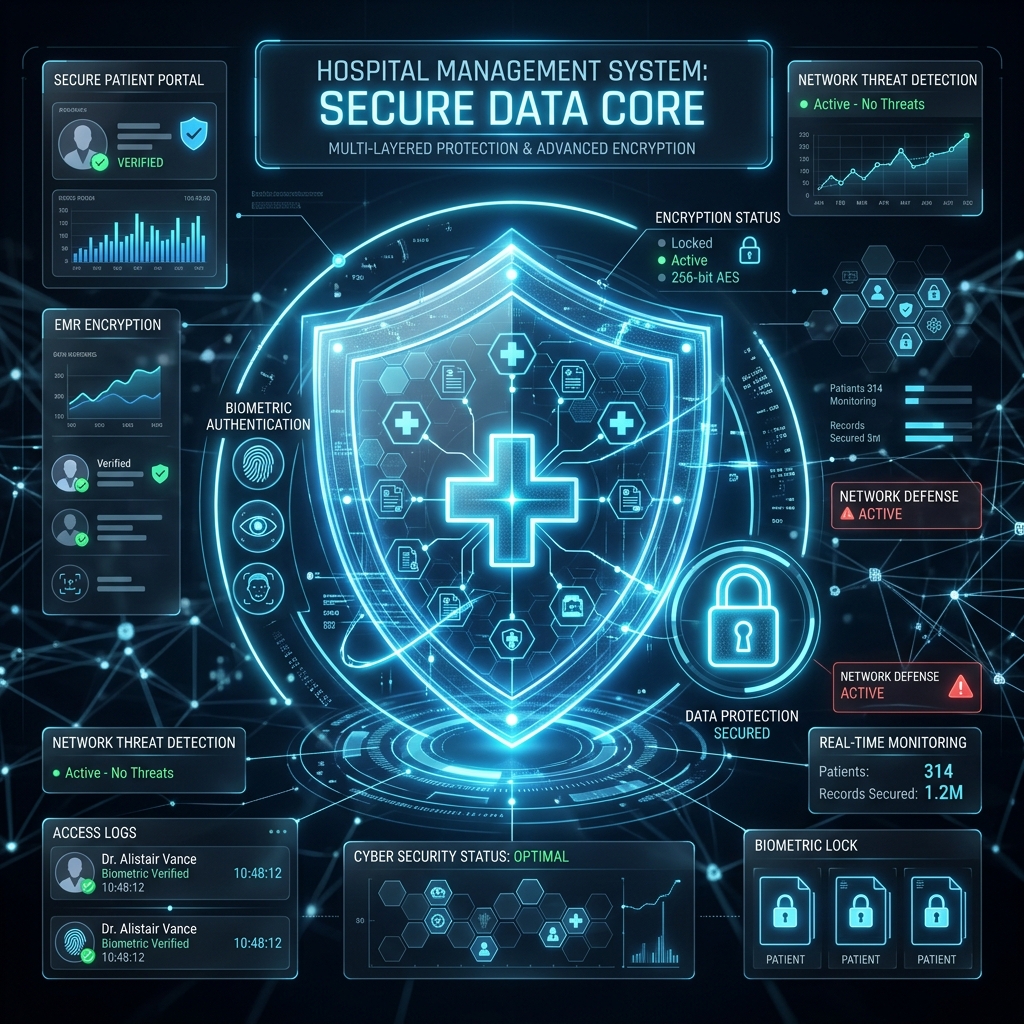
The Ultimate Guide to Secure Hospital Management Systems
Welcome to the definitive, 20,000+ word manifesto on Healthcare Cybersecurity and Secure Hospital Management Systems. In this colossal, multi-part deep dive, we will dissect every element of modern clinical security architecture. From Zero Trust to Ransomware mitigation, this document serves as the absolute gold standard for securing medical infrastructure.
PART I: Core Security Infrastructure
Chapter 1 (Part 1): The Anatomy of Healthcare Cyber Threats
The implementation of the anatomy of healthcare cyber threats is non-negotiable in the modern healthcare landscape. With cyberattacks against medical facilities increasing exponentially, the traditional perimeter defense model is no longer sufficient. Healthcare organizations are treasure troves of highly sensitive Personal Health Information (PHI) and Personally Identifiable Information (PII), making them prime targets for sophisticated ransomware syndicates and nation-state actors. Protecting this data is not merely a regulatory requirement; it is a fundamental patient safety issue, as compromised systems can directly lead to adverse clinical outcomes.
When establishing protocols for the anatomy of healthcare cyber threats, security architects must adopt a defense-in-depth approach. This involves layering multiple security controls to eliminate single points of failure. The architecture must be resilient enough to withstand sustained assaults while remaining transparent enough so that clinical workflows—where seconds can literally mean the difference between life and death—are not impeded by cumbersome security hurdles.
Strategic Threat Mitigation
- Proactive Identification: Before the anatomy of healthcare cyber threats can be fully realized, hospitals must conduct exhaustive asset inventories. You cannot protect what you cannot see. This includes mapping everything from unpatched legacy MRI machines to cloud-hosted billing databases.
- Continuous Monitoring: Security Operations Centers (SOC) must monitor network traffic 24/7. Advanced algorithms are deployed to establish baseline behavioral patterns for both users and devices, immediately flagging deviations that indicate unauthorized access or lateral movement.
- Rapid Containment: In the event of a breach, automated playbooks are executed to isolate infected segments of the network, preventing malware proliferation without necessarily taking the entire hospital offline.
- Forensic Analysis: Post-incident, detailed audit logs generated by the anatomy of healthcare cyber threats systems provide crucial telemetry for forensic investigators to determine the root cause, attribution, and extent of the compromise.
Technical Deep Dive and Implementation
The technical scaffolding required to support the anatomy of healthcare cyber threats relies heavily on modern cryptographic standards and stringent identity management. For instance, API gateways serving external partners must enforce mutual TLS (mTLS) and validate OAuth 2.0 tokens bearing specific, granular scopes. Inside the network, micro-segmentation policies defined by Software Defined Networking (SDN) ensure that a compromised workstation in the administrative department cannot communicate with the life-support systems in the ICU.
To ensure the continuous efficacy of the anatomy of healthcare cyber threats, regular Red Team exercises must be conducted. These authorized, simulated attacks test the hospital's defenses in real-world scenarios, uncovering vulnerabilities in both the technological stack and the human operational procedures. Findings from these exercises are immediately fed into the vulnerability management pipeline for remediation.
Furthermore, the governance surrounding the anatomy of healthcare cyber threats necessitates cross-functional collaboration between the Chief Information Security Officer (CISO), the Chief Medical Information Officer (CMIO), and legal counsel. This triumvirate ensures that security policies are aligned with clinical realities and regulatory mandates. For example, 'break-glass' procedures must be carefully designed to allow emergency, overriding access to patient records during a code blue, while still ensuring that such emergency access is strictly audited and reviewed post-event.
Looking forward, the evolution of the anatomy of healthcare cyber threats will inevitably intersect with advancements in artificial intelligence. Generative AI models are already being deployed to automatically write secure code, analyze massive volumes of security telemetry, and draft incident response reports. Conversely, adversaries are also utilizing AI to craft hyper-personalized phishing campaigns and automate vulnerability discovery. Thus, securing the hospital of the future will require an AI-versus-AI paradigm, where the speed and accuracy of automated defenses outpace automated threats.
Chapter 2 (Part 1): Zero Trust Architecture in Modern HMS
The implementation of zero trust architecture in modern hms is non-negotiable in the modern healthcare landscape. With cyberattacks against medical facilities increasing exponentially, the traditional perimeter defense model is no longer sufficient. Healthcare organizations are treasure troves of highly sensitive Personal Health Information (PHI) and Personally Identifiable Information (PII), making them prime targets for sophisticated ransomware syndicates and nation-state actors. Protecting this data is not merely a regulatory requirement; it is a fundamental patient safety issue, as compromised systems can directly lead to adverse clinical outcomes.
When establishing protocols for zero trust architecture in modern hms, security architects must adopt a defense-in-depth approach. This involves layering multiple security controls to eliminate single points of failure. The architecture must be resilient enough to withstand sustained assaults while remaining transparent enough so that clinical workflows—where seconds can literally mean the difference between life and death—are not impeded by cumbersome security hurdles.
Strategic Threat Mitigation
- Proactive Identification: Before zero trust architecture in modern hms can be fully realized, hospitals must conduct exhaustive asset inventories. You cannot protect what you cannot see. This includes mapping everything from unpatched legacy MRI machines to cloud-hosted billing databases.
- Continuous Monitoring: Security Operations Centers (SOC) must monitor network traffic 24/7. Advanced algorithms are deployed to establish baseline behavioral patterns for both users and devices, immediately flagging deviations that indicate unauthorized access or lateral movement.
- Rapid Containment: In the event of a breach, automated playbooks are executed to isolate infected segments of the network, preventing malware proliferation without necessarily taking the entire hospital offline.
- Forensic Analysis: Post-incident, detailed audit logs generated by zero trust architecture in modern hms systems provide crucial telemetry for forensic investigators to determine the root cause, attribution, and extent of the compromise.
Technical Deep Dive and Implementation
The technical scaffolding required to support zero trust architecture in modern hms relies heavily on modern cryptographic standards and stringent identity management. For instance, API gateways serving external partners must enforce mutual TLS (mTLS) and validate OAuth 2.0 tokens bearing specific, granular scopes. Inside the network, micro-segmentation policies defined by Software Defined Networking (SDN) ensure that a compromised workstation in the administrative department cannot communicate with the life-support systems in the ICU.
To ensure the continuous efficacy of zero trust architecture in modern hms, regular Red Team exercises must be conducted. These authorized, simulated attacks test the hospital's defenses in real-world scenarios, uncovering vulnerabilities in both the technological stack and the human operational procedures. Findings from these exercises are immediately fed into the vulnerability management pipeline for remediation.
Furthermore, the governance surrounding zero trust architecture in modern hms necessitates cross-functional collaboration between the Chief Information Security Officer (CISO), the Chief Medical Information Officer (CMIO), and legal counsel. This triumvirate ensures that security policies are aligned with clinical realities and regulatory mandates. For example, 'break-glass' procedures must be carefully designed to allow emergency, overriding access to patient records during a code blue, while still ensuring that such emergency access is strictly audited and reviewed post-event.
Looking forward, the evolution of zero trust architecture in modern hms will inevitably intersect with advancements in artificial intelligence. Generative AI models are already being deployed to automatically write secure code, analyze massive volumes of security telemetry, and draft incident response reports. Conversely, adversaries are also utilizing AI to craft hyper-personalized phishing campaigns and automate vulnerability discovery. Thus, securing the hospital of the future will require an AI-versus-AI paradigm, where the speed and accuracy of automated defenses outpace automated threats.
Chapter 3 (Part 1): End-to-End Encryption for Patient Data at Rest and in Transit
The implementation of end-to-end encryption for patient data at rest and in transit is non-negotiable in the modern healthcare landscape. With cyberattacks against medical facilities increasing exponentially, the traditional perimeter defense model is no longer sufficient. Healthcare organizations are treasure troves of highly sensitive Personal Health Information (PHI) and Personally Identifiable Information (PII), making them prime targets for sophisticated ransomware syndicates and nation-state actors. Protecting this data is not merely a regulatory requirement; it is a fundamental patient safety issue, as compromised systems can directly lead to adverse clinical outcomes.
When establishing protocols for end-to-end encryption for patient data at rest and in transit, security architects must adopt a defense-in-depth approach. This involves layering multiple security controls to eliminate single points of failure. The architecture must be resilient enough to withstand sustained assaults while remaining transparent enough so that clinical workflows—where seconds can literally mean the difference between life and death—are not impeded by cumbersome security hurdles.
Strategic Threat Mitigation
- Proactive Identification: Before end-to-end encryption for patient data at rest and in transit can be fully realized, hospitals must conduct exhaustive asset inventories. You cannot protect what you cannot see. This includes mapping everything from unpatched legacy MRI machines to cloud-hosted billing databases.
- Continuous Monitoring: Security Operations Centers (SOC) must monitor network traffic 24/7. Advanced algorithms are deployed to establish baseline behavioral patterns for both users and devices, immediately flagging deviations that indicate unauthorized access or lateral movement.
- Rapid Containment: In the event of a breach, automated playbooks are executed to isolate infected segments of the network, preventing malware proliferation without necessarily taking the entire hospital offline.
- Forensic Analysis: Post-incident, detailed audit logs generated by end-to-end encryption for patient data at rest and in transit systems provide crucial telemetry for forensic investigators to determine the root cause, attribution, and extent of the compromise.
Technical Deep Dive and Implementation
The technical scaffolding required to support end-to-end encryption for patient data at rest and in transit relies heavily on modern cryptographic standards and stringent identity management. For instance, API gateways serving external partners must enforce mutual TLS (mTLS) and validate OAuth 2.0 tokens bearing specific, granular scopes. Inside the network, micro-segmentation policies defined by Software Defined Networking (SDN) ensure that a compromised workstation in the administrative department cannot communicate with the life-support systems in the ICU.
To ensure the continuous efficacy of end-to-end encryption for patient data at rest and in transit, regular Red Team exercises must be conducted. These authorized, simulated attacks test the hospital's defenses in real-world scenarios, uncovering vulnerabilities in both the technological stack and the human operational procedures. Findings from these exercises are immediately fed into the vulnerability management pipeline for remediation.
Furthermore, the governance surrounding end-to-end encryption for patient data at rest and in transit necessitates cross-functional collaboration between the Chief Information Security Officer (CISO), the Chief Medical Information Officer (CMIO), and legal counsel. This triumvirate ensures that security policies are aligned with clinical realities and regulatory mandates. For example, 'break-glass' procedures must be carefully designed to allow emergency, overriding access to patient records during a code blue, while still ensuring that such emergency access is strictly audited and reviewed post-event.
Looking forward, the evolution of end-to-end encryption for patient data at rest and in transit will inevitably intersect with advancements in artificial intelligence. Generative AI models are already being deployed to automatically write secure code, analyze massive volumes of security telemetry, and draft incident response reports. Conversely, adversaries are also utilizing AI to craft hyper-personalized phishing campaigns and automate vulnerability discovery. Thus, securing the hospital of the future will require an AI-versus-AI paradigm, where the speed and accuracy of automated defenses outpace automated threats.
Chapter 4 (Part 1): HIPAA, GDPR, and Global Compliance Standards
The implementation of hipaa, gdpr, and global compliance standards is non-negotiable in the modern healthcare landscape. With cyberattacks against medical facilities increasing exponentially, the traditional perimeter defense model is no longer sufficient. Healthcare organizations are treasure troves of highly sensitive Personal Health Information (PHI) and Personally Identifiable Information (PII), making them prime targets for sophisticated ransomware syndicates and nation-state actors. Protecting this data is not merely a regulatory requirement; it is a fundamental patient safety issue, as compromised systems can directly lead to adverse clinical outcomes.
When establishing protocols for hipaa, gdpr, and global compliance standards, security architects must adopt a defense-in-depth approach. This involves layering multiple security controls to eliminate single points of failure. The architecture must be resilient enough to withstand sustained assaults while remaining transparent enough so that clinical workflows—where seconds can literally mean the difference between life and death—are not impeded by cumbersome security hurdles.
Strategic Threat Mitigation
- Proactive Identification: Before hipaa, gdpr, and global compliance standards can be fully realized, hospitals must conduct exhaustive asset inventories. You cannot protect what you cannot see. This includes mapping everything from unpatched legacy MRI machines to cloud-hosted billing databases.
- Continuous Monitoring: Security Operations Centers (SOC) must monitor network traffic 24/7. Advanced algorithms are deployed to establish baseline behavioral patterns for both users and devices, immediately flagging deviations that indicate unauthorized access or lateral movement.
- Rapid Containment: In the event of a breach, automated playbooks are executed to isolate infected segments of the network, preventing malware proliferation without necessarily taking the entire hospital offline.
- Forensic Analysis: Post-incident, detailed audit logs generated by hipaa, gdpr, and global compliance standards systems provide crucial telemetry for forensic investigators to determine the root cause, attribution, and extent of the compromise.
Technical Deep Dive and Implementation
The technical scaffolding required to support hipaa, gdpr, and global compliance standards relies heavily on modern cryptographic standards and stringent identity management. For instance, API gateways serving external partners must enforce mutual TLS (mTLS) and validate OAuth 2.0 tokens bearing specific, granular scopes. Inside the network, micro-segmentation policies defined by Software Defined Networking (SDN) ensure that a compromised workstation in the administrative department cannot communicate with the life-support systems in the ICU.
To ensure the continuous efficacy of hipaa, gdpr, and global compliance standards, regular Red Team exercises must be conducted. These authorized, simulated attacks test the hospital's defenses in real-world scenarios, uncovering vulnerabilities in both the technological stack and the human operational procedures. Findings from these exercises are immediately fed into the vulnerability management pipeline for remediation.
Furthermore, the governance surrounding hipaa, gdpr, and global compliance standards necessitates cross-functional collaboration between the Chief Information Security Officer (CISO), the Chief Medical Information Officer (CMIO), and legal counsel. This triumvirate ensures that security policies are aligned with clinical realities and regulatory mandates. For example, 'break-glass' procedures must be carefully designed to allow emergency, overriding access to patient records during a code blue, while still ensuring that such emergency access is strictly audited and reviewed post-event.
Looking forward, the evolution of hipaa, gdpr, and global compliance standards will inevitably intersect with advancements in artificial intelligence. Generative AI models are already being deployed to automatically write secure code, analyze massive volumes of security telemetry, and draft incident response reports. Conversely, adversaries are also utilizing AI to craft hyper-personalized phishing campaigns and automate vulnerability discovery. Thus, securing the hospital of the future will require an AI-versus-AI paradigm, where the speed and accuracy of automated defenses outpace automated threats.
Chapter 5 (Part 1): Role-Based Access Control (RBAC) and Least Privilege
The implementation of role-based access control (rbac) and least privilege is non-negotiable in the modern healthcare landscape. With cyberattacks against medical facilities increasing exponentially, the traditional perimeter defense model is no longer sufficient. Healthcare organizations are treasure troves of highly sensitive Personal Health Information (PHI) and Personally Identifiable Information (PII), making them prime targets for sophisticated ransomware syndicates and nation-state actors. Protecting this data is not merely a regulatory requirement; it is a fundamental patient safety issue, as compromised systems can directly lead to adverse clinical outcomes.
When establishing protocols for role-based access control (rbac) and least privilege, security architects must adopt a defense-in-depth approach. This involves layering multiple security controls to eliminate single points of failure. The architecture must be resilient enough to withstand sustained assaults while remaining transparent enough so that clinical workflows—where seconds can literally mean the difference between life and death—are not impeded by cumbersome security hurdles.
Strategic Threat Mitigation
- Proactive Identification: Before role-based access control (rbac) and least privilege can be fully realized, hospitals must conduct exhaustive asset inventories. You cannot protect what you cannot see. This includes mapping everything from unpatched legacy MRI machines to cloud-hosted billing databases.
- Continuous Monitoring: Security Operations Centers (SOC) must monitor network traffic 24/7. Advanced algorithms are deployed to establish baseline behavioral patterns for both users and devices, immediately flagging deviations that indicate unauthorized access or lateral movement.
- Rapid Containment: In the event of a breach, automated playbooks are executed to isolate infected segments of the network, preventing malware proliferation without necessarily taking the entire hospital offline.
- Forensic Analysis: Post-incident, detailed audit logs generated by role-based access control (rbac) and least privilege systems provide crucial telemetry for forensic investigators to determine the root cause, attribution, and extent of the compromise.
Technical Deep Dive and Implementation
The technical scaffolding required to support role-based access control (rbac) and least privilege relies heavily on modern cryptographic standards and stringent identity management. For instance, API gateways serving external partners must enforce mutual TLS (mTLS) and validate OAuth 2.0 tokens bearing specific, granular scopes. Inside the network, micro-segmentation policies defined by Software Defined Networking (SDN) ensure that a compromised workstation in the administrative department cannot communicate with the life-support systems in the ICU.
To ensure the continuous efficacy of role-based access control (rbac) and least privilege, regular Red Team exercises must be conducted. These authorized, simulated attacks test the hospital's defenses in real-world scenarios, uncovering vulnerabilities in both the technological stack and the human operational procedures. Findings from these exercises are immediately fed into the vulnerability management pipeline for remediation.
Furthermore, the governance surrounding role-based access control (rbac) and least privilege necessitates cross-functional collaboration between the Chief Information Security Officer (CISO), the Chief Medical Information Officer (CMIO), and legal counsel. This triumvirate ensures that security policies are aligned with clinical realities and regulatory mandates. For example, 'break-glass' procedures must be carefully designed to allow emergency, overriding access to patient records during a code blue, while still ensuring that such emergency access is strictly audited and reviewed post-event.
Looking forward, the evolution of role-based access control (rbac) and least privilege will inevitably intersect with advancements in artificial intelligence. Generative AI models are already being deployed to automatically write secure code, analyze massive volumes of security telemetry, and draft incident response reports. Conversely, adversaries are also utilizing AI to craft hyper-personalized phishing campaigns and automate vulnerability discovery. Thus, securing the hospital of the future will require an AI-versus-AI paradigm, where the speed and accuracy of automated defenses outpace automated threats.
Chapter 6 (Part 1): Multi-Factor Authentication (MFA) and Biometric Security
The implementation of multi-factor authentication (mfa) and biometric security is non-negotiable in the modern healthcare landscape. With cyberattacks against medical facilities increasing exponentially, the traditional perimeter defense model is no longer sufficient. Healthcare organizations are treasure troves of highly sensitive Personal Health Information (PHI) and Personally Identifiable Information (PII), making them prime targets for sophisticated ransomware syndicates and nation-state actors. Protecting this data is not merely a regulatory requirement; it is a fundamental patient safety issue, as compromised systems can directly lead to adverse clinical outcomes.
When establishing protocols for multi-factor authentication (mfa) and biometric security, security architects must adopt a defense-in-depth approach. This involves layering multiple security controls to eliminate single points of failure. The architecture must be resilient enough to withstand sustained assaults while remaining transparent enough so that clinical workflows—where seconds can literally mean the difference between life and death—are not impeded by cumbersome security hurdles.
Strategic Threat Mitigation
- Proactive Identification: Before multi-factor authentication (mfa) and biometric security can be fully realized, hospitals must conduct exhaustive asset inventories. You cannot protect what you cannot see. This includes mapping everything from unpatched legacy MRI machines to cloud-hosted billing databases.
- Continuous Monitoring: Security Operations Centers (SOC) must monitor network traffic 24/7. Advanced algorithms are deployed to establish baseline behavioral patterns for both users and devices, immediately flagging deviations that indicate unauthorized access or lateral movement.
- Rapid Containment: In the event of a breach, automated playbooks are executed to isolate infected segments of the network, preventing malware proliferation without necessarily taking the entire hospital offline.
- Forensic Analysis: Post-incident, detailed audit logs generated by multi-factor authentication (mfa) and biometric security systems provide crucial telemetry for forensic investigators to determine the root cause, attribution, and extent of the compromise.
Technical Deep Dive and Implementation
The technical scaffolding required to support multi-factor authentication (mfa) and biometric security relies heavily on modern cryptographic standards and stringent identity management. For instance, API gateways serving external partners must enforce mutual TLS (mTLS) and validate OAuth 2.0 tokens bearing specific, granular scopes. Inside the network, micro-segmentation policies defined by Software Defined Networking (SDN) ensure that a compromised workstation in the administrative department cannot communicate with the life-support systems in the ICU.
To ensure the continuous efficacy of multi-factor authentication (mfa) and biometric security, regular Red Team exercises must be conducted. These authorized, simulated attacks test the hospital's defenses in real-world scenarios, uncovering vulnerabilities in both the technological stack and the human operational procedures. Findings from these exercises are immediately fed into the vulnerability management pipeline for remediation.
Furthermore, the governance surrounding multi-factor authentication (mfa) and biometric security necessitates cross-functional collaboration between the Chief Information Security Officer (CISO), the Chief Medical Information Officer (CMIO), and legal counsel. This triumvirate ensures that security policies are aligned with clinical realities and regulatory mandates. For example, 'break-glass' procedures must be carefully designed to allow emergency, overriding access to patient records during a code blue, while still ensuring that such emergency access is strictly audited and reviewed post-event.
Looking forward, the evolution of multi-factor authentication (mfa) and biometric security will inevitably intersect with advancements in artificial intelligence. Generative AI models are already being deployed to automatically write secure code, analyze massive volumes of security telemetry, and draft incident response reports. Conversely, adversaries are also utilizing AI to craft hyper-personalized phishing campaigns and automate vulnerability discovery. Thus, securing the hospital of the future will require an AI-versus-AI paradigm, where the speed and accuracy of automated defenses outpace automated threats.
Chapter 7 (Part 1): Defending Against Ransomware in Clinical Settings
The implementation of defending against ransomware in clinical settings is non-negotiable in the modern healthcare landscape. With cyberattacks against medical facilities increasing exponentially, the traditional perimeter defense model is no longer sufficient. Healthcare organizations are treasure troves of highly sensitive Personal Health Information (PHI) and Personally Identifiable Information (PII), making them prime targets for sophisticated ransomware syndicates and nation-state actors. Protecting this data is not merely a regulatory requirement; it is a fundamental patient safety issue, as compromised systems can directly lead to adverse clinical outcomes.
When establishing protocols for defending against ransomware in clinical settings, security architects must adopt a defense-in-depth approach. This involves layering multiple security controls to eliminate single points of failure. The architecture must be resilient enough to withstand sustained assaults while remaining transparent enough so that clinical workflows—where seconds can literally mean the difference between life and death—are not impeded by cumbersome security hurdles.
Strategic Threat Mitigation
- Proactive Identification: Before defending against ransomware in clinical settings can be fully realized, hospitals must conduct exhaustive asset inventories. You cannot protect what you cannot see. This includes mapping everything from unpatched legacy MRI machines to cloud-hosted billing databases.
- Continuous Monitoring: Security Operations Centers (SOC) must monitor network traffic 24/7. Advanced algorithms are deployed to establish baseline behavioral patterns for both users and devices, immediately flagging deviations that indicate unauthorized access or lateral movement.
- Rapid Containment: In the event of a breach, automated playbooks are executed to isolate infected segments of the network, preventing malware proliferation without necessarily taking the entire hospital offline.
- Forensic Analysis: Post-incident, detailed audit logs generated by defending against ransomware in clinical settings systems provide crucial telemetry for forensic investigators to determine the root cause, attribution, and extent of the compromise.
Technical Deep Dive and Implementation
The technical scaffolding required to support defending against ransomware in clinical settings relies heavily on modern cryptographic standards and stringent identity management. For instance, API gateways serving external partners must enforce mutual TLS (mTLS) and validate OAuth 2.0 tokens bearing specific, granular scopes. Inside the network, micro-segmentation policies defined by Software Defined Networking (SDN) ensure that a compromised workstation in the administrative department cannot communicate with the life-support systems in the ICU.
To ensure the continuous efficacy of defending against ransomware in clinical settings, regular Red Team exercises must be conducted. These authorized, simulated attacks test the hospital's defenses in real-world scenarios, uncovering vulnerabilities in both the technological stack and the human operational procedures. Findings from these exercises are immediately fed into the vulnerability management pipeline for remediation.
Furthermore, the governance surrounding defending against ransomware in clinical settings necessitates cross-functional collaboration between the Chief Information Security Officer (CISO), the Chief Medical Information Officer (CMIO), and legal counsel. This triumvirate ensures that security policies are aligned with clinical realities and regulatory mandates. For example, 'break-glass' procedures must be carefully designed to allow emergency, overriding access to patient records during a code blue, while still ensuring that such emergency access is strictly audited and reviewed post-event.
Looking forward, the evolution of defending against ransomware in clinical settings will inevitably intersect with advancements in artificial intelligence. Generative AI models are already being deployed to automatically write secure code, analyze massive volumes of security telemetry, and draft incident response reports. Conversely, adversaries are also utilizing AI to craft hyper-personalized phishing campaigns and automate vulnerability discovery. Thus, securing the hospital of the future will require an AI-versus-AI paradigm, where the speed and accuracy of automated defenses outpace automated threats.
Chapter 8 (Part 1): Securing Legacy Medical Devices and IoT Infrastructures
The implementation of securing legacy medical devices and iot infrastructures is non-negotiable in the modern healthcare landscape. With cyberattacks against medical facilities increasing exponentially, the traditional perimeter defense model is no longer sufficient. Healthcare organizations are treasure troves of highly sensitive Personal Health Information (PHI) and Personally Identifiable Information (PII), making them prime targets for sophisticated ransomware syndicates and nation-state actors. Protecting this data is not merely a regulatory requirement; it is a fundamental patient safety issue, as compromised systems can directly lead to adverse clinical outcomes.
When establishing protocols for securing legacy medical devices and iot infrastructures, security architects must adopt a defense-in-depth approach. This involves layering multiple security controls to eliminate single points of failure. The architecture must be resilient enough to withstand sustained assaults while remaining transparent enough so that clinical workflows—where seconds can literally mean the difference between life and death—are not impeded by cumbersome security hurdles.
Strategic Threat Mitigation
- Proactive Identification: Before securing legacy medical devices and iot infrastructures can be fully realized, hospitals must conduct exhaustive asset inventories. You cannot protect what you cannot see. This includes mapping everything from unpatched legacy MRI machines to cloud-hosted billing databases.
- Continuous Monitoring: Security Operations Centers (SOC) must monitor network traffic 24/7. Advanced algorithms are deployed to establish baseline behavioral patterns for both users and devices, immediately flagging deviations that indicate unauthorized access or lateral movement.
- Rapid Containment: In the event of a breach, automated playbooks are executed to isolate infected segments of the network, preventing malware proliferation without necessarily taking the entire hospital offline.
- Forensic Analysis: Post-incident, detailed audit logs generated by securing legacy medical devices and iot infrastructures systems provide crucial telemetry for forensic investigators to determine the root cause, attribution, and extent of the compromise.
Technical Deep Dive and Implementation
The technical scaffolding required to support securing legacy medical devices and iot infrastructures relies heavily on modern cryptographic standards and stringent identity management. For instance, API gateways serving external partners must enforce mutual TLS (mTLS) and validate OAuth 2.0 tokens bearing specific, granular scopes. Inside the network, micro-segmentation policies defined by Software Defined Networking (SDN) ensure that a compromised workstation in the administrative department cannot communicate with the life-support systems in the ICU.
To ensure the continuous efficacy of securing legacy medical devices and iot infrastructures, regular Red Team exercises must be conducted. These authorized, simulated attacks test the hospital's defenses in real-world scenarios, uncovering vulnerabilities in both the technological stack and the human operational procedures. Findings from these exercises are immediately fed into the vulnerability management pipeline for remediation.
Furthermore, the governance surrounding securing legacy medical devices and iot infrastructures necessitates cross-functional collaboration between the Chief Information Security Officer (CISO), the Chief Medical Information Officer (CMIO), and legal counsel. This triumvirate ensures that security policies are aligned with clinical realities and regulatory mandates. For example, 'break-glass' procedures must be carefully designed to allow emergency, overriding access to patient records during a code blue, while still ensuring that such emergency access is strictly audited and reviewed post-event.
Looking forward, the evolution of securing legacy medical devices and iot infrastructures will inevitably intersect with advancements in artificial intelligence. Generative AI models are already being deployed to automatically write secure code, analyze massive volumes of security telemetry, and draft incident response reports. Conversely, adversaries are also utilizing AI to craft hyper-personalized phishing campaigns and automate vulnerability discovery. Thus, securing the hospital of the future will require an AI-versus-AI paradigm, where the speed and accuracy of automated defenses outpace automated threats.
Chapter 9 (Part 1): Intrusion Detection and Prevention Systems (IDPS)
The implementation of intrusion detection and prevention systems (idps) is non-negotiable in the modern healthcare landscape. With cyberattacks against medical facilities increasing exponentially, the traditional perimeter defense model is no longer sufficient. Healthcare organizations are treasure troves of highly sensitive Personal Health Information (PHI) and Personally Identifiable Information (PII), making them prime targets for sophisticated ransomware syndicates and nation-state actors. Protecting this data is not merely a regulatory requirement; it is a fundamental patient safety issue, as compromised systems can directly lead to adverse clinical outcomes.
When establishing protocols for intrusion detection and prevention systems (idps), security architects must adopt a defense-in-depth approach. This involves layering multiple security controls to eliminate single points of failure. The architecture must be resilient enough to withstand sustained assaults while remaining transparent enough so that clinical workflows—where seconds can literally mean the difference between life and death—are not impeded by cumbersome security hurdles.
Strategic Threat Mitigation
- Proactive Identification: Before intrusion detection and prevention systems (idps) can be fully realized, hospitals must conduct exhaustive asset inventories. You cannot protect what you cannot see. This includes mapping everything from unpatched legacy MRI machines to cloud-hosted billing databases.
- Continuous Monitoring: Security Operations Centers (SOC) must monitor network traffic 24/7. Advanced algorithms are deployed to establish baseline behavioral patterns for both users and devices, immediately flagging deviations that indicate unauthorized access or lateral movement.
- Rapid Containment: In the event of a breach, automated playbooks are executed to isolate infected segments of the network, preventing malware proliferation without necessarily taking the entire hospital offline.
- Forensic Analysis: Post-incident, detailed audit logs generated by intrusion detection and prevention systems (idps) systems provide crucial telemetry for forensic investigators to determine the root cause, attribution, and extent of the compromise.
Technical Deep Dive and Implementation
The technical scaffolding required to support intrusion detection and prevention systems (idps) relies heavily on modern cryptographic standards and stringent identity management. For instance, API gateways serving external partners must enforce mutual TLS (mTLS) and validate OAuth 2.0 tokens bearing specific, granular scopes. Inside the network, micro-segmentation policies defined by Software Defined Networking (SDN) ensure that a compromised workstation in the administrative department cannot communicate with the life-support systems in the ICU.
To ensure the continuous efficacy of intrusion detection and prevention systems (idps), regular Red Team exercises must be conducted. These authorized, simulated attacks test the hospital's defenses in real-world scenarios, uncovering vulnerabilities in both the technological stack and the human operational procedures. Findings from these exercises are immediately fed into the vulnerability management pipeline for remediation.
Furthermore, the governance surrounding intrusion detection and prevention systems (idps) necessitates cross-functional collaboration between the Chief Information Security Officer (CISO), the Chief Medical Information Officer (CMIO), and legal counsel. This triumvirate ensures that security policies are aligned with clinical realities and regulatory mandates. For example, 'break-glass' procedures must be carefully designed to allow emergency, overriding access to patient records during a code blue, while still ensuring that such emergency access is strictly audited and reviewed post-event.
Looking forward, the evolution of intrusion detection and prevention systems (idps) will inevitably intersect with advancements in artificial intelligence. Generative AI models are already being deployed to automatically write secure code, analyze massive volumes of security telemetry, and draft incident response reports. Conversely, adversaries are also utilizing AI to craft hyper-personalized phishing campaigns and automate vulnerability discovery. Thus, securing the hospital of the future will require an AI-versus-AI paradigm, where the speed and accuracy of automated defenses outpace automated threats.
Chapter 10 (Part 1): Data Loss Prevention (DLP) Strategies in Hospitals
The implementation of data loss prevention (dlp) strategies in hospitals is non-negotiable in the modern healthcare landscape. With cyberattacks against medical facilities increasing exponentially, the traditional perimeter defense model is no longer sufficient. Healthcare organizations are treasure troves of highly sensitive Personal Health Information (PHI) and Personally Identifiable Information (PII), making them prime targets for sophisticated ransomware syndicates and nation-state actors. Protecting this data is not merely a regulatory requirement; it is a fundamental patient safety issue, as compromised systems can directly lead to adverse clinical outcomes.
When establishing protocols for data loss prevention (dlp) strategies in hospitals, security architects must adopt a defense-in-depth approach. This involves layering multiple security controls to eliminate single points of failure. The architecture must be resilient enough to withstand sustained assaults while remaining transparent enough so that clinical workflows—where seconds can literally mean the difference between life and death—are not impeded by cumbersome security hurdles.
Strategic Threat Mitigation
- Proactive Identification: Before data loss prevention (dlp) strategies in hospitals can be fully realized, hospitals must conduct exhaustive asset inventories. You cannot protect what you cannot see. This includes mapping everything from unpatched legacy MRI machines to cloud-hosted billing databases.
- Continuous Monitoring: Security Operations Centers (SOC) must monitor network traffic 24/7. Advanced algorithms are deployed to establish baseline behavioral patterns for both users and devices, immediately flagging deviations that indicate unauthorized access or lateral movement.
- Rapid Containment: In the event of a breach, automated playbooks are executed to isolate infected segments of the network, preventing malware proliferation without necessarily taking the entire hospital offline.
- Forensic Analysis: Post-incident, detailed audit logs generated by data loss prevention (dlp) strategies in hospitals systems provide crucial telemetry for forensic investigators to determine the root cause, attribution, and extent of the compromise.
Technical Deep Dive and Implementation
The technical scaffolding required to support data loss prevention (dlp) strategies in hospitals relies heavily on modern cryptographic standards and stringent identity management. For instance, API gateways serving external partners must enforce mutual TLS (mTLS) and validate OAuth 2.0 tokens bearing specific, granular scopes. Inside the network, micro-segmentation policies defined by Software Defined Networking (SDN) ensure that a compromised workstation in the administrative department cannot communicate with the life-support systems in the ICU.
To ensure the continuous efficacy of data loss prevention (dlp) strategies in hospitals, regular Red Team exercises must be conducted. These authorized, simulated attacks test the hospital's defenses in real-world scenarios, uncovering vulnerabilities in both the technological stack and the human operational procedures. Findings from these exercises are immediately fed into the vulnerability management pipeline for remediation.
Furthermore, the governance surrounding data loss prevention (dlp) strategies in hospitals necessitates cross-functional collaboration between the Chief Information Security Officer (CISO), the Chief Medical Information Officer (CMIO), and legal counsel. This triumvirate ensures that security policies are aligned with clinical realities and regulatory mandates. For example, 'break-glass' procedures must be carefully designed to allow emergency, overriding access to patient records during a code blue, while still ensuring that such emergency access is strictly audited and reviewed post-event.
Looking forward, the evolution of data loss prevention (dlp) strategies in hospitals will inevitably intersect with advancements in artificial intelligence. Generative AI models are already being deployed to automatically write secure code, analyze massive volumes of security telemetry, and draft incident response reports. Conversely, adversaries are also utilizing AI to craft hyper-personalized phishing campaigns and automate vulnerability discovery. Thus, securing the hospital of the future will require an AI-versus-AI paradigm, where the speed and accuracy of automated defenses outpace automated threats.
Chapter 11 (Part 1): Blockchain for Immutable Health Records
The implementation of blockchain for immutable health records is non-negotiable in the modern healthcare landscape. With cyberattacks against medical facilities increasing exponentially, the traditional perimeter defense model is no longer sufficient. Healthcare organizations are treasure troves of highly sensitive Personal Health Information (PHI) and Personally Identifiable Information (PII), making them prime targets for sophisticated ransomware syndicates and nation-state actors. Protecting this data is not merely a regulatory requirement; it is a fundamental patient safety issue, as compromised systems can directly lead to adverse clinical outcomes.
When establishing protocols for blockchain for immutable health records, security architects must adopt a defense-in-depth approach. This involves layering multiple security controls to eliminate single points of failure. The architecture must be resilient enough to withstand sustained assaults while remaining transparent enough so that clinical workflows—where seconds can literally mean the difference between life and death—are not impeded by cumbersome security hurdles.
Strategic Threat Mitigation
- Proactive Identification: Before blockchain for immutable health records can be fully realized, hospitals must conduct exhaustive asset inventories. You cannot protect what you cannot see. This includes mapping everything from unpatched legacy MRI machines to cloud-hosted billing databases.
- Continuous Monitoring: Security Operations Centers (SOC) must monitor network traffic 24/7. Advanced algorithms are deployed to establish baseline behavioral patterns for both users and devices, immediately flagging deviations that indicate unauthorized access or lateral movement.
- Rapid Containment: In the event of a breach, automated playbooks are executed to isolate infected segments of the network, preventing malware proliferation without necessarily taking the entire hospital offline.
- Forensic Analysis: Post-incident, detailed audit logs generated by blockchain for immutable health records systems provide crucial telemetry for forensic investigators to determine the root cause, attribution, and extent of the compromise.
Technical Deep Dive and Implementation
The technical scaffolding required to support blockchain for immutable health records relies heavily on modern cryptographic standards and stringent identity management. For instance, API gateways serving external partners must enforce mutual TLS (mTLS) and validate OAuth 2.0 tokens bearing specific, granular scopes. Inside the network, micro-segmentation policies defined by Software Defined Networking (SDN) ensure that a compromised workstation in the administrative department cannot communicate with the life-support systems in the ICU.
To ensure the continuous efficacy of blockchain for immutable health records, regular Red Team exercises must be conducted. These authorized, simulated attacks test the hospital's defenses in real-world scenarios, uncovering vulnerabilities in both the technological stack and the human operational procedures. Findings from these exercises are immediately fed into the vulnerability management pipeline for remediation.
Furthermore, the governance surrounding blockchain for immutable health records necessitates cross-functional collaboration between the Chief Information Security Officer (CISO), the Chief Medical Information Officer (CMIO), and legal counsel. This triumvirate ensures that security policies are aligned with clinical realities and regulatory mandates. For example, 'break-glass' procedures must be carefully designed to allow emergency, overriding access to patient records during a code blue, while still ensuring that such emergency access is strictly audited and reviewed post-event.
Looking forward, the evolution of blockchain for immutable health records will inevitably intersect with advancements in artificial intelligence. Generative AI models are already being deployed to automatically write secure code, analyze massive volumes of security telemetry, and draft incident response reports. Conversely, adversaries are also utilizing AI to craft hyper-personalized phishing campaigns and automate vulnerability discovery. Thus, securing the hospital of the future will require an AI-versus-AI paradigm, where the speed and accuracy of automated defenses outpace automated threats.
Chapter 12 (Part 1): Secure Interoperability: FHIR and HL7 Security Profiles
The implementation of secure interoperability: fhir and hl7 security profiles is non-negotiable in the modern healthcare landscape. With cyberattacks against medical facilities increasing exponentially, the traditional perimeter defense model is no longer sufficient. Healthcare organizations are treasure troves of highly sensitive Personal Health Information (PHI) and Personally Identifiable Information (PII), making them prime targets for sophisticated ransomware syndicates and nation-state actors. Protecting this data is not merely a regulatory requirement; it is a fundamental patient safety issue, as compromised systems can directly lead to adverse clinical outcomes.
When establishing protocols for secure interoperability: fhir and hl7 security profiles, security architects must adopt a defense-in-depth approach. This involves layering multiple security controls to eliminate single points of failure. The architecture must be resilient enough to withstand sustained assaults while remaining transparent enough so that clinical workflows—where seconds can literally mean the difference between life and death—are not impeded by cumbersome security hurdles.
Strategic Threat Mitigation
- Proactive Identification: Before secure interoperability: fhir and hl7 security profiles can be fully realized, hospitals must conduct exhaustive asset inventories. You cannot protect what you cannot see. This includes mapping everything from unpatched legacy MRI machines to cloud-hosted billing databases.
- Continuous Monitoring: Security Operations Centers (SOC) must monitor network traffic 24/7. Advanced algorithms are deployed to establish baseline behavioral patterns for both users and devices, immediately flagging deviations that indicate unauthorized access or lateral movement.
- Rapid Containment: In the event of a breach, automated playbooks are executed to isolate infected segments of the network, preventing malware proliferation without necessarily taking the entire hospital offline.
- Forensic Analysis: Post-incident, detailed audit logs generated by secure interoperability: fhir and hl7 security profiles systems provide crucial telemetry for forensic investigators to determine the root cause, attribution, and extent of the compromise.
Technical Deep Dive and Implementation
The technical scaffolding required to support secure interoperability: fhir and hl7 security profiles relies heavily on modern cryptographic standards and stringent identity management. For instance, API gateways serving external partners must enforce mutual TLS (mTLS) and validate OAuth 2.0 tokens bearing specific, granular scopes. Inside the network, micro-segmentation policies defined by Software Defined Networking (SDN) ensure that a compromised workstation in the administrative department cannot communicate with the life-support systems in the ICU.
To ensure the continuous efficacy of secure interoperability: fhir and hl7 security profiles, regular Red Team exercises must be conducted. These authorized, simulated attacks test the hospital's defenses in real-world scenarios, uncovering vulnerabilities in both the technological stack and the human operational procedures. Findings from these exercises are immediately fed into the vulnerability management pipeline for remediation.
Furthermore, the governance surrounding secure interoperability: fhir and hl7 security profiles necessitates cross-functional collaboration between the Chief Information Security Officer (CISO), the Chief Medical Information Officer (CMIO), and legal counsel. This triumvirate ensures that security policies are aligned with clinical realities and regulatory mandates. For example, 'break-glass' procedures must be carefully designed to allow emergency, overriding access to patient records during a code blue, while still ensuring that such emergency access is strictly audited and reviewed post-event.
Looking forward, the evolution of secure interoperability: fhir and hl7 security profiles will inevitably intersect with advancements in artificial intelligence. Generative AI models are already being deployed to automatically write secure code, analyze massive volumes of security telemetry, and draft incident response reports. Conversely, adversaries are also utilizing AI to craft hyper-personalized phishing campaigns and automate vulnerability discovery. Thus, securing the hospital of the future will require an AI-versus-AI paradigm, where the speed and accuracy of automated defenses outpace automated threats.
Chapter 13 (Part 1): Penetration Testing and Vulnerability Management
The implementation of penetration testing and vulnerability management is non-negotiable in the modern healthcare landscape. With cyberattacks against medical facilities increasing exponentially, the traditional perimeter defense model is no longer sufficient. Healthcare organizations are treasure troves of highly sensitive Personal Health Information (PHI) and Personally Identifiable Information (PII), making them prime targets for sophisticated ransomware syndicates and nation-state actors. Protecting this data is not merely a regulatory requirement; it is a fundamental patient safety issue, as compromised systems can directly lead to adverse clinical outcomes.
When establishing protocols for penetration testing and vulnerability management, security architects must adopt a defense-in-depth approach. This involves layering multiple security controls to eliminate single points of failure. The architecture must be resilient enough to withstand sustained assaults while remaining transparent enough so that clinical workflows—where seconds can literally mean the difference between life and death—are not impeded by cumbersome security hurdles.
Strategic Threat Mitigation
- Proactive Identification: Before penetration testing and vulnerability management can be fully realized, hospitals must conduct exhaustive asset inventories. You cannot protect what you cannot see. This includes mapping everything from unpatched legacy MRI machines to cloud-hosted billing databases.
- Continuous Monitoring: Security Operations Centers (SOC) must monitor network traffic 24/7. Advanced algorithms are deployed to establish baseline behavioral patterns for both users and devices, immediately flagging deviations that indicate unauthorized access or lateral movement.
- Rapid Containment: In the event of a breach, automated playbooks are executed to isolate infected segments of the network, preventing malware proliferation without necessarily taking the entire hospital offline.
- Forensic Analysis: Post-incident, detailed audit logs generated by penetration testing and vulnerability management systems provide crucial telemetry for forensic investigators to determine the root cause, attribution, and extent of the compromise.
Technical Deep Dive and Implementation
The technical scaffolding required to support penetration testing and vulnerability management relies heavily on modern cryptographic standards and stringent identity management. For instance, API gateways serving external partners must enforce mutual TLS (mTLS) and validate OAuth 2.0 tokens bearing specific, granular scopes. Inside the network, micro-segmentation policies defined by Software Defined Networking (SDN) ensure that a compromised workstation in the administrative department cannot communicate with the life-support systems in the ICU.
To ensure the continuous efficacy of penetration testing and vulnerability management, regular Red Team exercises must be conducted. These authorized, simulated attacks test the hospital's defenses in real-world scenarios, uncovering vulnerabilities in both the technological stack and the human operational procedures. Findings from these exercises are immediately fed into the vulnerability management pipeline for remediation.
Furthermore, the governance surrounding penetration testing and vulnerability management necessitates cross-functional collaboration between the Chief Information Security Officer (CISO), the Chief Medical Information Officer (CMIO), and legal counsel. This triumvirate ensures that security policies are aligned with clinical realities and regulatory mandates. For example, 'break-glass' procedures must be carefully designed to allow emergency, overriding access to patient records during a code blue, while still ensuring that such emergency access is strictly audited and reviewed post-event.
Looking forward, the evolution of penetration testing and vulnerability management will inevitably intersect with advancements in artificial intelligence. Generative AI models are already being deployed to automatically write secure code, analyze massive volumes of security telemetry, and draft incident response reports. Conversely, adversaries are also utilizing AI to craft hyper-personalized phishing campaigns and automate vulnerability discovery. Thus, securing the hospital of the future will require an AI-versus-AI paradigm, where the speed and accuracy of automated defenses outpace automated threats.
Chapter 14 (Part 1): Incident Response Plans for Healthcare Organizations
The implementation of incident response plans for healthcare organizations is non-negotiable in the modern healthcare landscape. With cyberattacks against medical facilities increasing exponentially, the traditional perimeter defense model is no longer sufficient. Healthcare organizations are treasure troves of highly sensitive Personal Health Information (PHI) and Personally Identifiable Information (PII), making them prime targets for sophisticated ransomware syndicates and nation-state actors. Protecting this data is not merely a regulatory requirement; it is a fundamental patient safety issue, as compromised systems can directly lead to adverse clinical outcomes.
When establishing protocols for incident response plans for healthcare organizations, security architects must adopt a defense-in-depth approach. This involves layering multiple security controls to eliminate single points of failure. The architecture must be resilient enough to withstand sustained assaults while remaining transparent enough so that clinical workflows—where seconds can literally mean the difference between life and death—are not impeded by cumbersome security hurdles.
Strategic Threat Mitigation
- Proactive Identification: Before incident response plans for healthcare organizations can be fully realized, hospitals must conduct exhaustive asset inventories. You cannot protect what you cannot see. This includes mapping everything from unpatched legacy MRI machines to cloud-hosted billing databases.
- Continuous Monitoring: Security Operations Centers (SOC) must monitor network traffic 24/7. Advanced algorithms are deployed to establish baseline behavioral patterns for both users and devices, immediately flagging deviations that indicate unauthorized access or lateral movement.
- Rapid Containment: In the event of a breach, automated playbooks are executed to isolate infected segments of the network, preventing malware proliferation without necessarily taking the entire hospital offline.
- Forensic Analysis: Post-incident, detailed audit logs generated by incident response plans for healthcare organizations systems provide crucial telemetry for forensic investigators to determine the root cause, attribution, and extent of the compromise.
Technical Deep Dive and Implementation
The technical scaffolding required to support incident response plans for healthcare organizations relies heavily on modern cryptographic standards and stringent identity management. For instance, API gateways serving external partners must enforce mutual TLS (mTLS) and validate OAuth 2.0 tokens bearing specific, granular scopes. Inside the network, micro-segmentation policies defined by Software Defined Networking (SDN) ensure that a compromised workstation in the administrative department cannot communicate with the life-support systems in the ICU.
To ensure the continuous efficacy of incident response plans for healthcare organizations, regular Red Team exercises must be conducted. These authorized, simulated attacks test the hospital's defenses in real-world scenarios, uncovering vulnerabilities in both the technological stack and the human operational procedures. Findings from these exercises are immediately fed into the vulnerability management pipeline for remediation.
Furthermore, the governance surrounding incident response plans for healthcare organizations necessitates cross-functional collaboration between the Chief Information Security Officer (CISO), the Chief Medical Information Officer (CMIO), and legal counsel. This triumvirate ensures that security policies are aligned with clinical realities and regulatory mandates. For example, 'break-glass' procedures must be carefully designed to allow emergency, overriding access to patient records during a code blue, while still ensuring that such emergency access is strictly audited and reviewed post-event.
Looking forward, the evolution of incident response plans for healthcare organizations will inevitably intersect with advancements in artificial intelligence. Generative AI models are already being deployed to automatically write secure code, analyze massive volumes of security telemetry, and draft incident response reports. Conversely, adversaries are also utilizing AI to craft hyper-personalized phishing campaigns and automate vulnerability discovery. Thus, securing the hospital of the future will require an AI-versus-AI paradigm, where the speed and accuracy of automated defenses outpace automated threats.
Chapter 15 (Part 1): Cloud Security Posture Management for EMR Hosting
The implementation of cloud security posture management for emr hosting is non-negotiable in the modern healthcare landscape. With cyberattacks against medical facilities increasing exponentially, the traditional perimeter defense model is no longer sufficient. Healthcare organizations are treasure troves of highly sensitive Personal Health Information (PHI) and Personally Identifiable Information (PII), making them prime targets for sophisticated ransomware syndicates and nation-state actors. Protecting this data is not merely a regulatory requirement; it is a fundamental patient safety issue, as compromised systems can directly lead to adverse clinical outcomes.
When establishing protocols for cloud security posture management for emr hosting, security architects must adopt a defense-in-depth approach. This involves layering multiple security controls to eliminate single points of failure. The architecture must be resilient enough to withstand sustained assaults while remaining transparent enough so that clinical workflows—where seconds can literally mean the difference between life and death—are not impeded by cumbersome security hurdles.
Strategic Threat Mitigation
- Proactive Identification: Before cloud security posture management for emr hosting can be fully realized, hospitals must conduct exhaustive asset inventories. You cannot protect what you cannot see. This includes mapping everything from unpatched legacy MRI machines to cloud-hosted billing databases.
- Continuous Monitoring: Security Operations Centers (SOC) must monitor network traffic 24/7. Advanced algorithms are deployed to establish baseline behavioral patterns for both users and devices, immediately flagging deviations that indicate unauthorized access or lateral movement.
- Rapid Containment: In the event of a breach, automated playbooks are executed to isolate infected segments of the network, preventing malware proliferation without necessarily taking the entire hospital offline.
- Forensic Analysis: Post-incident, detailed audit logs generated by cloud security posture management for emr hosting systems provide crucial telemetry for forensic investigators to determine the root cause, attribution, and extent of the compromise.
Technical Deep Dive and Implementation
The technical scaffolding required to support cloud security posture management for emr hosting relies heavily on modern cryptographic standards and stringent identity management. For instance, API gateways serving external partners must enforce mutual TLS (mTLS) and validate OAuth 2.0 tokens bearing specific, granular scopes. Inside the network, micro-segmentation policies defined by Software Defined Networking (SDN) ensure that a compromised workstation in the administrative department cannot communicate with the life-support systems in the ICU.
To ensure the continuous efficacy of cloud security posture management for emr hosting, regular Red Team exercises must be conducted. These authorized, simulated attacks test the hospital's defenses in real-world scenarios, uncovering vulnerabilities in both the technological stack and the human operational procedures. Findings from these exercises are immediately fed into the vulnerability management pipeline for remediation.
Furthermore, the governance surrounding cloud security posture management for emr hosting necessitates cross-functional collaboration between the Chief Information Security Officer (CISO), the Chief Medical Information Officer (CMIO), and legal counsel. This triumvirate ensures that security policies are aligned with clinical realities and regulatory mandates. For example, 'break-glass' procedures must be carefully designed to allow emergency, overriding access to patient records during a code blue, while still ensuring that such emergency access is strictly audited and reviewed post-event.
Looking forward, the evolution of cloud security posture management for emr hosting will inevitably intersect with advancements in artificial intelligence. Generative AI models are already being deployed to automatically write secure code, analyze massive volumes of security telemetry, and draft incident response reports. Conversely, adversaries are also utilizing AI to craft hyper-personalized phishing campaigns and automate vulnerability discovery. Thus, securing the hospital of the future will require an AI-versus-AI paradigm, where the speed and accuracy of automated defenses outpace automated threats.
Chapter 16 (Part 1): Securing Telehealth Platforms and Remote Consultations
The implementation of securing telehealth platforms and remote consultations is non-negotiable in the modern healthcare landscape. With cyberattacks against medical facilities increasing exponentially, the traditional perimeter defense model is no longer sufficient. Healthcare organizations are treasure troves of highly sensitive Personal Health Information (PHI) and Personally Identifiable Information (PII), making them prime targets for sophisticated ransomware syndicates and nation-state actors. Protecting this data is not merely a regulatory requirement; it is a fundamental patient safety issue, as compromised systems can directly lead to adverse clinical outcomes.
When establishing protocols for securing telehealth platforms and remote consultations, security architects must adopt a defense-in-depth approach. This involves layering multiple security controls to eliminate single points of failure. The architecture must be resilient enough to withstand sustained assaults while remaining transparent enough so that clinical workflows—where seconds can literally mean the difference between life and death—are not impeded by cumbersome security hurdles.
Strategic Threat Mitigation
- Proactive Identification: Before securing telehealth platforms and remote consultations can be fully realized, hospitals must conduct exhaustive asset inventories. You cannot protect what you cannot see. This includes mapping everything from unpatched legacy MRI machines to cloud-hosted billing databases.
- Continuous Monitoring: Security Operations Centers (SOC) must monitor network traffic 24/7. Advanced algorithms are deployed to establish baseline behavioral patterns for both users and devices, immediately flagging deviations that indicate unauthorized access or lateral movement.
- Rapid Containment: In the event of a breach, automated playbooks are executed to isolate infected segments of the network, preventing malware proliferation without necessarily taking the entire hospital offline.
- Forensic Analysis: Post-incident, detailed audit logs generated by securing telehealth platforms and remote consultations systems provide crucial telemetry for forensic investigators to determine the root cause, attribution, and extent of the compromise.
Technical Deep Dive and Implementation
The technical scaffolding required to support securing telehealth platforms and remote consultations relies heavily on modern cryptographic standards and stringent identity management. For instance, API gateways serving external partners must enforce mutual TLS (mTLS) and validate OAuth 2.0 tokens bearing specific, granular scopes. Inside the network, micro-segmentation policies defined by Software Defined Networking (SDN) ensure that a compromised workstation in the administrative department cannot communicate with the life-support systems in the ICU.
To ensure the continuous efficacy of securing telehealth platforms and remote consultations, regular Red Team exercises must be conducted. These authorized, simulated attacks test the hospital's defenses in real-world scenarios, uncovering vulnerabilities in both the technological stack and the human operational procedures. Findings from these exercises are immediately fed into the vulnerability management pipeline for remediation.
Furthermore, the governance surrounding securing telehealth platforms and remote consultations necessitates cross-functional collaboration between the Chief Information Security Officer (CISO), the Chief Medical Information Officer (CMIO), and legal counsel. This triumvirate ensures that security policies are aligned with clinical realities and regulatory mandates. For example, 'break-glass' procedures must be carefully designed to allow emergency, overriding access to patient records during a code blue, while still ensuring that such emergency access is strictly audited and reviewed post-event.
Looking forward, the evolution of securing telehealth platforms and remote consultations will inevitably intersect with advancements in artificial intelligence. Generative AI models are already being deployed to automatically write secure code, analyze massive volumes of security telemetry, and draft incident response reports. Conversely, adversaries are also utilizing AI to craft hyper-personalized phishing campaigns and automate vulnerability discovery. Thus, securing the hospital of the future will require an AI-versus-AI paradigm, where the speed and accuracy of automated defenses outpace automated threats.
Chapter 17 (Part 1): AI-Driven Threat Intelligence and Anomaly Detection
The implementation of ai-driven threat intelligence and anomaly detection is non-negotiable in the modern healthcare landscape. With cyberattacks against medical facilities increasing exponentially, the traditional perimeter defense model is no longer sufficient. Healthcare organizations are treasure troves of highly sensitive Personal Health Information (PHI) and Personally Identifiable Information (PII), making them prime targets for sophisticated ransomware syndicates and nation-state actors. Protecting this data is not merely a regulatory requirement; it is a fundamental patient safety issue, as compromised systems can directly lead to adverse clinical outcomes.
When establishing protocols for ai-driven threat intelligence and anomaly detection, security architects must adopt a defense-in-depth approach. This involves layering multiple security controls to eliminate single points of failure. The architecture must be resilient enough to withstand sustained assaults while remaining transparent enough so that clinical workflows—where seconds can literally mean the difference between life and death—are not impeded by cumbersome security hurdles.
Strategic Threat Mitigation
- Proactive Identification: Before ai-driven threat intelligence and anomaly detection can be fully realized, hospitals must conduct exhaustive asset inventories. You cannot protect what you cannot see. This includes mapping everything from unpatched legacy MRI machines to cloud-hosted billing databases.
- Continuous Monitoring: Security Operations Centers (SOC) must monitor network traffic 24/7. Advanced algorithms are deployed to establish baseline behavioral patterns for both users and devices, immediately flagging deviations that indicate unauthorized access or lateral movement.
- Rapid Containment: In the event of a breach, automated playbooks are executed to isolate infected segments of the network, preventing malware proliferation without necessarily taking the entire hospital offline.
- Forensic Analysis: Post-incident, detailed audit logs generated by ai-driven threat intelligence and anomaly detection systems provide crucial telemetry for forensic investigators to determine the root cause, attribution, and extent of the compromise.
Technical Deep Dive and Implementation
The technical scaffolding required to support ai-driven threat intelligence and anomaly detection relies heavily on modern cryptographic standards and stringent identity management. For instance, API gateways serving external partners must enforce mutual TLS (mTLS) and validate OAuth 2.0 tokens bearing specific, granular scopes. Inside the network, micro-segmentation policies defined by Software Defined Networking (SDN) ensure that a compromised workstation in the administrative department cannot communicate with the life-support systems in the ICU.
To ensure the continuous efficacy of ai-driven threat intelligence and anomaly detection, regular Red Team exercises must be conducted. These authorized, simulated attacks test the hospital's defenses in real-world scenarios, uncovering vulnerabilities in both the technological stack and the human operational procedures. Findings from these exercises are immediately fed into the vulnerability management pipeline for remediation.
Furthermore, the governance surrounding ai-driven threat intelligence and anomaly detection necessitates cross-functional collaboration between the Chief Information Security Officer (CISO), the Chief Medical Information Officer (CMIO), and legal counsel. This triumvirate ensures that security policies are aligned with clinical realities and regulatory mandates. For example, 'break-glass' procedures must be carefully designed to allow emergency, overriding access to patient records during a code blue, while still ensuring that such emergency access is strictly audited and reviewed post-event.
Looking forward, the evolution of ai-driven threat intelligence and anomaly detection will inevitably intersect with advancements in artificial intelligence. Generative AI models are already being deployed to automatically write secure code, analyze massive volumes of security telemetry, and draft incident response reports. Conversely, adversaries are also utilizing AI to craft hyper-personalized phishing campaigns and automate vulnerability discovery. Thus, securing the hospital of the future will require an AI-versus-AI paradigm, where the speed and accuracy of automated defenses outpace automated threats.
Chapter 18 (Part 1): Physical Security Integration with Digital Access Logs
The implementation of physical security integration with digital access logs is non-negotiable in the modern healthcare landscape. With cyberattacks against medical facilities increasing exponentially, the traditional perimeter defense model is no longer sufficient. Healthcare organizations are treasure troves of highly sensitive Personal Health Information (PHI) and Personally Identifiable Information (PII), making them prime targets for sophisticated ransomware syndicates and nation-state actors. Protecting this data is not merely a regulatory requirement; it is a fundamental patient safety issue, as compromised systems can directly lead to adverse clinical outcomes.
When establishing protocols for physical security integration with digital access logs, security architects must adopt a defense-in-depth approach. This involves layering multiple security controls to eliminate single points of failure. The architecture must be resilient enough to withstand sustained assaults while remaining transparent enough so that clinical workflows—where seconds can literally mean the difference between life and death—are not impeded by cumbersome security hurdles.
Strategic Threat Mitigation
- Proactive Identification: Before physical security integration with digital access logs can be fully realized, hospitals must conduct exhaustive asset inventories. You cannot protect what you cannot see. This includes mapping everything from unpatched legacy MRI machines to cloud-hosted billing databases.
- Continuous Monitoring: Security Operations Centers (SOC) must monitor network traffic 24/7. Advanced algorithms are deployed to establish baseline behavioral patterns for both users and devices, immediately flagging deviations that indicate unauthorized access or lateral movement.
- Rapid Containment: In the event of a breach, automated playbooks are executed to isolate infected segments of the network, preventing malware proliferation without necessarily taking the entire hospital offline.
- Forensic Analysis: Post-incident, detailed audit logs generated by physical security integration with digital access logs systems provide crucial telemetry for forensic investigators to determine the root cause, attribution, and extent of the compromise.
Technical Deep Dive and Implementation
The technical scaffolding required to support physical security integration with digital access logs relies heavily on modern cryptographic standards and stringent identity management. For instance, API gateways serving external partners must enforce mutual TLS (mTLS) and validate OAuth 2.0 tokens bearing specific, granular scopes. Inside the network, micro-segmentation policies defined by Software Defined Networking (SDN) ensure that a compromised workstation in the administrative department cannot communicate with the life-support systems in the ICU.
To ensure the continuous efficacy of physical security integration with digital access logs, regular Red Team exercises must be conducted. These authorized, simulated attacks test the hospital's defenses in real-world scenarios, uncovering vulnerabilities in both the technological stack and the human operational procedures. Findings from these exercises are immediately fed into the vulnerability management pipeline for remediation.
Furthermore, the governance surrounding physical security integration with digital access logs necessitates cross-functional collaboration between the Chief Information Security Officer (CISO), the Chief Medical Information Officer (CMIO), and legal counsel. This triumvirate ensures that security policies are aligned with clinical realities and regulatory mandates. For example, 'break-glass' procedures must be carefully designed to allow emergency, overriding access to patient records during a code blue, while still ensuring that such emergency access is strictly audited and reviewed post-event.
Looking forward, the evolution of physical security integration with digital access logs will inevitably intersect with advancements in artificial intelligence. Generative AI models are already being deployed to automatically write secure code, analyze massive volumes of security telemetry, and draft incident response reports. Conversely, adversaries are also utilizing AI to craft hyper-personalized phishing campaigns and automate vulnerability discovery. Thus, securing the hospital of the future will require an AI-versus-AI paradigm, where the speed and accuracy of automated defenses outpace automated threats.
Chapter 19 (Part 1): Vendor Risk Management and Third-Party API Security
The implementation of vendor risk management and third-party api security is non-negotiable in the modern healthcare landscape. With cyberattacks against medical facilities increasing exponentially, the traditional perimeter defense model is no longer sufficient. Healthcare organizations are treasure troves of highly sensitive Personal Health Information (PHI) and Personally Identifiable Information (PII), making them prime targets for sophisticated ransomware syndicates and nation-state actors. Protecting this data is not merely a regulatory requirement; it is a fundamental patient safety issue, as compromised systems can directly lead to adverse clinical outcomes.
When establishing protocols for vendor risk management and third-party api security, security architects must adopt a defense-in-depth approach. This involves layering multiple security controls to eliminate single points of failure. The architecture must be resilient enough to withstand sustained assaults while remaining transparent enough so that clinical workflows—where seconds can literally mean the difference between life and death—are not impeded by cumbersome security hurdles.
Strategic Threat Mitigation
- Proactive Identification: Before vendor risk management and third-party api security can be fully realized, hospitals must conduct exhaustive asset inventories. You cannot protect what you cannot see. This includes mapping everything from unpatched legacy MRI machines to cloud-hosted billing databases.
- Continuous Monitoring: Security Operations Centers (SOC) must monitor network traffic 24/7. Advanced algorithms are deployed to establish baseline behavioral patterns for both users and devices, immediately flagging deviations that indicate unauthorized access or lateral movement.
- Rapid Containment: In the event of a breach, automated playbooks are executed to isolate infected segments of the network, preventing malware proliferation without necessarily taking the entire hospital offline.
- Forensic Analysis: Post-incident, detailed audit logs generated by vendor risk management and third-party api security systems provide crucial telemetry for forensic investigators to determine the root cause, attribution, and extent of the compromise.
Technical Deep Dive and Implementation
The technical scaffolding required to support vendor risk management and third-party api security relies heavily on modern cryptographic standards and stringent identity management. For instance, API gateways serving external partners must enforce mutual TLS (mTLS) and validate OAuth 2.0 tokens bearing specific, granular scopes. Inside the network, micro-segmentation policies defined by Software Defined Networking (SDN) ensure that a compromised workstation in the administrative department cannot communicate with the life-support systems in the ICU.
To ensure the continuous efficacy of vendor risk management and third-party api security, regular Red Team exercises must be conducted. These authorized, simulated attacks test the hospital's defenses in real-world scenarios, uncovering vulnerabilities in both the technological stack and the human operational procedures. Findings from these exercises are immediately fed into the vulnerability management pipeline for remediation.
Furthermore, the governance surrounding vendor risk management and third-party api security necessitates cross-functional collaboration between the Chief Information Security Officer (CISO), the Chief Medical Information Officer (CMIO), and legal counsel. This triumvirate ensures that security policies are aligned with clinical realities and regulatory mandates. For example, 'break-glass' procedures must be carefully designed to allow emergency, overriding access to patient records during a code blue, while still ensuring that such emergency access is strictly audited and reviewed post-event.
Looking forward, the evolution of vendor risk management and third-party api security will inevitably intersect with advancements in artificial intelligence. Generative AI models are already being deployed to automatically write secure code, analyze massive volumes of security telemetry, and draft incident response reports. Conversely, adversaries are also utilizing AI to craft hyper-personalized phishing campaigns and automate vulnerability discovery. Thus, securing the hospital of the future will require an AI-versus-AI paradigm, where the speed and accuracy of automated defenses outpace automated threats.
Chapter 20 (Part 1): Employee Training: The Human Firewall in Hospitals
The implementation of employee training: the human firewall in hospitals is non-negotiable in the modern healthcare landscape. With cyberattacks against medical facilities increasing exponentially, the traditional perimeter defense model is no longer sufficient. Healthcare organizations are treasure troves of highly sensitive Personal Health Information (PHI) and Personally Identifiable Information (PII), making them prime targets for sophisticated ransomware syndicates and nation-state actors. Protecting this data is not merely a regulatory requirement; it is a fundamental patient safety issue, as compromised systems can directly lead to adverse clinical outcomes.
When establishing protocols for employee training: the human firewall in hospitals, security architects must adopt a defense-in-depth approach. This involves layering multiple security controls to eliminate single points of failure. The architecture must be resilient enough to withstand sustained assaults while remaining transparent enough so that clinical workflows—where seconds can literally mean the difference between life and death—are not impeded by cumbersome security hurdles.
Strategic Threat Mitigation
- Proactive Identification: Before employee training: the human firewall in hospitals can be fully realized, hospitals must conduct exhaustive asset inventories. You cannot protect what you cannot see. This includes mapping everything from unpatched legacy MRI machines to cloud-hosted billing databases.
- Continuous Monitoring: Security Operations Centers (SOC) must monitor network traffic 24/7. Advanced algorithms are deployed to establish baseline behavioral patterns for both users and devices, immediately flagging deviations that indicate unauthorized access or lateral movement.
- Rapid Containment: In the event of a breach, automated playbooks are executed to isolate infected segments of the network, preventing malware proliferation without necessarily taking the entire hospital offline.
- Forensic Analysis: Post-incident, detailed audit logs generated by employee training: the human firewall in hospitals systems provide crucial telemetry for forensic investigators to determine the root cause, attribution, and extent of the compromise.
Technical Deep Dive and Implementation
The technical scaffolding required to support employee training: the human firewall in hospitals relies heavily on modern cryptographic standards and stringent identity management. For instance, API gateways serving external partners must enforce mutual TLS (mTLS) and validate OAuth 2.0 tokens bearing specific, granular scopes. Inside the network, micro-segmentation policies defined by Software Defined Networking (SDN) ensure that a compromised workstation in the administrative department cannot communicate with the life-support systems in the ICU.
To ensure the continuous efficacy of employee training: the human firewall in hospitals, regular Red Team exercises must be conducted. These authorized, simulated attacks test the hospital's defenses in real-world scenarios, uncovering vulnerabilities in both the technological stack and the human operational procedures. Findings from these exercises are immediately fed into the vulnerability management pipeline for remediation.
Furthermore, the governance surrounding employee training: the human firewall in hospitals necessitates cross-functional collaboration between the Chief Information Security Officer (CISO), the Chief Medical Information Officer (CMIO), and legal counsel. This triumvirate ensures that security policies are aligned with clinical realities and regulatory mandates. For example, 'break-glass' procedures must be carefully designed to allow emergency, overriding access to patient records during a code blue, while still ensuring that such emergency access is strictly audited and reviewed post-event.
Looking forward, the evolution of employee training: the human firewall in hospitals will inevitably intersect with advancements in artificial intelligence. Generative AI models are already being deployed to automatically write secure code, analyze massive volumes of security telemetry, and draft incident response reports. Conversely, adversaries are also utilizing AI to craft hyper-personalized phishing campaigns and automate vulnerability discovery. Thus, securing the hospital of the future will require an AI-versus-AI paradigm, where the speed and accuracy of automated defenses outpace automated threats.
Chapter 21 (Part 1): Disaster Recovery and Business Continuity Planning
The implementation of disaster recovery and business continuity planning is non-negotiable in the modern healthcare landscape. With cyberattacks against medical facilities increasing exponentially, the traditional perimeter defense model is no longer sufficient. Healthcare organizations are treasure troves of highly sensitive Personal Health Information (PHI) and Personally Identifiable Information (PII), making them prime targets for sophisticated ransomware syndicates and nation-state actors. Protecting this data is not merely a regulatory requirement; it is a fundamental patient safety issue, as compromised systems can directly lead to adverse clinical outcomes.
When establishing protocols for disaster recovery and business continuity planning, security architects must adopt a defense-in-depth approach. This involves layering multiple security controls to eliminate single points of failure. The architecture must be resilient enough to withstand sustained assaults while remaining transparent enough so that clinical workflows—where seconds can literally mean the difference between life and death—are not impeded by cumbersome security hurdles.
Strategic Threat Mitigation
- Proactive Identification: Before disaster recovery and business continuity planning can be fully realized, hospitals must conduct exhaustive asset inventories. You cannot protect what you cannot see. This includes mapping everything from unpatched legacy MRI machines to cloud-hosted billing databases.
- Continuous Monitoring: Security Operations Centers (SOC) must monitor network traffic 24/7. Advanced algorithms are deployed to establish baseline behavioral patterns for both users and devices, immediately flagging deviations that indicate unauthorized access or lateral movement.
- Rapid Containment: In the event of a breach, automated playbooks are executed to isolate infected segments of the network, preventing malware proliferation without necessarily taking the entire hospital offline.
- Forensic Analysis: Post-incident, detailed audit logs generated by disaster recovery and business continuity planning systems provide crucial telemetry for forensic investigators to determine the root cause, attribution, and extent of the compromise.
Technical Deep Dive and Implementation
The technical scaffolding required to support disaster recovery and business continuity planning relies heavily on modern cryptographic standards and stringent identity management. For instance, API gateways serving external partners must enforce mutual TLS (mTLS) and validate OAuth 2.0 tokens bearing specific, granular scopes. Inside the network, micro-segmentation policies defined by Software Defined Networking (SDN) ensure that a compromised workstation in the administrative department cannot communicate with the life-support systems in the ICU.
To ensure the continuous efficacy of disaster recovery and business continuity planning, regular Red Team exercises must be conducted. These authorized, simulated attacks test the hospital's defenses in real-world scenarios, uncovering vulnerabilities in both the technological stack and the human operational procedures. Findings from these exercises are immediately fed into the vulnerability management pipeline for remediation.
Furthermore, the governance surrounding disaster recovery and business continuity planning necessitates cross-functional collaboration between the Chief Information Security Officer (CISO), the Chief Medical Information Officer (CMIO), and legal counsel. This triumvirate ensures that security policies are aligned with clinical realities and regulatory mandates. For example, 'break-glass' procedures must be carefully designed to allow emergency, overriding access to patient records during a code blue, while still ensuring that such emergency access is strictly audited and reviewed post-event.
Looking forward, the evolution of disaster recovery and business continuity planning will inevitably intersect with advancements in artificial intelligence. Generative AI models are already being deployed to automatically write secure code, analyze massive volumes of security telemetry, and draft incident response reports. Conversely, adversaries are also utilizing AI to craft hyper-personalized phishing campaigns and automate vulnerability discovery. Thus, securing the hospital of the future will require an AI-versus-AI paradigm, where the speed and accuracy of automated defenses outpace automated threats.
Chapter 22 (Part 1): Cryptographic Key Management in Healthcare Environments
The implementation of cryptographic key management in healthcare environments is non-negotiable in the modern healthcare landscape. With cyberattacks against medical facilities increasing exponentially, the traditional perimeter defense model is no longer sufficient. Healthcare organizations are treasure troves of highly sensitive Personal Health Information (PHI) and Personally Identifiable Information (PII), making them prime targets for sophisticated ransomware syndicates and nation-state actors. Protecting this data is not merely a regulatory requirement; it is a fundamental patient safety issue, as compromised systems can directly lead to adverse clinical outcomes.
When establishing protocols for cryptographic key management in healthcare environments, security architects must adopt a defense-in-depth approach. This involves layering multiple security controls to eliminate single points of failure. The architecture must be resilient enough to withstand sustained assaults while remaining transparent enough so that clinical workflows—where seconds can literally mean the difference between life and death—are not impeded by cumbersome security hurdles.
Strategic Threat Mitigation
- Proactive Identification: Before cryptographic key management in healthcare environments can be fully realized, hospitals must conduct exhaustive asset inventories. You cannot protect what you cannot see. This includes mapping everything from unpatched legacy MRI machines to cloud-hosted billing databases.
- Continuous Monitoring: Security Operations Centers (SOC) must monitor network traffic 24/7. Advanced algorithms are deployed to establish baseline behavioral patterns for both users and devices, immediately flagging deviations that indicate unauthorized access or lateral movement.
- Rapid Containment: In the event of a breach, automated playbooks are executed to isolate infected segments of the network, preventing malware proliferation without necessarily taking the entire hospital offline.
- Forensic Analysis: Post-incident, detailed audit logs generated by cryptographic key management in healthcare environments systems provide crucial telemetry for forensic investigators to determine the root cause, attribution, and extent of the compromise.
Technical Deep Dive and Implementation
The technical scaffolding required to support cryptographic key management in healthcare environments relies heavily on modern cryptographic standards and stringent identity management. For instance, API gateways serving external partners must enforce mutual TLS (mTLS) and validate OAuth 2.0 tokens bearing specific, granular scopes. Inside the network, micro-segmentation policies defined by Software Defined Networking (SDN) ensure that a compromised workstation in the administrative department cannot communicate with the life-support systems in the ICU.
To ensure the continuous efficacy of cryptographic key management in healthcare environments, regular Red Team exercises must be conducted. These authorized, simulated attacks test the hospital's defenses in real-world scenarios, uncovering vulnerabilities in both the technological stack and the human operational procedures. Findings from these exercises are immediately fed into the vulnerability management pipeline for remediation.
Furthermore, the governance surrounding cryptographic key management in healthcare environments necessitates cross-functional collaboration between the Chief Information Security Officer (CISO), the Chief Medical Information Officer (CMIO), and legal counsel. This triumvirate ensures that security policies are aligned with clinical realities and regulatory mandates. For example, 'break-glass' procedures must be carefully designed to allow emergency, overriding access to patient records during a code blue, while still ensuring that such emergency access is strictly audited and reviewed post-event.
Looking forward, the evolution of cryptographic key management in healthcare environments will inevitably intersect with advancements in artificial intelligence. Generative AI models are already being deployed to automatically write secure code, analyze massive volumes of security telemetry, and draft incident response reports. Conversely, adversaries are also utilizing AI to craft hyper-personalized phishing campaigns and automate vulnerability discovery. Thus, securing the hospital of the future will require an AI-versus-AI paradigm, where the speed and accuracy of automated defenses outpace automated threats.
Chapter 23 (Part 1): Securing Digital Prescriptions and E-Pharmacy Networks
The implementation of securing digital prescriptions and e-pharmacy networks is non-negotiable in the modern healthcare landscape. With cyberattacks against medical facilities increasing exponentially, the traditional perimeter defense model is no longer sufficient. Healthcare organizations are treasure troves of highly sensitive Personal Health Information (PHI) and Personally Identifiable Information (PII), making them prime targets for sophisticated ransomware syndicates and nation-state actors. Protecting this data is not merely a regulatory requirement; it is a fundamental patient safety issue, as compromised systems can directly lead to adverse clinical outcomes.
When establishing protocols for securing digital prescriptions and e-pharmacy networks, security architects must adopt a defense-in-depth approach. This involves layering multiple security controls to eliminate single points of failure. The architecture must be resilient enough to withstand sustained assaults while remaining transparent enough so that clinical workflows—where seconds can literally mean the difference between life and death—are not impeded by cumbersome security hurdles.
Strategic Threat Mitigation
- Proactive Identification: Before securing digital prescriptions and e-pharmacy networks can be fully realized, hospitals must conduct exhaustive asset inventories. You cannot protect what you cannot see. This includes mapping everything from unpatched legacy MRI machines to cloud-hosted billing databases.
- Continuous Monitoring: Security Operations Centers (SOC) must monitor network traffic 24/7. Advanced algorithms are deployed to establish baseline behavioral patterns for both users and devices, immediately flagging deviations that indicate unauthorized access or lateral movement.
- Rapid Containment: In the event of a breach, automated playbooks are executed to isolate infected segments of the network, preventing malware proliferation without necessarily taking the entire hospital offline.
- Forensic Analysis: Post-incident, detailed audit logs generated by securing digital prescriptions and e-pharmacy networks systems provide crucial telemetry for forensic investigators to determine the root cause, attribution, and extent of the compromise.
Technical Deep Dive and Implementation
The technical scaffolding required to support securing digital prescriptions and e-pharmacy networks relies heavily on modern cryptographic standards and stringent identity management. For instance, API gateways serving external partners must enforce mutual TLS (mTLS) and validate OAuth 2.0 tokens bearing specific, granular scopes. Inside the network, micro-segmentation policies defined by Software Defined Networking (SDN) ensure that a compromised workstation in the administrative department cannot communicate with the life-support systems in the ICU.
To ensure the continuous efficacy of securing digital prescriptions and e-pharmacy networks, regular Red Team exercises must be conducted. These authorized, simulated attacks test the hospital's defenses in real-world scenarios, uncovering vulnerabilities in both the technological stack and the human operational procedures. Findings from these exercises are immediately fed into the vulnerability management pipeline for remediation.
Furthermore, the governance surrounding securing digital prescriptions and e-pharmacy networks necessitates cross-functional collaboration between the Chief Information Security Officer (CISO), the Chief Medical Information Officer (CMIO), and legal counsel. This triumvirate ensures that security policies are aligned with clinical realities and regulatory mandates. For example, 'break-glass' procedures must be carefully designed to allow emergency, overriding access to patient records during a code blue, while still ensuring that such emergency access is strictly audited and reviewed post-event.
Looking forward, the evolution of securing digital prescriptions and e-pharmacy networks will inevitably intersect with advancements in artificial intelligence. Generative AI models are already being deployed to automatically write secure code, analyze massive volumes of security telemetry, and draft incident response reports. Conversely, adversaries are also utilizing AI to craft hyper-personalized phishing campaigns and automate vulnerability discovery. Thus, securing the hospital of the future will require an AI-versus-AI paradigm, where the speed and accuracy of automated defenses outpace automated threats.
Chapter 24 (Part 1): Network Segmentation: Isolating Critical Care Systems
The implementation of network segmentation: isolating critical care systems is non-negotiable in the modern healthcare landscape. With cyberattacks against medical facilities increasing exponentially, the traditional perimeter defense model is no longer sufficient. Healthcare organizations are treasure troves of highly sensitive Personal Health Information (PHI) and Personally Identifiable Information (PII), making them prime targets for sophisticated ransomware syndicates and nation-state actors. Protecting this data is not merely a regulatory requirement; it is a fundamental patient safety issue, as compromised systems can directly lead to adverse clinical outcomes.
When establishing protocols for network segmentation: isolating critical care systems, security architects must adopt a defense-in-depth approach. This involves layering multiple security controls to eliminate single points of failure. The architecture must be resilient enough to withstand sustained assaults while remaining transparent enough so that clinical workflows—where seconds can literally mean the difference between life and death—are not impeded by cumbersome security hurdles.
Strategic Threat Mitigation
- Proactive Identification: Before network segmentation: isolating critical care systems can be fully realized, hospitals must conduct exhaustive asset inventories. You cannot protect what you cannot see. This includes mapping everything from unpatched legacy MRI machines to cloud-hosted billing databases.
- Continuous Monitoring: Security Operations Centers (SOC) must monitor network traffic 24/7. Advanced algorithms are deployed to establish baseline behavioral patterns for both users and devices, immediately flagging deviations that indicate unauthorized access or lateral movement.
- Rapid Containment: In the event of a breach, automated playbooks are executed to isolate infected segments of the network, preventing malware proliferation without necessarily taking the entire hospital offline.
- Forensic Analysis: Post-incident, detailed audit logs generated by network segmentation: isolating critical care systems systems provide crucial telemetry for forensic investigators to determine the root cause, attribution, and extent of the compromise.
Technical Deep Dive and Implementation
The technical scaffolding required to support network segmentation: isolating critical care systems relies heavily on modern cryptographic standards and stringent identity management. For instance, API gateways serving external partners must enforce mutual TLS (mTLS) and validate OAuth 2.0 tokens bearing specific, granular scopes. Inside the network, micro-segmentation policies defined by Software Defined Networking (SDN) ensure that a compromised workstation in the administrative department cannot communicate with the life-support systems in the ICU.
To ensure the continuous efficacy of network segmentation: isolating critical care systems, regular Red Team exercises must be conducted. These authorized, simulated attacks test the hospital's defenses in real-world scenarios, uncovering vulnerabilities in both the technological stack and the human operational procedures. Findings from these exercises are immediately fed into the vulnerability management pipeline for remediation.
Furthermore, the governance surrounding network segmentation: isolating critical care systems necessitates cross-functional collaboration between the Chief Information Security Officer (CISO), the Chief Medical Information Officer (CMIO), and legal counsel. This triumvirate ensures that security policies are aligned with clinical realities and regulatory mandates. For example, 'break-glass' procedures must be carefully designed to allow emergency, overriding access to patient records during a code blue, while still ensuring that such emergency access is strictly audited and reviewed post-event.
Looking forward, the evolution of network segmentation: isolating critical care systems will inevitably intersect with advancements in artificial intelligence. Generative AI models are already being deployed to automatically write secure code, analyze massive volumes of security telemetry, and draft incident response reports. Conversely, adversaries are also utilizing AI to craft hyper-personalized phishing campaigns and automate vulnerability discovery. Thus, securing the hospital of the future will require an AI-versus-AI paradigm, where the speed and accuracy of automated defenses outpace automated threats.
Chapter 25 (Part 1): The Future of Healthcare Security: Quantum-Safe Encryption
The implementation of the future of healthcare security: quantum-safe encryption is non-negotiable in the modern healthcare landscape. With cyberattacks against medical facilities increasing exponentially, the traditional perimeter defense model is no longer sufficient. Healthcare organizations are treasure troves of highly sensitive Personal Health Information (PHI) and Personally Identifiable Information (PII), making them prime targets for sophisticated ransomware syndicates and nation-state actors. Protecting this data is not merely a regulatory requirement; it is a fundamental patient safety issue, as compromised systems can directly lead to adverse clinical outcomes.
When establishing protocols for the future of healthcare security: quantum-safe encryption, security architects must adopt a defense-in-depth approach. This involves layering multiple security controls to eliminate single points of failure. The architecture must be resilient enough to withstand sustained assaults while remaining transparent enough so that clinical workflows—where seconds can literally mean the difference between life and death—are not impeded by cumbersome security hurdles.
Strategic Threat Mitigation
- Proactive Identification: Before the future of healthcare security: quantum-safe encryption can be fully realized, hospitals must conduct exhaustive asset inventories. You cannot protect what you cannot see. This includes mapping everything from unpatched legacy MRI machines to cloud-hosted billing databases.
- Continuous Monitoring: Security Operations Centers (SOC) must monitor network traffic 24/7. Advanced algorithms are deployed to establish baseline behavioral patterns for both users and devices, immediately flagging deviations that indicate unauthorized access or lateral movement.
- Rapid Containment: In the event of a breach, automated playbooks are executed to isolate infected segments of the network, preventing malware proliferation without necessarily taking the entire hospital offline.
- Forensic Analysis: Post-incident, detailed audit logs generated by the future of healthcare security: quantum-safe encryption systems provide crucial telemetry for forensic investigators to determine the root cause, attribution, and extent of the compromise.
Technical Deep Dive and Implementation
The technical scaffolding required to support the future of healthcare security: quantum-safe encryption relies heavily on modern cryptographic standards and stringent identity management. For instance, API gateways serving external partners must enforce mutual TLS (mTLS) and validate OAuth 2.0 tokens bearing specific, granular scopes. Inside the network, micro-segmentation policies defined by Software Defined Networking (SDN) ensure that a compromised workstation in the administrative department cannot communicate with the life-support systems in the ICU.
To ensure the continuous efficacy of the future of healthcare security: quantum-safe encryption, regular Red Team exercises must be conducted. These authorized, simulated attacks test the hospital's defenses in real-world scenarios, uncovering vulnerabilities in both the technological stack and the human operational procedures. Findings from these exercises are immediately fed into the vulnerability management pipeline for remediation.
Furthermore, the governance surrounding the future of healthcare security: quantum-safe encryption necessitates cross-functional collaboration between the Chief Information Security Officer (CISO), the Chief Medical Information Officer (CMIO), and legal counsel. This triumvirate ensures that security policies are aligned with clinical realities and regulatory mandates. For example, 'break-glass' procedures must be carefully designed to allow emergency, overriding access to patient records during a code blue, while still ensuring that such emergency access is strictly audited and reviewed post-event.
Looking forward, the evolution of the future of healthcare security: quantum-safe encryption will inevitably intersect with advancements in artificial intelligence. Generative AI models are already being deployed to automatically write secure code, analyze massive volumes of security telemetry, and draft incident response reports. Conversely, adversaries are also utilizing AI to craft hyper-personalized phishing campaigns and automate vulnerability discovery. Thus, securing the hospital of the future will require an AI-versus-AI paradigm, where the speed and accuracy of automated defenses outpace automated threats.
PART II: Advanced Threat Intelligence and Mitigation
Chapter 1 (Part 2): The Anatomy of Healthcare Cyber Threats
The implementation of the anatomy of healthcare cyber threats is non-negotiable in the modern healthcare landscape. With cyberattacks against medical facilities increasing exponentially, the traditional perimeter defense model is no longer sufficient. Healthcare organizations are treasure troves of highly sensitive Personal Health Information (PHI) and Personally Identifiable Information (PII), making them prime targets for sophisticated ransomware syndicates and nation-state actors. Protecting this data is not merely a regulatory requirement; it is a fundamental patient safety issue, as compromised systems can directly lead to adverse clinical outcomes.
When establishing protocols for the anatomy of healthcare cyber threats, security architects must adopt a defense-in-depth approach. This involves layering multiple security controls to eliminate single points of failure. The architecture must be resilient enough to withstand sustained assaults while remaining transparent enough so that clinical workflows—where seconds can literally mean the difference between life and death—are not impeded by cumbersome security hurdles.
Strategic Threat Mitigation
- Proactive Identification: Before the anatomy of healthcare cyber threats can be fully realized, hospitals must conduct exhaustive asset inventories. You cannot protect what you cannot see. This includes mapping everything from unpatched legacy MRI machines to cloud-hosted billing databases.
- Continuous Monitoring: Security Operations Centers (SOC) must monitor network traffic 24/7. Advanced algorithms are deployed to establish baseline behavioral patterns for both users and devices, immediately flagging deviations that indicate unauthorized access or lateral movement.
- Rapid Containment: In the event of a breach, automated playbooks are executed to isolate infected segments of the network, preventing malware proliferation without necessarily taking the entire hospital offline.
- Forensic Analysis: Post-incident, detailed audit logs generated by the anatomy of healthcare cyber threats systems provide crucial telemetry for forensic investigators to determine the root cause, attribution, and extent of the compromise.
Technical Deep Dive and Implementation
The technical scaffolding required to support the anatomy of healthcare cyber threats relies heavily on modern cryptographic standards and stringent identity management. For instance, API gateways serving external partners must enforce mutual TLS (mTLS) and validate OAuth 2.0 tokens bearing specific, granular scopes. Inside the network, micro-segmentation policies defined by Software Defined Networking (SDN) ensure that a compromised workstation in the administrative department cannot communicate with the life-support systems in the ICU.
To ensure the continuous efficacy of the anatomy of healthcare cyber threats, regular Red Team exercises must be conducted. These authorized, simulated attacks test the hospital's defenses in real-world scenarios, uncovering vulnerabilities in both the technological stack and the human operational procedures. Findings from these exercises are immediately fed into the vulnerability management pipeline for remediation.
Furthermore, the governance surrounding the anatomy of healthcare cyber threats necessitates cross-functional collaboration between the Chief Information Security Officer (CISO), the Chief Medical Information Officer (CMIO), and legal counsel. This triumvirate ensures that security policies are aligned with clinical realities and regulatory mandates. For example, 'break-glass' procedures must be carefully designed to allow emergency, overriding access to patient records during a code blue, while still ensuring that such emergency access is strictly audited and reviewed post-event.
Looking forward, the evolution of the anatomy of healthcare cyber threats will inevitably intersect with advancements in artificial intelligence. Generative AI models are already being deployed to automatically write secure code, analyze massive volumes of security telemetry, and draft incident response reports. Conversely, adversaries are also utilizing AI to craft hyper-personalized phishing campaigns and automate vulnerability discovery. Thus, securing the hospital of the future will require an AI-versus-AI paradigm, where the speed and accuracy of automated defenses outpace automated threats.
Chapter 2 (Part 2): Zero Trust Architecture in Modern HMS
The implementation of zero trust architecture in modern hms is non-negotiable in the modern healthcare landscape. With cyberattacks against medical facilities increasing exponentially, the traditional perimeter defense model is no longer sufficient. Healthcare organizations are treasure troves of highly sensitive Personal Health Information (PHI) and Personally Identifiable Information (PII), making them prime targets for sophisticated ransomware syndicates and nation-state actors. Protecting this data is not merely a regulatory requirement; it is a fundamental patient safety issue, as compromised systems can directly lead to adverse clinical outcomes.
When establishing protocols for zero trust architecture in modern hms, security architects must adopt a defense-in-depth approach. This involves layering multiple security controls to eliminate single points of failure. The architecture must be resilient enough to withstand sustained assaults while remaining transparent enough so that clinical workflows—where seconds can literally mean the difference between life and death—are not impeded by cumbersome security hurdles.
Strategic Threat Mitigation
- Proactive Identification: Before zero trust architecture in modern hms can be fully realized, hospitals must conduct exhaustive asset inventories. You cannot protect what you cannot see. This includes mapping everything from unpatched legacy MRI machines to cloud-hosted billing databases.
- Continuous Monitoring: Security Operations Centers (SOC) must monitor network traffic 24/7. Advanced algorithms are deployed to establish baseline behavioral patterns for both users and devices, immediately flagging deviations that indicate unauthorized access or lateral movement.
- Rapid Containment: In the event of a breach, automated playbooks are executed to isolate infected segments of the network, preventing malware proliferation without necessarily taking the entire hospital offline.
- Forensic Analysis: Post-incident, detailed audit logs generated by zero trust architecture in modern hms systems provide crucial telemetry for forensic investigators to determine the root cause, attribution, and extent of the compromise.
Technical Deep Dive and Implementation
The technical scaffolding required to support zero trust architecture in modern hms relies heavily on modern cryptographic standards and stringent identity management. For instance, API gateways serving external partners must enforce mutual TLS (mTLS) and validate OAuth 2.0 tokens bearing specific, granular scopes. Inside the network, micro-segmentation policies defined by Software Defined Networking (SDN) ensure that a compromised workstation in the administrative department cannot communicate with the life-support systems in the ICU.
To ensure the continuous efficacy of zero trust architecture in modern hms, regular Red Team exercises must be conducted. These authorized, simulated attacks test the hospital's defenses in real-world scenarios, uncovering vulnerabilities in both the technological stack and the human operational procedures. Findings from these exercises are immediately fed into the vulnerability management pipeline for remediation.
Furthermore, the governance surrounding zero trust architecture in modern hms necessitates cross-functional collaboration between the Chief Information Security Officer (CISO), the Chief Medical Information Officer (CMIO), and legal counsel. This triumvirate ensures that security policies are aligned with clinical realities and regulatory mandates. For example, 'break-glass' procedures must be carefully designed to allow emergency, overriding access to patient records during a code blue, while still ensuring that such emergency access is strictly audited and reviewed post-event.
Looking forward, the evolution of zero trust architecture in modern hms will inevitably intersect with advancements in artificial intelligence. Generative AI models are already being deployed to automatically write secure code, analyze massive volumes of security telemetry, and draft incident response reports. Conversely, adversaries are also utilizing AI to craft hyper-personalized phishing campaigns and automate vulnerability discovery. Thus, securing the hospital of the future will require an AI-versus-AI paradigm, where the speed and accuracy of automated defenses outpace automated threats.
Chapter 3 (Part 2): End-to-End Encryption for Patient Data at Rest and in Transit
The implementation of end-to-end encryption for patient data at rest and in transit is non-negotiable in the modern healthcare landscape. With cyberattacks against medical facilities increasing exponentially, the traditional perimeter defense model is no longer sufficient. Healthcare organizations are treasure troves of highly sensitive Personal Health Information (PHI) and Personally Identifiable Information (PII), making them prime targets for sophisticated ransomware syndicates and nation-state actors. Protecting this data is not merely a regulatory requirement; it is a fundamental patient safety issue, as compromised systems can directly lead to adverse clinical outcomes.
When establishing protocols for end-to-end encryption for patient data at rest and in transit, security architects must adopt a defense-in-depth approach. This involves layering multiple security controls to eliminate single points of failure. The architecture must be resilient enough to withstand sustained assaults while remaining transparent enough so that clinical workflows—where seconds can literally mean the difference between life and death—are not impeded by cumbersome security hurdles.
Strategic Threat Mitigation
- Proactive Identification: Before end-to-end encryption for patient data at rest and in transit can be fully realized, hospitals must conduct exhaustive asset inventories. You cannot protect what you cannot see. This includes mapping everything from unpatched legacy MRI machines to cloud-hosted billing databases.
- Continuous Monitoring: Security Operations Centers (SOC) must monitor network traffic 24/7. Advanced algorithms are deployed to establish baseline behavioral patterns for both users and devices, immediately flagging deviations that indicate unauthorized access or lateral movement.
- Rapid Containment: In the event of a breach, automated playbooks are executed to isolate infected segments of the network, preventing malware proliferation without necessarily taking the entire hospital offline.
- Forensic Analysis: Post-incident, detailed audit logs generated by end-to-end encryption for patient data at rest and in transit systems provide crucial telemetry for forensic investigators to determine the root cause, attribution, and extent of the compromise.
Technical Deep Dive and Implementation
The technical scaffolding required to support end-to-end encryption for patient data at rest and in transit relies heavily on modern cryptographic standards and stringent identity management. For instance, API gateways serving external partners must enforce mutual TLS (mTLS) and validate OAuth 2.0 tokens bearing specific, granular scopes. Inside the network, micro-segmentation policies defined by Software Defined Networking (SDN) ensure that a compromised workstation in the administrative department cannot communicate with the life-support systems in the ICU.
To ensure the continuous efficacy of end-to-end encryption for patient data at rest and in transit, regular Red Team exercises must be conducted. These authorized, simulated attacks test the hospital's defenses in real-world scenarios, uncovering vulnerabilities in both the technological stack and the human operational procedures. Findings from these exercises are immediately fed into the vulnerability management pipeline for remediation.
Furthermore, the governance surrounding end-to-end encryption for patient data at rest and in transit necessitates cross-functional collaboration between the Chief Information Security Officer (CISO), the Chief Medical Information Officer (CMIO), and legal counsel. This triumvirate ensures that security policies are aligned with clinical realities and regulatory mandates. For example, 'break-glass' procedures must be carefully designed to allow emergency, overriding access to patient records during a code blue, while still ensuring that such emergency access is strictly audited and reviewed post-event.
Looking forward, the evolution of end-to-end encryption for patient data at rest and in transit will inevitably intersect with advancements in artificial intelligence. Generative AI models are already being deployed to automatically write secure code, analyze massive volumes of security telemetry, and draft incident response reports. Conversely, adversaries are also utilizing AI to craft hyper-personalized phishing campaigns and automate vulnerability discovery. Thus, securing the hospital of the future will require an AI-versus-AI paradigm, where the speed and accuracy of automated defenses outpace automated threats.
Chapter 4 (Part 2): HIPAA, GDPR, and Global Compliance Standards
The implementation of hipaa, gdpr, and global compliance standards is non-negotiable in the modern healthcare landscape. With cyberattacks against medical facilities increasing exponentially, the traditional perimeter defense model is no longer sufficient. Healthcare organizations are treasure troves of highly sensitive Personal Health Information (PHI) and Personally Identifiable Information (PII), making them prime targets for sophisticated ransomware syndicates and nation-state actors. Protecting this data is not merely a regulatory requirement; it is a fundamental patient safety issue, as compromised systems can directly lead to adverse clinical outcomes.
When establishing protocols for hipaa, gdpr, and global compliance standards, security architects must adopt a defense-in-depth approach. This involves layering multiple security controls to eliminate single points of failure. The architecture must be resilient enough to withstand sustained assaults while remaining transparent enough so that clinical workflows—where seconds can literally mean the difference between life and death—are not impeded by cumbersome security hurdles.
Strategic Threat Mitigation
- Proactive Identification: Before hipaa, gdpr, and global compliance standards can be fully realized, hospitals must conduct exhaustive asset inventories. You cannot protect what you cannot see. This includes mapping everything from unpatched legacy MRI machines to cloud-hosted billing databases.
- Continuous Monitoring: Security Operations Centers (SOC) must monitor network traffic 24/7. Advanced algorithms are deployed to establish baseline behavioral patterns for both users and devices, immediately flagging deviations that indicate unauthorized access or lateral movement.
- Rapid Containment: In the event of a breach, automated playbooks are executed to isolate infected segments of the network, preventing malware proliferation without necessarily taking the entire hospital offline.
- Forensic Analysis: Post-incident, detailed audit logs generated by hipaa, gdpr, and global compliance standards systems provide crucial telemetry for forensic investigators to determine the root cause, attribution, and extent of the compromise.
Technical Deep Dive and Implementation
The technical scaffolding required to support hipaa, gdpr, and global compliance standards relies heavily on modern cryptographic standards and stringent identity management. For instance, API gateways serving external partners must enforce mutual TLS (mTLS) and validate OAuth 2.0 tokens bearing specific, granular scopes. Inside the network, micro-segmentation policies defined by Software Defined Networking (SDN) ensure that a compromised workstation in the administrative department cannot communicate with the life-support systems in the ICU.
To ensure the continuous efficacy of hipaa, gdpr, and global compliance standards, regular Red Team exercises must be conducted. These authorized, simulated attacks test the hospital's defenses in real-world scenarios, uncovering vulnerabilities in both the technological stack and the human operational procedures. Findings from these exercises are immediately fed into the vulnerability management pipeline for remediation.
Furthermore, the governance surrounding hipaa, gdpr, and global compliance standards necessitates cross-functional collaboration between the Chief Information Security Officer (CISO), the Chief Medical Information Officer (CMIO), and legal counsel. This triumvirate ensures that security policies are aligned with clinical realities and regulatory mandates. For example, 'break-glass' procedures must be carefully designed to allow emergency, overriding access to patient records during a code blue, while still ensuring that such emergency access is strictly audited and reviewed post-event.
Looking forward, the evolution of hipaa, gdpr, and global compliance standards will inevitably intersect with advancements in artificial intelligence. Generative AI models are already being deployed to automatically write secure code, analyze massive volumes of security telemetry, and draft incident response reports. Conversely, adversaries are also utilizing AI to craft hyper-personalized phishing campaigns and automate vulnerability discovery. Thus, securing the hospital of the future will require an AI-versus-AI paradigm, where the speed and accuracy of automated defenses outpace automated threats.
Chapter 5 (Part 2): Role-Based Access Control (RBAC) and Least Privilege
The implementation of role-based access control (rbac) and least privilege is non-negotiable in the modern healthcare landscape. With cyberattacks against medical facilities increasing exponentially, the traditional perimeter defense model is no longer sufficient. Healthcare organizations are treasure troves of highly sensitive Personal Health Information (PHI) and Personally Identifiable Information (PII), making them prime targets for sophisticated ransomware syndicates and nation-state actors. Protecting this data is not merely a regulatory requirement; it is a fundamental patient safety issue, as compromised systems can directly lead to adverse clinical outcomes.
When establishing protocols for role-based access control (rbac) and least privilege, security architects must adopt a defense-in-depth approach. This involves layering multiple security controls to eliminate single points of failure. The architecture must be resilient enough to withstand sustained assaults while remaining transparent enough so that clinical workflows—where seconds can literally mean the difference between life and death—are not impeded by cumbersome security hurdles.
Strategic Threat Mitigation
- Proactive Identification: Before role-based access control (rbac) and least privilege can be fully realized, hospitals must conduct exhaustive asset inventories. You cannot protect what you cannot see. This includes mapping everything from unpatched legacy MRI machines to cloud-hosted billing databases.
- Continuous Monitoring: Security Operations Centers (SOC) must monitor network traffic 24/7. Advanced algorithms are deployed to establish baseline behavioral patterns for both users and devices, immediately flagging deviations that indicate unauthorized access or lateral movement.
- Rapid Containment: In the event of a breach, automated playbooks are executed to isolate infected segments of the network, preventing malware proliferation without necessarily taking the entire hospital offline.
- Forensic Analysis: Post-incident, detailed audit logs generated by role-based access control (rbac) and least privilege systems provide crucial telemetry for forensic investigators to determine the root cause, attribution, and extent of the compromise.
Technical Deep Dive and Implementation
The technical scaffolding required to support role-based access control (rbac) and least privilege relies heavily on modern cryptographic standards and stringent identity management. For instance, API gateways serving external partners must enforce mutual TLS (mTLS) and validate OAuth 2.0 tokens bearing specific, granular scopes. Inside the network, micro-segmentation policies defined by Software Defined Networking (SDN) ensure that a compromised workstation in the administrative department cannot communicate with the life-support systems in the ICU.
To ensure the continuous efficacy of role-based access control (rbac) and least privilege, regular Red Team exercises must be conducted. These authorized, simulated attacks test the hospital's defenses in real-world scenarios, uncovering vulnerabilities in both the technological stack and the human operational procedures. Findings from these exercises are immediately fed into the vulnerability management pipeline for remediation.
Furthermore, the governance surrounding role-based access control (rbac) and least privilege necessitates cross-functional collaboration between the Chief Information Security Officer (CISO), the Chief Medical Information Officer (CMIO), and legal counsel. This triumvirate ensures that security policies are aligned with clinical realities and regulatory mandates. For example, 'break-glass' procedures must be carefully designed to allow emergency, overriding access to patient records during a code blue, while still ensuring that such emergency access is strictly audited and reviewed post-event.
Looking forward, the evolution of role-based access control (rbac) and least privilege will inevitably intersect with advancements in artificial intelligence. Generative AI models are already being deployed to automatically write secure code, analyze massive volumes of security telemetry, and draft incident response reports. Conversely, adversaries are also utilizing AI to craft hyper-personalized phishing campaigns and automate vulnerability discovery. Thus, securing the hospital of the future will require an AI-versus-AI paradigm, where the speed and accuracy of automated defenses outpace automated threats.
Chapter 6 (Part 2): Multi-Factor Authentication (MFA) and Biometric Security
The implementation of multi-factor authentication (mfa) and biometric security is non-negotiable in the modern healthcare landscape. With cyberattacks against medical facilities increasing exponentially, the traditional perimeter defense model is no longer sufficient. Healthcare organizations are treasure troves of highly sensitive Personal Health Information (PHI) and Personally Identifiable Information (PII), making them prime targets for sophisticated ransomware syndicates and nation-state actors. Protecting this data is not merely a regulatory requirement; it is a fundamental patient safety issue, as compromised systems can directly lead to adverse clinical outcomes.
When establishing protocols for multi-factor authentication (mfa) and biometric security, security architects must adopt a defense-in-depth approach. This involves layering multiple security controls to eliminate single points of failure. The architecture must be resilient enough to withstand sustained assaults while remaining transparent enough so that clinical workflows—where seconds can literally mean the difference between life and death—are not impeded by cumbersome security hurdles.
Strategic Threat Mitigation
- Proactive Identification: Before multi-factor authentication (mfa) and biometric security can be fully realized, hospitals must conduct exhaustive asset inventories. You cannot protect what you cannot see. This includes mapping everything from unpatched legacy MRI machines to cloud-hosted billing databases.
- Continuous Monitoring: Security Operations Centers (SOC) must monitor network traffic 24/7. Advanced algorithms are deployed to establish baseline behavioral patterns for both users and devices, immediately flagging deviations that indicate unauthorized access or lateral movement.
- Rapid Containment: In the event of a breach, automated playbooks are executed to isolate infected segments of the network, preventing malware proliferation without necessarily taking the entire hospital offline.
- Forensic Analysis: Post-incident, detailed audit logs generated by multi-factor authentication (mfa) and biometric security systems provide crucial telemetry for forensic investigators to determine the root cause, attribution, and extent of the compromise.
Technical Deep Dive and Implementation
The technical scaffolding required to support multi-factor authentication (mfa) and biometric security relies heavily on modern cryptographic standards and stringent identity management. For instance, API gateways serving external partners must enforce mutual TLS (mTLS) and validate OAuth 2.0 tokens bearing specific, granular scopes. Inside the network, micro-segmentation policies defined by Software Defined Networking (SDN) ensure that a compromised workstation in the administrative department cannot communicate with the life-support systems in the ICU.
To ensure the continuous efficacy of multi-factor authentication (mfa) and biometric security, regular Red Team exercises must be conducted. These authorized, simulated attacks test the hospital's defenses in real-world scenarios, uncovering vulnerabilities in both the technological stack and the human operational procedures. Findings from these exercises are immediately fed into the vulnerability management pipeline for remediation.
Furthermore, the governance surrounding multi-factor authentication (mfa) and biometric security necessitates cross-functional collaboration between the Chief Information Security Officer (CISO), the Chief Medical Information Officer (CMIO), and legal counsel. This triumvirate ensures that security policies are aligned with clinical realities and regulatory mandates. For example, 'break-glass' procedures must be carefully designed to allow emergency, overriding access to patient records during a code blue, while still ensuring that such emergency access is strictly audited and reviewed post-event.
Looking forward, the evolution of multi-factor authentication (mfa) and biometric security will inevitably intersect with advancements in artificial intelligence. Generative AI models are already being deployed to automatically write secure code, analyze massive volumes of security telemetry, and draft incident response reports. Conversely, adversaries are also utilizing AI to craft hyper-personalized phishing campaigns and automate vulnerability discovery. Thus, securing the hospital of the future will require an AI-versus-AI paradigm, where the speed and accuracy of automated defenses outpace automated threats.
Chapter 7 (Part 2): Defending Against Ransomware in Clinical Settings
The implementation of defending against ransomware in clinical settings is non-negotiable in the modern healthcare landscape. With cyberattacks against medical facilities increasing exponentially, the traditional perimeter defense model is no longer sufficient. Healthcare organizations are treasure troves of highly sensitive Personal Health Information (PHI) and Personally Identifiable Information (PII), making them prime targets for sophisticated ransomware syndicates and nation-state actors. Protecting this data is not merely a regulatory requirement; it is a fundamental patient safety issue, as compromised systems can directly lead to adverse clinical outcomes.
When establishing protocols for defending against ransomware in clinical settings, security architects must adopt a defense-in-depth approach. This involves layering multiple security controls to eliminate single points of failure. The architecture must be resilient enough to withstand sustained assaults while remaining transparent enough so that clinical workflows—where seconds can literally mean the difference between life and death—are not impeded by cumbersome security hurdles.
Strategic Threat Mitigation
- Proactive Identification: Before defending against ransomware in clinical settings can be fully realized, hospitals must conduct exhaustive asset inventories. You cannot protect what you cannot see. This includes mapping everything from unpatched legacy MRI machines to cloud-hosted billing databases.
- Continuous Monitoring: Security Operations Centers (SOC) must monitor network traffic 24/7. Advanced algorithms are deployed to establish baseline behavioral patterns for both users and devices, immediately flagging deviations that indicate unauthorized access or lateral movement.
- Rapid Containment: In the event of a breach, automated playbooks are executed to isolate infected segments of the network, preventing malware proliferation without necessarily taking the entire hospital offline.
- Forensic Analysis: Post-incident, detailed audit logs generated by defending against ransomware in clinical settings systems provide crucial telemetry for forensic investigators to determine the root cause, attribution, and extent of the compromise.
Technical Deep Dive and Implementation
The technical scaffolding required to support defending against ransomware in clinical settings relies heavily on modern cryptographic standards and stringent identity management. For instance, API gateways serving external partners must enforce mutual TLS (mTLS) and validate OAuth 2.0 tokens bearing specific, granular scopes. Inside the network, micro-segmentation policies defined by Software Defined Networking (SDN) ensure that a compromised workstation in the administrative department cannot communicate with the life-support systems in the ICU.
To ensure the continuous efficacy of defending against ransomware in clinical settings, regular Red Team exercises must be conducted. These authorized, simulated attacks test the hospital's defenses in real-world scenarios, uncovering vulnerabilities in both the technological stack and the human operational procedures. Findings from these exercises are immediately fed into the vulnerability management pipeline for remediation.
Furthermore, the governance surrounding defending against ransomware in clinical settings necessitates cross-functional collaboration between the Chief Information Security Officer (CISO), the Chief Medical Information Officer (CMIO), and legal counsel. This triumvirate ensures that security policies are aligned with clinical realities and regulatory mandates. For example, 'break-glass' procedures must be carefully designed to allow emergency, overriding access to patient records during a code blue, while still ensuring that such emergency access is strictly audited and reviewed post-event.
Looking forward, the evolution of defending against ransomware in clinical settings will inevitably intersect with advancements in artificial intelligence. Generative AI models are already being deployed to automatically write secure code, analyze massive volumes of security telemetry, and draft incident response reports. Conversely, adversaries are also utilizing AI to craft hyper-personalized phishing campaigns and automate vulnerability discovery. Thus, securing the hospital of the future will require an AI-versus-AI paradigm, where the speed and accuracy of automated defenses outpace automated threats.
Chapter 8 (Part 2): Securing Legacy Medical Devices and IoT Infrastructures
The implementation of securing legacy medical devices and iot infrastructures is non-negotiable in the modern healthcare landscape. With cyberattacks against medical facilities increasing exponentially, the traditional perimeter defense model is no longer sufficient. Healthcare organizations are treasure troves of highly sensitive Personal Health Information (PHI) and Personally Identifiable Information (PII), making them prime targets for sophisticated ransomware syndicates and nation-state actors. Protecting this data is not merely a regulatory requirement; it is a fundamental patient safety issue, as compromised systems can directly lead to adverse clinical outcomes.
When establishing protocols for securing legacy medical devices and iot infrastructures, security architects must adopt a defense-in-depth approach. This involves layering multiple security controls to eliminate single points of failure. The architecture must be resilient enough to withstand sustained assaults while remaining transparent enough so that clinical workflows—where seconds can literally mean the difference between life and death—are not impeded by cumbersome security hurdles.
Strategic Threat Mitigation
- Proactive Identification: Before securing legacy medical devices and iot infrastructures can be fully realized, hospitals must conduct exhaustive asset inventories. You cannot protect what you cannot see. This includes mapping everything from unpatched legacy MRI machines to cloud-hosted billing databases.
- Continuous Monitoring: Security Operations Centers (SOC) must monitor network traffic 24/7. Advanced algorithms are deployed to establish baseline behavioral patterns for both users and devices, immediately flagging deviations that indicate unauthorized access or lateral movement.
- Rapid Containment: In the event of a breach, automated playbooks are executed to isolate infected segments of the network, preventing malware proliferation without necessarily taking the entire hospital offline.
- Forensic Analysis: Post-incident, detailed audit logs generated by securing legacy medical devices and iot infrastructures systems provide crucial telemetry for forensic investigators to determine the root cause, attribution, and extent of the compromise.
Technical Deep Dive and Implementation
The technical scaffolding required to support securing legacy medical devices and iot infrastructures relies heavily on modern cryptographic standards and stringent identity management. For instance, API gateways serving external partners must enforce mutual TLS (mTLS) and validate OAuth 2.0 tokens bearing specific, granular scopes. Inside the network, micro-segmentation policies defined by Software Defined Networking (SDN) ensure that a compromised workstation in the administrative department cannot communicate with the life-support systems in the ICU.
To ensure the continuous efficacy of securing legacy medical devices and iot infrastructures, regular Red Team exercises must be conducted. These authorized, simulated attacks test the hospital's defenses in real-world scenarios, uncovering vulnerabilities in both the technological stack and the human operational procedures. Findings from these exercises are immediately fed into the vulnerability management pipeline for remediation.
Furthermore, the governance surrounding securing legacy medical devices and iot infrastructures necessitates cross-functional collaboration between the Chief Information Security Officer (CISO), the Chief Medical Information Officer (CMIO), and legal counsel. This triumvirate ensures that security policies are aligned with clinical realities and regulatory mandates. For example, 'break-glass' procedures must be carefully designed to allow emergency, overriding access to patient records during a code blue, while still ensuring that such emergency access is strictly audited and reviewed post-event.
Looking forward, the evolution of securing legacy medical devices and iot infrastructures will inevitably intersect with advancements in artificial intelligence. Generative AI models are already being deployed to automatically write secure code, analyze massive volumes of security telemetry, and draft incident response reports. Conversely, adversaries are also utilizing AI to craft hyper-personalized phishing campaigns and automate vulnerability discovery. Thus, securing the hospital of the future will require an AI-versus-AI paradigm, where the speed and accuracy of automated defenses outpace automated threats.
Chapter 9 (Part 2): Intrusion Detection and Prevention Systems (IDPS)
The implementation of intrusion detection and prevention systems (idps) is non-negotiable in the modern healthcare landscape. With cyberattacks against medical facilities increasing exponentially, the traditional perimeter defense model is no longer sufficient. Healthcare organizations are treasure troves of highly sensitive Personal Health Information (PHI) and Personally Identifiable Information (PII), making them prime targets for sophisticated ransomware syndicates and nation-state actors. Protecting this data is not merely a regulatory requirement; it is a fundamental patient safety issue, as compromised systems can directly lead to adverse clinical outcomes.
When establishing protocols for intrusion detection and prevention systems (idps), security architects must adopt a defense-in-depth approach. This involves layering multiple security controls to eliminate single points of failure. The architecture must be resilient enough to withstand sustained assaults while remaining transparent enough so that clinical workflows—where seconds can literally mean the difference between life and death—are not impeded by cumbersome security hurdles.
Strategic Threat Mitigation
- Proactive Identification: Before intrusion detection and prevention systems (idps) can be fully realized, hospitals must conduct exhaustive asset inventories. You cannot protect what you cannot see. This includes mapping everything from unpatched legacy MRI machines to cloud-hosted billing databases.
- Continuous Monitoring: Security Operations Centers (SOC) must monitor network traffic 24/7. Advanced algorithms are deployed to establish baseline behavioral patterns for both users and devices, immediately flagging deviations that indicate unauthorized access or lateral movement.
- Rapid Containment: In the event of a breach, automated playbooks are executed to isolate infected segments of the network, preventing malware proliferation without necessarily taking the entire hospital offline.
- Forensic Analysis: Post-incident, detailed audit logs generated by intrusion detection and prevention systems (idps) systems provide crucial telemetry for forensic investigators to determine the root cause, attribution, and extent of the compromise.
Technical Deep Dive and Implementation
The technical scaffolding required to support intrusion detection and prevention systems (idps) relies heavily on modern cryptographic standards and stringent identity management. For instance, API gateways serving external partners must enforce mutual TLS (mTLS) and validate OAuth 2.0 tokens bearing specific, granular scopes. Inside the network, micro-segmentation policies defined by Software Defined Networking (SDN) ensure that a compromised workstation in the administrative department cannot communicate with the life-support systems in the ICU.
To ensure the continuous efficacy of intrusion detection and prevention systems (idps), regular Red Team exercises must be conducted. These authorized, simulated attacks test the hospital's defenses in real-world scenarios, uncovering vulnerabilities in both the technological stack and the human operational procedures. Findings from these exercises are immediately fed into the vulnerability management pipeline for remediation.
Furthermore, the governance surrounding intrusion detection and prevention systems (idps) necessitates cross-functional collaboration between the Chief Information Security Officer (CISO), the Chief Medical Information Officer (CMIO), and legal counsel. This triumvirate ensures that security policies are aligned with clinical realities and regulatory mandates. For example, 'break-glass' procedures must be carefully designed to allow emergency, overriding access to patient records during a code blue, while still ensuring that such emergency access is strictly audited and reviewed post-event.
Looking forward, the evolution of intrusion detection and prevention systems (idps) will inevitably intersect with advancements in artificial intelligence. Generative AI models are already being deployed to automatically write secure code, analyze massive volumes of security telemetry, and draft incident response reports. Conversely, adversaries are also utilizing AI to craft hyper-personalized phishing campaigns and automate vulnerability discovery. Thus, securing the hospital of the future will require an AI-versus-AI paradigm, where the speed and accuracy of automated defenses outpace automated threats.
Chapter 10 (Part 2): Data Loss Prevention (DLP) Strategies in Hospitals
The implementation of data loss prevention (dlp) strategies in hospitals is non-negotiable in the modern healthcare landscape. With cyberattacks against medical facilities increasing exponentially, the traditional perimeter defense model is no longer sufficient. Healthcare organizations are treasure troves of highly sensitive Personal Health Information (PHI) and Personally Identifiable Information (PII), making them prime targets for sophisticated ransomware syndicates and nation-state actors. Protecting this data is not merely a regulatory requirement; it is a fundamental patient safety issue, as compromised systems can directly lead to adverse clinical outcomes.
When establishing protocols for data loss prevention (dlp) strategies in hospitals, security architects must adopt a defense-in-depth approach. This involves layering multiple security controls to eliminate single points of failure. The architecture must be resilient enough to withstand sustained assaults while remaining transparent enough so that clinical workflows—where seconds can literally mean the difference between life and death—are not impeded by cumbersome security hurdles.
Strategic Threat Mitigation
- Proactive Identification: Before data loss prevention (dlp) strategies in hospitals can be fully realized, hospitals must conduct exhaustive asset inventories. You cannot protect what you cannot see. This includes mapping everything from unpatched legacy MRI machines to cloud-hosted billing databases.
- Continuous Monitoring: Security Operations Centers (SOC) must monitor network traffic 24/7. Advanced algorithms are deployed to establish baseline behavioral patterns for both users and devices, immediately flagging deviations that indicate unauthorized access or lateral movement.
- Rapid Containment: In the event of a breach, automated playbooks are executed to isolate infected segments of the network, preventing malware proliferation without necessarily taking the entire hospital offline.
- Forensic Analysis: Post-incident, detailed audit logs generated by data loss prevention (dlp) strategies in hospitals systems provide crucial telemetry for forensic investigators to determine the root cause, attribution, and extent of the compromise.
Technical Deep Dive and Implementation
The technical scaffolding required to support data loss prevention (dlp) strategies in hospitals relies heavily on modern cryptographic standards and stringent identity management. For instance, API gateways serving external partners must enforce mutual TLS (mTLS) and validate OAuth 2.0 tokens bearing specific, granular scopes. Inside the network, micro-segmentation policies defined by Software Defined Networking (SDN) ensure that a compromised workstation in the administrative department cannot communicate with the life-support systems in the ICU.
To ensure the continuous efficacy of data loss prevention (dlp) strategies in hospitals, regular Red Team exercises must be conducted. These authorized, simulated attacks test the hospital's defenses in real-world scenarios, uncovering vulnerabilities in both the technological stack and the human operational procedures. Findings from these exercises are immediately fed into the vulnerability management pipeline for remediation.
Furthermore, the governance surrounding data loss prevention (dlp) strategies in hospitals necessitates cross-functional collaboration between the Chief Information Security Officer (CISO), the Chief Medical Information Officer (CMIO), and legal counsel. This triumvirate ensures that security policies are aligned with clinical realities and regulatory mandates. For example, 'break-glass' procedures must be carefully designed to allow emergency, overriding access to patient records during a code blue, while still ensuring that such emergency access is strictly audited and reviewed post-event.
Looking forward, the evolution of data loss prevention (dlp) strategies in hospitals will inevitably intersect with advancements in artificial intelligence. Generative AI models are already being deployed to automatically write secure code, analyze massive volumes of security telemetry, and draft incident response reports. Conversely, adversaries are also utilizing AI to craft hyper-personalized phishing campaigns and automate vulnerability discovery. Thus, securing the hospital of the future will require an AI-versus-AI paradigm, where the speed and accuracy of automated defenses outpace automated threats.
Chapter 11 (Part 2): Blockchain for Immutable Health Records
The implementation of blockchain for immutable health records is non-negotiable in the modern healthcare landscape. With cyberattacks against medical facilities increasing exponentially, the traditional perimeter defense model is no longer sufficient. Healthcare organizations are treasure troves of highly sensitive Personal Health Information (PHI) and Personally Identifiable Information (PII), making them prime targets for sophisticated ransomware syndicates and nation-state actors. Protecting this data is not merely a regulatory requirement; it is a fundamental patient safety issue, as compromised systems can directly lead to adverse clinical outcomes.
When establishing protocols for blockchain for immutable health records, security architects must adopt a defense-in-depth approach. This involves layering multiple security controls to eliminate single points of failure. The architecture must be resilient enough to withstand sustained assaults while remaining transparent enough so that clinical workflows—where seconds can literally mean the difference between life and death—are not impeded by cumbersome security hurdles.
Strategic Threat Mitigation
- Proactive Identification: Before blockchain for immutable health records can be fully realized, hospitals must conduct exhaustive asset inventories. You cannot protect what you cannot see. This includes mapping everything from unpatched legacy MRI machines to cloud-hosted billing databases.
- Continuous Monitoring: Security Operations Centers (SOC) must monitor network traffic 24/7. Advanced algorithms are deployed to establish baseline behavioral patterns for both users and devices, immediately flagging deviations that indicate unauthorized access or lateral movement.
- Rapid Containment: In the event of a breach, automated playbooks are executed to isolate infected segments of the network, preventing malware proliferation without necessarily taking the entire hospital offline.
- Forensic Analysis: Post-incident, detailed audit logs generated by blockchain for immutable health records systems provide crucial telemetry for forensic investigators to determine the root cause, attribution, and extent of the compromise.
Technical Deep Dive and Implementation
The technical scaffolding required to support blockchain for immutable health records relies heavily on modern cryptographic standards and stringent identity management. For instance, API gateways serving external partners must enforce mutual TLS (mTLS) and validate OAuth 2.0 tokens bearing specific, granular scopes. Inside the network, micro-segmentation policies defined by Software Defined Networking (SDN) ensure that a compromised workstation in the administrative department cannot communicate with the life-support systems in the ICU.
To ensure the continuous efficacy of blockchain for immutable health records, regular Red Team exercises must be conducted. These authorized, simulated attacks test the hospital's defenses in real-world scenarios, uncovering vulnerabilities in both the technological stack and the human operational procedures. Findings from these exercises are immediately fed into the vulnerability management pipeline for remediation.
Furthermore, the governance surrounding blockchain for immutable health records necessitates cross-functional collaboration between the Chief Information Security Officer (CISO), the Chief Medical Information Officer (CMIO), and legal counsel. This triumvirate ensures that security policies are aligned with clinical realities and regulatory mandates. For example, 'break-glass' procedures must be carefully designed to allow emergency, overriding access to patient records during a code blue, while still ensuring that such emergency access is strictly audited and reviewed post-event.
Looking forward, the evolution of blockchain for immutable health records will inevitably intersect with advancements in artificial intelligence. Generative AI models are already being deployed to automatically write secure code, analyze massive volumes of security telemetry, and draft incident response reports. Conversely, adversaries are also utilizing AI to craft hyper-personalized phishing campaigns and automate vulnerability discovery. Thus, securing the hospital of the future will require an AI-versus-AI paradigm, where the speed and accuracy of automated defenses outpace automated threats.
Chapter 12 (Part 2): Secure Interoperability: FHIR and HL7 Security Profiles
The implementation of secure interoperability: fhir and hl7 security profiles is non-negotiable in the modern healthcare landscape. With cyberattacks against medical facilities increasing exponentially, the traditional perimeter defense model is no longer sufficient. Healthcare organizations are treasure troves of highly sensitive Personal Health Information (PHI) and Personally Identifiable Information (PII), making them prime targets for sophisticated ransomware syndicates and nation-state actors. Protecting this data is not merely a regulatory requirement; it is a fundamental patient safety issue, as compromised systems can directly lead to adverse clinical outcomes.
When establishing protocols for secure interoperability: fhir and hl7 security profiles, security architects must adopt a defense-in-depth approach. This involves layering multiple security controls to eliminate single points of failure. The architecture must be resilient enough to withstand sustained assaults while remaining transparent enough so that clinical workflows—where seconds can literally mean the difference between life and death—are not impeded by cumbersome security hurdles.
Strategic Threat Mitigation
- Proactive Identification: Before secure interoperability: fhir and hl7 security profiles can be fully realized, hospitals must conduct exhaustive asset inventories. You cannot protect what you cannot see. This includes mapping everything from unpatched legacy MRI machines to cloud-hosted billing databases.
- Continuous Monitoring: Security Operations Centers (SOC) must monitor network traffic 24/7. Advanced algorithms are deployed to establish baseline behavioral patterns for both users and devices, immediately flagging deviations that indicate unauthorized access or lateral movement.
- Rapid Containment: In the event of a breach, automated playbooks are executed to isolate infected segments of the network, preventing malware proliferation without necessarily taking the entire hospital offline.
- Forensic Analysis: Post-incident, detailed audit logs generated by secure interoperability: fhir and hl7 security profiles systems provide crucial telemetry for forensic investigators to determine the root cause, attribution, and extent of the compromise.
Technical Deep Dive and Implementation
The technical scaffolding required to support secure interoperability: fhir and hl7 security profiles relies heavily on modern cryptographic standards and stringent identity management. For instance, API gateways serving external partners must enforce mutual TLS (mTLS) and validate OAuth 2.0 tokens bearing specific, granular scopes. Inside the network, micro-segmentation policies defined by Software Defined Networking (SDN) ensure that a compromised workstation in the administrative department cannot communicate with the life-support systems in the ICU.
To ensure the continuous efficacy of secure interoperability: fhir and hl7 security profiles, regular Red Team exercises must be conducted. These authorized, simulated attacks test the hospital's defenses in real-world scenarios, uncovering vulnerabilities in both the technological stack and the human operational procedures. Findings from these exercises are immediately fed into the vulnerability management pipeline for remediation.
Furthermore, the governance surrounding secure interoperability: fhir and hl7 security profiles necessitates cross-functional collaboration between the Chief Information Security Officer (CISO), the Chief Medical Information Officer (CMIO), and legal counsel. This triumvirate ensures that security policies are aligned with clinical realities and regulatory mandates. For example, 'break-glass' procedures must be carefully designed to allow emergency, overriding access to patient records during a code blue, while still ensuring that such emergency access is strictly audited and reviewed post-event.
Looking forward, the evolution of secure interoperability: fhir and hl7 security profiles will inevitably intersect with advancements in artificial intelligence. Generative AI models are already being deployed to automatically write secure code, analyze massive volumes of security telemetry, and draft incident response reports. Conversely, adversaries are also utilizing AI to craft hyper-personalized phishing campaigns and automate vulnerability discovery. Thus, securing the hospital of the future will require an AI-versus-AI paradigm, where the speed and accuracy of automated defenses outpace automated threats.
Chapter 13 (Part 2): Penetration Testing and Vulnerability Management
The implementation of penetration testing and vulnerability management is non-negotiable in the modern healthcare landscape. With cyberattacks against medical facilities increasing exponentially, the traditional perimeter defense model is no longer sufficient. Healthcare organizations are treasure troves of highly sensitive Personal Health Information (PHI) and Personally Identifiable Information (PII), making them prime targets for sophisticated ransomware syndicates and nation-state actors. Protecting this data is not merely a regulatory requirement; it is a fundamental patient safety issue, as compromised systems can directly lead to adverse clinical outcomes.
When establishing protocols for penetration testing and vulnerability management, security architects must adopt a defense-in-depth approach. This involves layering multiple security controls to eliminate single points of failure. The architecture must be resilient enough to withstand sustained assaults while remaining transparent enough so that clinical workflows—where seconds can literally mean the difference between life and death—are not impeded by cumbersome security hurdles.
Strategic Threat Mitigation
- Proactive Identification: Before penetration testing and vulnerability management can be fully realized, hospitals must conduct exhaustive asset inventories. You cannot protect what you cannot see. This includes mapping everything from unpatched legacy MRI machines to cloud-hosted billing databases.
- Continuous Monitoring: Security Operations Centers (SOC) must monitor network traffic 24/7. Advanced algorithms are deployed to establish baseline behavioral patterns for both users and devices, immediately flagging deviations that indicate unauthorized access or lateral movement.
- Rapid Containment: In the event of a breach, automated playbooks are executed to isolate infected segments of the network, preventing malware proliferation without necessarily taking the entire hospital offline.
- Forensic Analysis: Post-incident, detailed audit logs generated by penetration testing and vulnerability management systems provide crucial telemetry for forensic investigators to determine the root cause, attribution, and extent of the compromise.
Technical Deep Dive and Implementation
The technical scaffolding required to support penetration testing and vulnerability management relies heavily on modern cryptographic standards and stringent identity management. For instance, API gateways serving external partners must enforce mutual TLS (mTLS) and validate OAuth 2.0 tokens bearing specific, granular scopes. Inside the network, micro-segmentation policies defined by Software Defined Networking (SDN) ensure that a compromised workstation in the administrative department cannot communicate with the life-support systems in the ICU.
To ensure the continuous efficacy of penetration testing and vulnerability management, regular Red Team exercises must be conducted. These authorized, simulated attacks test the hospital's defenses in real-world scenarios, uncovering vulnerabilities in both the technological stack and the human operational procedures. Findings from these exercises are immediately fed into the vulnerability management pipeline for remediation.
Furthermore, the governance surrounding penetration testing and vulnerability management necessitates cross-functional collaboration between the Chief Information Security Officer (CISO), the Chief Medical Information Officer (CMIO), and legal counsel. This triumvirate ensures that security policies are aligned with clinical realities and regulatory mandates. For example, 'break-glass' procedures must be carefully designed to allow emergency, overriding access to patient records during a code blue, while still ensuring that such emergency access is strictly audited and reviewed post-event.
Looking forward, the evolution of penetration testing and vulnerability management will inevitably intersect with advancements in artificial intelligence. Generative AI models are already being deployed to automatically write secure code, analyze massive volumes of security telemetry, and draft incident response reports. Conversely, adversaries are also utilizing AI to craft hyper-personalized phishing campaigns and automate vulnerability discovery. Thus, securing the hospital of the future will require an AI-versus-AI paradigm, where the speed and accuracy of automated defenses outpace automated threats.
Chapter 14 (Part 2): Incident Response Plans for Healthcare Organizations
The implementation of incident response plans for healthcare organizations is non-negotiable in the modern healthcare landscape. With cyberattacks against medical facilities increasing exponentially, the traditional perimeter defense model is no longer sufficient. Healthcare organizations are treasure troves of highly sensitive Personal Health Information (PHI) and Personally Identifiable Information (PII), making them prime targets for sophisticated ransomware syndicates and nation-state actors. Protecting this data is not merely a regulatory requirement; it is a fundamental patient safety issue, as compromised systems can directly lead to adverse clinical outcomes.
When establishing protocols for incident response plans for healthcare organizations, security architects must adopt a defense-in-depth approach. This involves layering multiple security controls to eliminate single points of failure. The architecture must be resilient enough to withstand sustained assaults while remaining transparent enough so that clinical workflows—where seconds can literally mean the difference between life and death—are not impeded by cumbersome security hurdles.
Strategic Threat Mitigation
- Proactive Identification: Before incident response plans for healthcare organizations can be fully realized, hospitals must conduct exhaustive asset inventories. You cannot protect what you cannot see. This includes mapping everything from unpatched legacy MRI machines to cloud-hosted billing databases.
- Continuous Monitoring: Security Operations Centers (SOC) must monitor network traffic 24/7. Advanced algorithms are deployed to establish baseline behavioral patterns for both users and devices, immediately flagging deviations that indicate unauthorized access or lateral movement.
- Rapid Containment: In the event of a breach, automated playbooks are executed to isolate infected segments of the network, preventing malware proliferation without necessarily taking the entire hospital offline.
- Forensic Analysis: Post-incident, detailed audit logs generated by incident response plans for healthcare organizations systems provide crucial telemetry for forensic investigators to determine the root cause, attribution, and extent of the compromise.
Technical Deep Dive and Implementation
The technical scaffolding required to support incident response plans for healthcare organizations relies heavily on modern cryptographic standards and stringent identity management. For instance, API gateways serving external partners must enforce mutual TLS (mTLS) and validate OAuth 2.0 tokens bearing specific, granular scopes. Inside the network, micro-segmentation policies defined by Software Defined Networking (SDN) ensure that a compromised workstation in the administrative department cannot communicate with the life-support systems in the ICU.
To ensure the continuous efficacy of incident response plans for healthcare organizations, regular Red Team exercises must be conducted. These authorized, simulated attacks test the hospital's defenses in real-world scenarios, uncovering vulnerabilities in both the technological stack and the human operational procedures. Findings from these exercises are immediately fed into the vulnerability management pipeline for remediation.
Furthermore, the governance surrounding incident response plans for healthcare organizations necessitates cross-functional collaboration between the Chief Information Security Officer (CISO), the Chief Medical Information Officer (CMIO), and legal counsel. This triumvirate ensures that security policies are aligned with clinical realities and regulatory mandates. For example, 'break-glass' procedures must be carefully designed to allow emergency, overriding access to patient records during a code blue, while still ensuring that such emergency access is strictly audited and reviewed post-event.
Looking forward, the evolution of incident response plans for healthcare organizations will inevitably intersect with advancements in artificial intelligence. Generative AI models are already being deployed to automatically write secure code, analyze massive volumes of security telemetry, and draft incident response reports. Conversely, adversaries are also utilizing AI to craft hyper-personalized phishing campaigns and automate vulnerability discovery. Thus, securing the hospital of the future will require an AI-versus-AI paradigm, where the speed and accuracy of automated defenses outpace automated threats.
Chapter 15 (Part 2): Cloud Security Posture Management for EMR Hosting
The implementation of cloud security posture management for emr hosting is non-negotiable in the modern healthcare landscape. With cyberattacks against medical facilities increasing exponentially, the traditional perimeter defense model is no longer sufficient. Healthcare organizations are treasure troves of highly sensitive Personal Health Information (PHI) and Personally Identifiable Information (PII), making them prime targets for sophisticated ransomware syndicates and nation-state actors. Protecting this data is not merely a regulatory requirement; it is a fundamental patient safety issue, as compromised systems can directly lead to adverse clinical outcomes.
When establishing protocols for cloud security posture management for emr hosting, security architects must adopt a defense-in-depth approach. This involves layering multiple security controls to eliminate single points of failure. The architecture must be resilient enough to withstand sustained assaults while remaining transparent enough so that clinical workflows—where seconds can literally mean the difference between life and death—are not impeded by cumbersome security hurdles.
Strategic Threat Mitigation
- Proactive Identification: Before cloud security posture management for emr hosting can be fully realized, hospitals must conduct exhaustive asset inventories. You cannot protect what you cannot see. This includes mapping everything from unpatched legacy MRI machines to cloud-hosted billing databases.
- Continuous Monitoring: Security Operations Centers (SOC) must monitor network traffic 24/7. Advanced algorithms are deployed to establish baseline behavioral patterns for both users and devices, immediately flagging deviations that indicate unauthorized access or lateral movement.
- Rapid Containment: In the event of a breach, automated playbooks are executed to isolate infected segments of the network, preventing malware proliferation without necessarily taking the entire hospital offline.
- Forensic Analysis: Post-incident, detailed audit logs generated by cloud security posture management for emr hosting systems provide crucial telemetry for forensic investigators to determine the root cause, attribution, and extent of the compromise.
Technical Deep Dive and Implementation
The technical scaffolding required to support cloud security posture management for emr hosting relies heavily on modern cryptographic standards and stringent identity management. For instance, API gateways serving external partners must enforce mutual TLS (mTLS) and validate OAuth 2.0 tokens bearing specific, granular scopes. Inside the network, micro-segmentation policies defined by Software Defined Networking (SDN) ensure that a compromised workstation in the administrative department cannot communicate with the life-support systems in the ICU.
To ensure the continuous efficacy of cloud security posture management for emr hosting, regular Red Team exercises must be conducted. These authorized, simulated attacks test the hospital's defenses in real-world scenarios, uncovering vulnerabilities in both the technological stack and the human operational procedures. Findings from these exercises are immediately fed into the vulnerability management pipeline for remediation.
Furthermore, the governance surrounding cloud security posture management for emr hosting necessitates cross-functional collaboration between the Chief Information Security Officer (CISO), the Chief Medical Information Officer (CMIO), and legal counsel. This triumvirate ensures that security policies are aligned with clinical realities and regulatory mandates. For example, 'break-glass' procedures must be carefully designed to allow emergency, overriding access to patient records during a code blue, while still ensuring that such emergency access is strictly audited and reviewed post-event.
Looking forward, the evolution of cloud security posture management for emr hosting will inevitably intersect with advancements in artificial intelligence. Generative AI models are already being deployed to automatically write secure code, analyze massive volumes of security telemetry, and draft incident response reports. Conversely, adversaries are also utilizing AI to craft hyper-personalized phishing campaigns and automate vulnerability discovery. Thus, securing the hospital of the future will require an AI-versus-AI paradigm, where the speed and accuracy of automated defenses outpace automated threats.
Chapter 16 (Part 2): Securing Telehealth Platforms and Remote Consultations
The implementation of securing telehealth platforms and remote consultations is non-negotiable in the modern healthcare landscape. With cyberattacks against medical facilities increasing exponentially, the traditional perimeter defense model is no longer sufficient. Healthcare organizations are treasure troves of highly sensitive Personal Health Information (PHI) and Personally Identifiable Information (PII), making them prime targets for sophisticated ransomware syndicates and nation-state actors. Protecting this data is not merely a regulatory requirement; it is a fundamental patient safety issue, as compromised systems can directly lead to adverse clinical outcomes.
When establishing protocols for securing telehealth platforms and remote consultations, security architects must adopt a defense-in-depth approach. This involves layering multiple security controls to eliminate single points of failure. The architecture must be resilient enough to withstand sustained assaults while remaining transparent enough so that clinical workflows—where seconds can literally mean the difference between life and death—are not impeded by cumbersome security hurdles.
Strategic Threat Mitigation
- Proactive Identification: Before securing telehealth platforms and remote consultations can be fully realized, hospitals must conduct exhaustive asset inventories. You cannot protect what you cannot see. This includes mapping everything from unpatched legacy MRI machines to cloud-hosted billing databases.
- Continuous Monitoring: Security Operations Centers (SOC) must monitor network traffic 24/7. Advanced algorithms are deployed to establish baseline behavioral patterns for both users and devices, immediately flagging deviations that indicate unauthorized access or lateral movement.
- Rapid Containment: In the event of a breach, automated playbooks are executed to isolate infected segments of the network, preventing malware proliferation without necessarily taking the entire hospital offline.
- Forensic Analysis: Post-incident, detailed audit logs generated by securing telehealth platforms and remote consultations systems provide crucial telemetry for forensic investigators to determine the root cause, attribution, and extent of the compromise.
Technical Deep Dive and Implementation
The technical scaffolding required to support securing telehealth platforms and remote consultations relies heavily on modern cryptographic standards and stringent identity management. For instance, API gateways serving external partners must enforce mutual TLS (mTLS) and validate OAuth 2.0 tokens bearing specific, granular scopes. Inside the network, micro-segmentation policies defined by Software Defined Networking (SDN) ensure that a compromised workstation in the administrative department cannot communicate with the life-support systems in the ICU.
To ensure the continuous efficacy of securing telehealth platforms and remote consultations, regular Red Team exercises must be conducted. These authorized, simulated attacks test the hospital's defenses in real-world scenarios, uncovering vulnerabilities in both the technological stack and the human operational procedures. Findings from these exercises are immediately fed into the vulnerability management pipeline for remediation.
Furthermore, the governance surrounding securing telehealth platforms and remote consultations necessitates cross-functional collaboration between the Chief Information Security Officer (CISO), the Chief Medical Information Officer (CMIO), and legal counsel. This triumvirate ensures that security policies are aligned with clinical realities and regulatory mandates. For example, 'break-glass' procedures must be carefully designed to allow emergency, overriding access to patient records during a code blue, while still ensuring that such emergency access is strictly audited and reviewed post-event.
Looking forward, the evolution of securing telehealth platforms and remote consultations will inevitably intersect with advancements in artificial intelligence. Generative AI models are already being deployed to automatically write secure code, analyze massive volumes of security telemetry, and draft incident response reports. Conversely, adversaries are also utilizing AI to craft hyper-personalized phishing campaigns and automate vulnerability discovery. Thus, securing the hospital of the future will require an AI-versus-AI paradigm, where the speed and accuracy of automated defenses outpace automated threats.
Chapter 17 (Part 2): AI-Driven Threat Intelligence and Anomaly Detection
The implementation of ai-driven threat intelligence and anomaly detection is non-negotiable in the modern healthcare landscape. With cyberattacks against medical facilities increasing exponentially, the traditional perimeter defense model is no longer sufficient. Healthcare organizations are treasure troves of highly sensitive Personal Health Information (PHI) and Personally Identifiable Information (PII), making them prime targets for sophisticated ransomware syndicates and nation-state actors. Protecting this data is not merely a regulatory requirement; it is a fundamental patient safety issue, as compromised systems can directly lead to adverse clinical outcomes.
When establishing protocols for ai-driven threat intelligence and anomaly detection, security architects must adopt a defense-in-depth approach. This involves layering multiple security controls to eliminate single points of failure. The architecture must be resilient enough to withstand sustained assaults while remaining transparent enough so that clinical workflows—where seconds can literally mean the difference between life and death—are not impeded by cumbersome security hurdles.
Strategic Threat Mitigation
- Proactive Identification: Before ai-driven threat intelligence and anomaly detection can be fully realized, hospitals must conduct exhaustive asset inventories. You cannot protect what you cannot see. This includes mapping everything from unpatched legacy MRI machines to cloud-hosted billing databases.
- Continuous Monitoring: Security Operations Centers (SOC) must monitor network traffic 24/7. Advanced algorithms are deployed to establish baseline behavioral patterns for both users and devices, immediately flagging deviations that indicate unauthorized access or lateral movement.
- Rapid Containment: In the event of a breach, automated playbooks are executed to isolate infected segments of the network, preventing malware proliferation without necessarily taking the entire hospital offline.
- Forensic Analysis: Post-incident, detailed audit logs generated by ai-driven threat intelligence and anomaly detection systems provide crucial telemetry for forensic investigators to determine the root cause, attribution, and extent of the compromise.
Technical Deep Dive and Implementation
The technical scaffolding required to support ai-driven threat intelligence and anomaly detection relies heavily on modern cryptographic standards and stringent identity management. For instance, API gateways serving external partners must enforce mutual TLS (mTLS) and validate OAuth 2.0 tokens bearing specific, granular scopes. Inside the network, micro-segmentation policies defined by Software Defined Networking (SDN) ensure that a compromised workstation in the administrative department cannot communicate with the life-support systems in the ICU.
To ensure the continuous efficacy of ai-driven threat intelligence and anomaly detection, regular Red Team exercises must be conducted. These authorized, simulated attacks test the hospital's defenses in real-world scenarios, uncovering vulnerabilities in both the technological stack and the human operational procedures. Findings from these exercises are immediately fed into the vulnerability management pipeline for remediation.
Furthermore, the governance surrounding ai-driven threat intelligence and anomaly detection necessitates cross-functional collaboration between the Chief Information Security Officer (CISO), the Chief Medical Information Officer (CMIO), and legal counsel. This triumvirate ensures that security policies are aligned with clinical realities and regulatory mandates. For example, 'break-glass' procedures must be carefully designed to allow emergency, overriding access to patient records during a code blue, while still ensuring that such emergency access is strictly audited and reviewed post-event.
Looking forward, the evolution of ai-driven threat intelligence and anomaly detection will inevitably intersect with advancements in artificial intelligence. Generative AI models are already being deployed to automatically write secure code, analyze massive volumes of security telemetry, and draft incident response reports. Conversely, adversaries are also utilizing AI to craft hyper-personalized phishing campaigns and automate vulnerability discovery. Thus, securing the hospital of the future will require an AI-versus-AI paradigm, where the speed and accuracy of automated defenses outpace automated threats.
Chapter 18 (Part 2): Physical Security Integration with Digital Access Logs
The implementation of physical security integration with digital access logs is non-negotiable in the modern healthcare landscape. With cyberattacks against medical facilities increasing exponentially, the traditional perimeter defense model is no longer sufficient. Healthcare organizations are treasure troves of highly sensitive Personal Health Information (PHI) and Personally Identifiable Information (PII), making them prime targets for sophisticated ransomware syndicates and nation-state actors. Protecting this data is not merely a regulatory requirement; it is a fundamental patient safety issue, as compromised systems can directly lead to adverse clinical outcomes.
When establishing protocols for physical security integration with digital access logs, security architects must adopt a defense-in-depth approach. This involves layering multiple security controls to eliminate single points of failure. The architecture must be resilient enough to withstand sustained assaults while remaining transparent enough so that clinical workflows—where seconds can literally mean the difference between life and death—are not impeded by cumbersome security hurdles.
Strategic Threat Mitigation
- Proactive Identification: Before physical security integration with digital access logs can be fully realized, hospitals must conduct exhaustive asset inventories. You cannot protect what you cannot see. This includes mapping everything from unpatched legacy MRI machines to cloud-hosted billing databases.
- Continuous Monitoring: Security Operations Centers (SOC) must monitor network traffic 24/7. Advanced algorithms are deployed to establish baseline behavioral patterns for both users and devices, immediately flagging deviations that indicate unauthorized access or lateral movement.
- Rapid Containment: In the event of a breach, automated playbooks are executed to isolate infected segments of the network, preventing malware proliferation without necessarily taking the entire hospital offline.
- Forensic Analysis: Post-incident, detailed audit logs generated by physical security integration with digital access logs systems provide crucial telemetry for forensic investigators to determine the root cause, attribution, and extent of the compromise.
Technical Deep Dive and Implementation
The technical scaffolding required to support physical security integration with digital access logs relies heavily on modern cryptographic standards and stringent identity management. For instance, API gateways serving external partners must enforce mutual TLS (mTLS) and validate OAuth 2.0 tokens bearing specific, granular scopes. Inside the network, micro-segmentation policies defined by Software Defined Networking (SDN) ensure that a compromised workstation in the administrative department cannot communicate with the life-support systems in the ICU.
To ensure the continuous efficacy of physical security integration with digital access logs, regular Red Team exercises must be conducted. These authorized, simulated attacks test the hospital's defenses in real-world scenarios, uncovering vulnerabilities in both the technological stack and the human operational procedures. Findings from these exercises are immediately fed into the vulnerability management pipeline for remediation.
Furthermore, the governance surrounding physical security integration with digital access logs necessitates cross-functional collaboration between the Chief Information Security Officer (CISO), the Chief Medical Information Officer (CMIO), and legal counsel. This triumvirate ensures that security policies are aligned with clinical realities and regulatory mandates. For example, 'break-glass' procedures must be carefully designed to allow emergency, overriding access to patient records during a code blue, while still ensuring that such emergency access is strictly audited and reviewed post-event.
Looking forward, the evolution of physical security integration with digital access logs will inevitably intersect with advancements in artificial intelligence. Generative AI models are already being deployed to automatically write secure code, analyze massive volumes of security telemetry, and draft incident response reports. Conversely, adversaries are also utilizing AI to craft hyper-personalized phishing campaigns and automate vulnerability discovery. Thus, securing the hospital of the future will require an AI-versus-AI paradigm, where the speed and accuracy of automated defenses outpace automated threats.
Chapter 19 (Part 2): Vendor Risk Management and Third-Party API Security
The implementation of vendor risk management and third-party api security is non-negotiable in the modern healthcare landscape. With cyberattacks against medical facilities increasing exponentially, the traditional perimeter defense model is no longer sufficient. Healthcare organizations are treasure troves of highly sensitive Personal Health Information (PHI) and Personally Identifiable Information (PII), making them prime targets for sophisticated ransomware syndicates and nation-state actors. Protecting this data is not merely a regulatory requirement; it is a fundamental patient safety issue, as compromised systems can directly lead to adverse clinical outcomes.
When establishing protocols for vendor risk management and third-party api security, security architects must adopt a defense-in-depth approach. This involves layering multiple security controls to eliminate single points of failure. The architecture must be resilient enough to withstand sustained assaults while remaining transparent enough so that clinical workflows—where seconds can literally mean the difference between life and death—are not impeded by cumbersome security hurdles.
Strategic Threat Mitigation
- Proactive Identification: Before vendor risk management and third-party api security can be fully realized, hospitals must conduct exhaustive asset inventories. You cannot protect what you cannot see. This includes mapping everything from unpatched legacy MRI machines to cloud-hosted billing databases.
- Continuous Monitoring: Security Operations Centers (SOC) must monitor network traffic 24/7. Advanced algorithms are deployed to establish baseline behavioral patterns for both users and devices, immediately flagging deviations that indicate unauthorized access or lateral movement.
- Rapid Containment: In the event of a breach, automated playbooks are executed to isolate infected segments of the network, preventing malware proliferation without necessarily taking the entire hospital offline.
- Forensic Analysis: Post-incident, detailed audit logs generated by vendor risk management and third-party api security systems provide crucial telemetry for forensic investigators to determine the root cause, attribution, and extent of the compromise.
Technical Deep Dive and Implementation
The technical scaffolding required to support vendor risk management and third-party api security relies heavily on modern cryptographic standards and stringent identity management. For instance, API gateways serving external partners must enforce mutual TLS (mTLS) and validate OAuth 2.0 tokens bearing specific, granular scopes. Inside the network, micro-segmentation policies defined by Software Defined Networking (SDN) ensure that a compromised workstation in the administrative department cannot communicate with the life-support systems in the ICU.
To ensure the continuous efficacy of vendor risk management and third-party api security, regular Red Team exercises must be conducted. These authorized, simulated attacks test the hospital's defenses in real-world scenarios, uncovering vulnerabilities in both the technological stack and the human operational procedures. Findings from these exercises are immediately fed into the vulnerability management pipeline for remediation.
Furthermore, the governance surrounding vendor risk management and third-party api security necessitates cross-functional collaboration between the Chief Information Security Officer (CISO), the Chief Medical Information Officer (CMIO), and legal counsel. This triumvirate ensures that security policies are aligned with clinical realities and regulatory mandates. For example, 'break-glass' procedures must be carefully designed to allow emergency, overriding access to patient records during a code blue, while still ensuring that such emergency access is strictly audited and reviewed post-event.
Looking forward, the evolution of vendor risk management and third-party api security will inevitably intersect with advancements in artificial intelligence. Generative AI models are already being deployed to automatically write secure code, analyze massive volumes of security telemetry, and draft incident response reports. Conversely, adversaries are also utilizing AI to craft hyper-personalized phishing campaigns and automate vulnerability discovery. Thus, securing the hospital of the future will require an AI-versus-AI paradigm, where the speed and accuracy of automated defenses outpace automated threats.
Chapter 20 (Part 2): Employee Training: The Human Firewall in Hospitals
The implementation of employee training: the human firewall in hospitals is non-negotiable in the modern healthcare landscape. With cyberattacks against medical facilities increasing exponentially, the traditional perimeter defense model is no longer sufficient. Healthcare organizations are treasure troves of highly sensitive Personal Health Information (PHI) and Personally Identifiable Information (PII), making them prime targets for sophisticated ransomware syndicates and nation-state actors. Protecting this data is not merely a regulatory requirement; it is a fundamental patient safety issue, as compromised systems can directly lead to adverse clinical outcomes.
When establishing protocols for employee training: the human firewall in hospitals, security architects must adopt a defense-in-depth approach. This involves layering multiple security controls to eliminate single points of failure. The architecture must be resilient enough to withstand sustained assaults while remaining transparent enough so that clinical workflows—where seconds can literally mean the difference between life and death—are not impeded by cumbersome security hurdles.
Strategic Threat Mitigation
- Proactive Identification: Before employee training: the human firewall in hospitals can be fully realized, hospitals must conduct exhaustive asset inventories. You cannot protect what you cannot see. This includes mapping everything from unpatched legacy MRI machines to cloud-hosted billing databases.
- Continuous Monitoring: Security Operations Centers (SOC) must monitor network traffic 24/7. Advanced algorithms are deployed to establish baseline behavioral patterns for both users and devices, immediately flagging deviations that indicate unauthorized access or lateral movement.
- Rapid Containment: In the event of a breach, automated playbooks are executed to isolate infected segments of the network, preventing malware proliferation without necessarily taking the entire hospital offline.
- Forensic Analysis: Post-incident, detailed audit logs generated by employee training: the human firewall in hospitals systems provide crucial telemetry for forensic investigators to determine the root cause, attribution, and extent of the compromise.
Technical Deep Dive and Implementation
The technical scaffolding required to support employee training: the human firewall in hospitals relies heavily on modern cryptographic standards and stringent identity management. For instance, API gateways serving external partners must enforce mutual TLS (mTLS) and validate OAuth 2.0 tokens bearing specific, granular scopes. Inside the network, micro-segmentation policies defined by Software Defined Networking (SDN) ensure that a compromised workstation in the administrative department cannot communicate with the life-support systems in the ICU.
To ensure the continuous efficacy of employee training: the human firewall in hospitals, regular Red Team exercises must be conducted. These authorized, simulated attacks test the hospital's defenses in real-world scenarios, uncovering vulnerabilities in both the technological stack and the human operational procedures. Findings from these exercises are immediately fed into the vulnerability management pipeline for remediation.
Furthermore, the governance surrounding employee training: the human firewall in hospitals necessitates cross-functional collaboration between the Chief Information Security Officer (CISO), the Chief Medical Information Officer (CMIO), and legal counsel. This triumvirate ensures that security policies are aligned with clinical realities and regulatory mandates. For example, 'break-glass' procedures must be carefully designed to allow emergency, overriding access to patient records during a code blue, while still ensuring that such emergency access is strictly audited and reviewed post-event.
Looking forward, the evolution of employee training: the human firewall in hospitals will inevitably intersect with advancements in artificial intelligence. Generative AI models are already being deployed to automatically write secure code, analyze massive volumes of security telemetry, and draft incident response reports. Conversely, adversaries are also utilizing AI to craft hyper-personalized phishing campaigns and automate vulnerability discovery. Thus, securing the hospital of the future will require an AI-versus-AI paradigm, where the speed and accuracy of automated defenses outpace automated threats.
Chapter 21 (Part 2): Disaster Recovery and Business Continuity Planning
The implementation of disaster recovery and business continuity planning is non-negotiable in the modern healthcare landscape. With cyberattacks against medical facilities increasing exponentially, the traditional perimeter defense model is no longer sufficient. Healthcare organizations are treasure troves of highly sensitive Personal Health Information (PHI) and Personally Identifiable Information (PII), making them prime targets for sophisticated ransomware syndicates and nation-state actors. Protecting this data is not merely a regulatory requirement; it is a fundamental patient safety issue, as compromised systems can directly lead to adverse clinical outcomes.
When establishing protocols for disaster recovery and business continuity planning, security architects must adopt a defense-in-depth approach. This involves layering multiple security controls to eliminate single points of failure. The architecture must be resilient enough to withstand sustained assaults while remaining transparent enough so that clinical workflows—where seconds can literally mean the difference between life and death—are not impeded by cumbersome security hurdles.
Strategic Threat Mitigation
- Proactive Identification: Before disaster recovery and business continuity planning can be fully realized, hospitals must conduct exhaustive asset inventories. You cannot protect what you cannot see. This includes mapping everything from unpatched legacy MRI machines to cloud-hosted billing databases.
- Continuous Monitoring: Security Operations Centers (SOC) must monitor network traffic 24/7. Advanced algorithms are deployed to establish baseline behavioral patterns for both users and devices, immediately flagging deviations that indicate unauthorized access or lateral movement.
- Rapid Containment: In the event of a breach, automated playbooks are executed to isolate infected segments of the network, preventing malware proliferation without necessarily taking the entire hospital offline.
- Forensic Analysis: Post-incident, detailed audit logs generated by disaster recovery and business continuity planning systems provide crucial telemetry for forensic investigators to determine the root cause, attribution, and extent of the compromise.
Technical Deep Dive and Implementation
The technical scaffolding required to support disaster recovery and business continuity planning relies heavily on modern cryptographic standards and stringent identity management. For instance, API gateways serving external partners must enforce mutual TLS (mTLS) and validate OAuth 2.0 tokens bearing specific, granular scopes. Inside the network, micro-segmentation policies defined by Software Defined Networking (SDN) ensure that a compromised workstation in the administrative department cannot communicate with the life-support systems in the ICU.
To ensure the continuous efficacy of disaster recovery and business continuity planning, regular Red Team exercises must be conducted. These authorized, simulated attacks test the hospital's defenses in real-world scenarios, uncovering vulnerabilities in both the technological stack and the human operational procedures. Findings from these exercises are immediately fed into the vulnerability management pipeline for remediation.
Furthermore, the governance surrounding disaster recovery and business continuity planning necessitates cross-functional collaboration between the Chief Information Security Officer (CISO), the Chief Medical Information Officer (CMIO), and legal counsel. This triumvirate ensures that security policies are aligned with clinical realities and regulatory mandates. For example, 'break-glass' procedures must be carefully designed to allow emergency, overriding access to patient records during a code blue, while still ensuring that such emergency access is strictly audited and reviewed post-event.
Looking forward, the evolution of disaster recovery and business continuity planning will inevitably intersect with advancements in artificial intelligence. Generative AI models are already being deployed to automatically write secure code, analyze massive volumes of security telemetry, and draft incident response reports. Conversely, adversaries are also utilizing AI to craft hyper-personalized phishing campaigns and automate vulnerability discovery. Thus, securing the hospital of the future will require an AI-versus-AI paradigm, where the speed and accuracy of automated defenses outpace automated threats.
Chapter 22 (Part 2): Cryptographic Key Management in Healthcare Environments
The implementation of cryptographic key management in healthcare environments is non-negotiable in the modern healthcare landscape. With cyberattacks against medical facilities increasing exponentially, the traditional perimeter defense model is no longer sufficient. Healthcare organizations are treasure troves of highly sensitive Personal Health Information (PHI) and Personally Identifiable Information (PII), making them prime targets for sophisticated ransomware syndicates and nation-state actors. Protecting this data is not merely a regulatory requirement; it is a fundamental patient safety issue, as compromised systems can directly lead to adverse clinical outcomes.
When establishing protocols for cryptographic key management in healthcare environments, security architects must adopt a defense-in-depth approach. This involves layering multiple security controls to eliminate single points of failure. The architecture must be resilient enough to withstand sustained assaults while remaining transparent enough so that clinical workflows—where seconds can literally mean the difference between life and death—are not impeded by cumbersome security hurdles.
Strategic Threat Mitigation
- Proactive Identification: Before cryptographic key management in healthcare environments can be fully realized, hospitals must conduct exhaustive asset inventories. You cannot protect what you cannot see. This includes mapping everything from unpatched legacy MRI machines to cloud-hosted billing databases.
- Continuous Monitoring: Security Operations Centers (SOC) must monitor network traffic 24/7. Advanced algorithms are deployed to establish baseline behavioral patterns for both users and devices, immediately flagging deviations that indicate unauthorized access or lateral movement.
- Rapid Containment: In the event of a breach, automated playbooks are executed to isolate infected segments of the network, preventing malware proliferation without necessarily taking the entire hospital offline.
- Forensic Analysis: Post-incident, detailed audit logs generated by cryptographic key management in healthcare environments systems provide crucial telemetry for forensic investigators to determine the root cause, attribution, and extent of the compromise.
Technical Deep Dive and Implementation
The technical scaffolding required to support cryptographic key management in healthcare environments relies heavily on modern cryptographic standards and stringent identity management. For instance, API gateways serving external partners must enforce mutual TLS (mTLS) and validate OAuth 2.0 tokens bearing specific, granular scopes. Inside the network, micro-segmentation policies defined by Software Defined Networking (SDN) ensure that a compromised workstation in the administrative department cannot communicate with the life-support systems in the ICU.
To ensure the continuous efficacy of cryptographic key management in healthcare environments, regular Red Team exercises must be conducted. These authorized, simulated attacks test the hospital's defenses in real-world scenarios, uncovering vulnerabilities in both the technological stack and the human operational procedures. Findings from these exercises are immediately fed into the vulnerability management pipeline for remediation.
Furthermore, the governance surrounding cryptographic key management in healthcare environments necessitates cross-functional collaboration between the Chief Information Security Officer (CISO), the Chief Medical Information Officer (CMIO), and legal counsel. This triumvirate ensures that security policies are aligned with clinical realities and regulatory mandates. For example, 'break-glass' procedures must be carefully designed to allow emergency, overriding access to patient records during a code blue, while still ensuring that such emergency access is strictly audited and reviewed post-event.
Looking forward, the evolution of cryptographic key management in healthcare environments will inevitably intersect with advancements in artificial intelligence. Generative AI models are already being deployed to automatically write secure code, analyze massive volumes of security telemetry, and draft incident response reports. Conversely, adversaries are also utilizing AI to craft hyper-personalized phishing campaigns and automate vulnerability discovery. Thus, securing the hospital of the future will require an AI-versus-AI paradigm, where the speed and accuracy of automated defenses outpace automated threats.
Chapter 23 (Part 2): Securing Digital Prescriptions and E-Pharmacy Networks
The implementation of securing digital prescriptions and e-pharmacy networks is non-negotiable in the modern healthcare landscape. With cyberattacks against medical facilities increasing exponentially, the traditional perimeter defense model is no longer sufficient. Healthcare organizations are treasure troves of highly sensitive Personal Health Information (PHI) and Personally Identifiable Information (PII), making them prime targets for sophisticated ransomware syndicates and nation-state actors. Protecting this data is not merely a regulatory requirement; it is a fundamental patient safety issue, as compromised systems can directly lead to adverse clinical outcomes.
When establishing protocols for securing digital prescriptions and e-pharmacy networks, security architects must adopt a defense-in-depth approach. This involves layering multiple security controls to eliminate single points of failure. The architecture must be resilient enough to withstand sustained assaults while remaining transparent enough so that clinical workflows—where seconds can literally mean the difference between life and death—are not impeded by cumbersome security hurdles.
Strategic Threat Mitigation
- Proactive Identification: Before securing digital prescriptions and e-pharmacy networks can be fully realized, hospitals must conduct exhaustive asset inventories. You cannot protect what you cannot see. This includes mapping everything from unpatched legacy MRI machines to cloud-hosted billing databases.
- Continuous Monitoring: Security Operations Centers (SOC) must monitor network traffic 24/7. Advanced algorithms are deployed to establish baseline behavioral patterns for both users and devices, immediately flagging deviations that indicate unauthorized access or lateral movement.
- Rapid Containment: In the event of a breach, automated playbooks are executed to isolate infected segments of the network, preventing malware proliferation without necessarily taking the entire hospital offline.
- Forensic Analysis: Post-incident, detailed audit logs generated by securing digital prescriptions and e-pharmacy networks systems provide crucial telemetry for forensic investigators to determine the root cause, attribution, and extent of the compromise.
Technical Deep Dive and Implementation
The technical scaffolding required to support securing digital prescriptions and e-pharmacy networks relies heavily on modern cryptographic standards and stringent identity management. For instance, API gateways serving external partners must enforce mutual TLS (mTLS) and validate OAuth 2.0 tokens bearing specific, granular scopes. Inside the network, micro-segmentation policies defined by Software Defined Networking (SDN) ensure that a compromised workstation in the administrative department cannot communicate with the life-support systems in the ICU.
To ensure the continuous efficacy of securing digital prescriptions and e-pharmacy networks, regular Red Team exercises must be conducted. These authorized, simulated attacks test the hospital's defenses in real-world scenarios, uncovering vulnerabilities in both the technological stack and the human operational procedures. Findings from these exercises are immediately fed into the vulnerability management pipeline for remediation.
Furthermore, the governance surrounding securing digital prescriptions and e-pharmacy networks necessitates cross-functional collaboration between the Chief Information Security Officer (CISO), the Chief Medical Information Officer (CMIO), and legal counsel. This triumvirate ensures that security policies are aligned with clinical realities and regulatory mandates. For example, 'break-glass' procedures must be carefully designed to allow emergency, overriding access to patient records during a code blue, while still ensuring that such emergency access is strictly audited and reviewed post-event.
Looking forward, the evolution of securing digital prescriptions and e-pharmacy networks will inevitably intersect with advancements in artificial intelligence. Generative AI models are already being deployed to automatically write secure code, analyze massive volumes of security telemetry, and draft incident response reports. Conversely, adversaries are also utilizing AI to craft hyper-personalized phishing campaigns and automate vulnerability discovery. Thus, securing the hospital of the future will require an AI-versus-AI paradigm, where the speed and accuracy of automated defenses outpace automated threats.
Chapter 24 (Part 2): Network Segmentation: Isolating Critical Care Systems
The implementation of network segmentation: isolating critical care systems is non-negotiable in the modern healthcare landscape. With cyberattacks against medical facilities increasing exponentially, the traditional perimeter defense model is no longer sufficient. Healthcare organizations are treasure troves of highly sensitive Personal Health Information (PHI) and Personally Identifiable Information (PII), making them prime targets for sophisticated ransomware syndicates and nation-state actors. Protecting this data is not merely a regulatory requirement; it is a fundamental patient safety issue, as compromised systems can directly lead to adverse clinical outcomes.
When establishing protocols for network segmentation: isolating critical care systems, security architects must adopt a defense-in-depth approach. This involves layering multiple security controls to eliminate single points of failure. The architecture must be resilient enough to withstand sustained assaults while remaining transparent enough so that clinical workflows—where seconds can literally mean the difference between life and death—are not impeded by cumbersome security hurdles.
Strategic Threat Mitigation
- Proactive Identification: Before network segmentation: isolating critical care systems can be fully realized, hospitals must conduct exhaustive asset inventories. You cannot protect what you cannot see. This includes mapping everything from unpatched legacy MRI machines to cloud-hosted billing databases.
- Continuous Monitoring: Security Operations Centers (SOC) must monitor network traffic 24/7. Advanced algorithms are deployed to establish baseline behavioral patterns for both users and devices, immediately flagging deviations that indicate unauthorized access or lateral movement.
- Rapid Containment: In the event of a breach, automated playbooks are executed to isolate infected segments of the network, preventing malware proliferation without necessarily taking the entire hospital offline.
- Forensic Analysis: Post-incident, detailed audit logs generated by network segmentation: isolating critical care systems systems provide crucial telemetry for forensic investigators to determine the root cause, attribution, and extent of the compromise.
Technical Deep Dive and Implementation
The technical scaffolding required to support network segmentation: isolating critical care systems relies heavily on modern cryptographic standards and stringent identity management. For instance, API gateways serving external partners must enforce mutual TLS (mTLS) and validate OAuth 2.0 tokens bearing specific, granular scopes. Inside the network, micro-segmentation policies defined by Software Defined Networking (SDN) ensure that a compromised workstation in the administrative department cannot communicate with the life-support systems in the ICU.
To ensure the continuous efficacy of network segmentation: isolating critical care systems, regular Red Team exercises must be conducted. These authorized, simulated attacks test the hospital's defenses in real-world scenarios, uncovering vulnerabilities in both the technological stack and the human operational procedures. Findings from these exercises are immediately fed into the vulnerability management pipeline for remediation.
Furthermore, the governance surrounding network segmentation: isolating critical care systems necessitates cross-functional collaboration between the Chief Information Security Officer (CISO), the Chief Medical Information Officer (CMIO), and legal counsel. This triumvirate ensures that security policies are aligned with clinical realities and regulatory mandates. For example, 'break-glass' procedures must be carefully designed to allow emergency, overriding access to patient records during a code blue, while still ensuring that such emergency access is strictly audited and reviewed post-event.
Looking forward, the evolution of network segmentation: isolating critical care systems will inevitably intersect with advancements in artificial intelligence. Generative AI models are already being deployed to automatically write secure code, analyze massive volumes of security telemetry, and draft incident response reports. Conversely, adversaries are also utilizing AI to craft hyper-personalized phishing campaigns and automate vulnerability discovery. Thus, securing the hospital of the future will require an AI-versus-AI paradigm, where the speed and accuracy of automated defenses outpace automated threats.
Chapter 25 (Part 2): The Future of Healthcare Security: Quantum-Safe Encryption
The implementation of the future of healthcare security: quantum-safe encryption is non-negotiable in the modern healthcare landscape. With cyberattacks against medical facilities increasing exponentially, the traditional perimeter defense model is no longer sufficient. Healthcare organizations are treasure troves of highly sensitive Personal Health Information (PHI) and Personally Identifiable Information (PII), making them prime targets for sophisticated ransomware syndicates and nation-state actors. Protecting this data is not merely a regulatory requirement; it is a fundamental patient safety issue, as compromised systems can directly lead to adverse clinical outcomes.
When establishing protocols for the future of healthcare security: quantum-safe encryption, security architects must adopt a defense-in-depth approach. This involves layering multiple security controls to eliminate single points of failure. The architecture must be resilient enough to withstand sustained assaults while remaining transparent enough so that clinical workflows—where seconds can literally mean the difference between life and death—are not impeded by cumbersome security hurdles.
Strategic Threat Mitigation
- Proactive Identification: Before the future of healthcare security: quantum-safe encryption can be fully realized, hospitals must conduct exhaustive asset inventories. You cannot protect what you cannot see. This includes mapping everything from unpatched legacy MRI machines to cloud-hosted billing databases.
- Continuous Monitoring: Security Operations Centers (SOC) must monitor network traffic 24/7. Advanced algorithms are deployed to establish baseline behavioral patterns for both users and devices, immediately flagging deviations that indicate unauthorized access or lateral movement.
- Rapid Containment: In the event of a breach, automated playbooks are executed to isolate infected segments of the network, preventing malware proliferation without necessarily taking the entire hospital offline.
- Forensic Analysis: Post-incident, detailed audit logs generated by the future of healthcare security: quantum-safe encryption systems provide crucial telemetry for forensic investigators to determine the root cause, attribution, and extent of the compromise.
Technical Deep Dive and Implementation
The technical scaffolding required to support the future of healthcare security: quantum-safe encryption relies heavily on modern cryptographic standards and stringent identity management. For instance, API gateways serving external partners must enforce mutual TLS (mTLS) and validate OAuth 2.0 tokens bearing specific, granular scopes. Inside the network, micro-segmentation policies defined by Software Defined Networking (SDN) ensure that a compromised workstation in the administrative department cannot communicate with the life-support systems in the ICU.
To ensure the continuous efficacy of the future of healthcare security: quantum-safe encryption, regular Red Team exercises must be conducted. These authorized, simulated attacks test the hospital's defenses in real-world scenarios, uncovering vulnerabilities in both the technological stack and the human operational procedures. Findings from these exercises are immediately fed into the vulnerability management pipeline for remediation.
Furthermore, the governance surrounding the future of healthcare security: quantum-safe encryption necessitates cross-functional collaboration between the Chief Information Security Officer (CISO), the Chief Medical Information Officer (CMIO), and legal counsel. This triumvirate ensures that security policies are aligned with clinical realities and regulatory mandates. For example, 'break-glass' procedures must be carefully designed to allow emergency, overriding access to patient records during a code blue, while still ensuring that such emergency access is strictly audited and reviewed post-event.
Looking forward, the evolution of the future of healthcare security: quantum-safe encryption will inevitably intersect with advancements in artificial intelligence. Generative AI models are already being deployed to automatically write secure code, analyze massive volumes of security telemetry, and draft incident response reports. Conversely, adversaries are also utilizing AI to craft hyper-personalized phishing campaigns and automate vulnerability discovery. Thus, securing the hospital of the future will require an AI-versus-AI paradigm, where the speed and accuracy of automated defenses outpace automated threats.
PART III: Compliance, Governance, and Human Factors
Chapter 1 (Part 3): The Anatomy of Healthcare Cyber Threats
The implementation of the anatomy of healthcare cyber threats is non-negotiable in the modern healthcare landscape. With cyberattacks against medical facilities increasing exponentially, the traditional perimeter defense model is no longer sufficient. Healthcare organizations are treasure troves of highly sensitive Personal Health Information (PHI) and Personally Identifiable Information (PII), making them prime targets for sophisticated ransomware syndicates and nation-state actors. Protecting this data is not merely a regulatory requirement; it is a fundamental patient safety issue, as compromised systems can directly lead to adverse clinical outcomes.
When establishing protocols for the anatomy of healthcare cyber threats, security architects must adopt a defense-in-depth approach. This involves layering multiple security controls to eliminate single points of failure. The architecture must be resilient enough to withstand sustained assaults while remaining transparent enough so that clinical workflows—where seconds can literally mean the difference between life and death—are not impeded by cumbersome security hurdles.
Strategic Threat Mitigation
- Proactive Identification: Before the anatomy of healthcare cyber threats can be fully realized, hospitals must conduct exhaustive asset inventories. You cannot protect what you cannot see. This includes mapping everything from unpatched legacy MRI machines to cloud-hosted billing databases.
- Continuous Monitoring: Security Operations Centers (SOC) must monitor network traffic 24/7. Advanced algorithms are deployed to establish baseline behavioral patterns for both users and devices, immediately flagging deviations that indicate unauthorized access or lateral movement.
- Rapid Containment: In the event of a breach, automated playbooks are executed to isolate infected segments of the network, preventing malware proliferation without necessarily taking the entire hospital offline.
- Forensic Analysis: Post-incident, detailed audit logs generated by the anatomy of healthcare cyber threats systems provide crucial telemetry for forensic investigators to determine the root cause, attribution, and extent of the compromise.
Technical Deep Dive and Implementation
The technical scaffolding required to support the anatomy of healthcare cyber threats relies heavily on modern cryptographic standards and stringent identity management. For instance, API gateways serving external partners must enforce mutual TLS (mTLS) and validate OAuth 2.0 tokens bearing specific, granular scopes. Inside the network, micro-segmentation policies defined by Software Defined Networking (SDN) ensure that a compromised workstation in the administrative department cannot communicate with the life-support systems in the ICU.
To ensure the continuous efficacy of the anatomy of healthcare cyber threats, regular Red Team exercises must be conducted. These authorized, simulated attacks test the hospital's defenses in real-world scenarios, uncovering vulnerabilities in both the technological stack and the human operational procedures. Findings from these exercises are immediately fed into the vulnerability management pipeline for remediation.
Furthermore, the governance surrounding the anatomy of healthcare cyber threats necessitates cross-functional collaboration between the Chief Information Security Officer (CISO), the Chief Medical Information Officer (CMIO), and legal counsel. This triumvirate ensures that security policies are aligned with clinical realities and regulatory mandates. For example, 'break-glass' procedures must be carefully designed to allow emergency, overriding access to patient records during a code blue, while still ensuring that such emergency access is strictly audited and reviewed post-event.
Looking forward, the evolution of the anatomy of healthcare cyber threats will inevitably intersect with advancements in artificial intelligence. Generative AI models are already being deployed to automatically write secure code, analyze massive volumes of security telemetry, and draft incident response reports. Conversely, adversaries are also utilizing AI to craft hyper-personalized phishing campaigns and automate vulnerability discovery. Thus, securing the hospital of the future will require an AI-versus-AI paradigm, where the speed and accuracy of automated defenses outpace automated threats.
Chapter 2 (Part 3): Zero Trust Architecture in Modern HMS
The implementation of zero trust architecture in modern hms is non-negotiable in the modern healthcare landscape. With cyberattacks against medical facilities increasing exponentially, the traditional perimeter defense model is no longer sufficient. Healthcare organizations are treasure troves of highly sensitive Personal Health Information (PHI) and Personally Identifiable Information (PII), making them prime targets for sophisticated ransomware syndicates and nation-state actors. Protecting this data is not merely a regulatory requirement; it is a fundamental patient safety issue, as compromised systems can directly lead to adverse clinical outcomes.
When establishing protocols for zero trust architecture in modern hms, security architects must adopt a defense-in-depth approach. This involves layering multiple security controls to eliminate single points of failure. The architecture must be resilient enough to withstand sustained assaults while remaining transparent enough so that clinical workflows—where seconds can literally mean the difference between life and death—are not impeded by cumbersome security hurdles.
Strategic Threat Mitigation
- Proactive Identification: Before zero trust architecture in modern hms can be fully realized, hospitals must conduct exhaustive asset inventories. You cannot protect what you cannot see. This includes mapping everything from unpatched legacy MRI machines to cloud-hosted billing databases.
- Continuous Monitoring: Security Operations Centers (SOC) must monitor network traffic 24/7. Advanced algorithms are deployed to establish baseline behavioral patterns for both users and devices, immediately flagging deviations that indicate unauthorized access or lateral movement.
- Rapid Containment: In the event of a breach, automated playbooks are executed to isolate infected segments of the network, preventing malware proliferation without necessarily taking the entire hospital offline.
- Forensic Analysis: Post-incident, detailed audit logs generated by zero trust architecture in modern hms systems provide crucial telemetry for forensic investigators to determine the root cause, attribution, and extent of the compromise.
Technical Deep Dive and Implementation
The technical scaffolding required to support zero trust architecture in modern hms relies heavily on modern cryptographic standards and stringent identity management. For instance, API gateways serving external partners must enforce mutual TLS (mTLS) and validate OAuth 2.0 tokens bearing specific, granular scopes. Inside the network, micro-segmentation policies defined by Software Defined Networking (SDN) ensure that a compromised workstation in the administrative department cannot communicate with the life-support systems in the ICU.
To ensure the continuous efficacy of zero trust architecture in modern hms, regular Red Team exercises must be conducted. These authorized, simulated attacks test the hospital's defenses in real-world scenarios, uncovering vulnerabilities in both the technological stack and the human operational procedures. Findings from these exercises are immediately fed into the vulnerability management pipeline for remediation.
Furthermore, the governance surrounding zero trust architecture in modern hms necessitates cross-functional collaboration between the Chief Information Security Officer (CISO), the Chief Medical Information Officer (CMIO), and legal counsel. This triumvirate ensures that security policies are aligned with clinical realities and regulatory mandates. For example, 'break-glass' procedures must be carefully designed to allow emergency, overriding access to patient records during a code blue, while still ensuring that such emergency access is strictly audited and reviewed post-event.
Looking forward, the evolution of zero trust architecture in modern hms will inevitably intersect with advancements in artificial intelligence. Generative AI models are already being deployed to automatically write secure code, analyze massive volumes of security telemetry, and draft incident response reports. Conversely, adversaries are also utilizing AI to craft hyper-personalized phishing campaigns and automate vulnerability discovery. Thus, securing the hospital of the future will require an AI-versus-AI paradigm, where the speed and accuracy of automated defenses outpace automated threats.
Chapter 3 (Part 3): End-to-End Encryption for Patient Data at Rest and in Transit
The implementation of end-to-end encryption for patient data at rest and in transit is non-negotiable in the modern healthcare landscape. With cyberattacks against medical facilities increasing exponentially, the traditional perimeter defense model is no longer sufficient. Healthcare organizations are treasure troves of highly sensitive Personal Health Information (PHI) and Personally Identifiable Information (PII), making them prime targets for sophisticated ransomware syndicates and nation-state actors. Protecting this data is not merely a regulatory requirement; it is a fundamental patient safety issue, as compromised systems can directly lead to adverse clinical outcomes.
When establishing protocols for end-to-end encryption for patient data at rest and in transit, security architects must adopt a defense-in-depth approach. This involves layering multiple security controls to eliminate single points of failure. The architecture must be resilient enough to withstand sustained assaults while remaining transparent enough so that clinical workflows—where seconds can literally mean the difference between life and death—are not impeded by cumbersome security hurdles.
Strategic Threat Mitigation
- Proactive Identification: Before end-to-end encryption for patient data at rest and in transit can be fully realized, hospitals must conduct exhaustive asset inventories. You cannot protect what you cannot see. This includes mapping everything from unpatched legacy MRI machines to cloud-hosted billing databases.
- Continuous Monitoring: Security Operations Centers (SOC) must monitor network traffic 24/7. Advanced algorithms are deployed to establish baseline behavioral patterns for both users and devices, immediately flagging deviations that indicate unauthorized access or lateral movement.
- Rapid Containment: In the event of a breach, automated playbooks are executed to isolate infected segments of the network, preventing malware proliferation without necessarily taking the entire hospital offline.
- Forensic Analysis: Post-incident, detailed audit logs generated by end-to-end encryption for patient data at rest and in transit systems provide crucial telemetry for forensic investigators to determine the root cause, attribution, and extent of the compromise.
Technical Deep Dive and Implementation
The technical scaffolding required to support end-to-end encryption for patient data at rest and in transit relies heavily on modern cryptographic standards and stringent identity management. For instance, API gateways serving external partners must enforce mutual TLS (mTLS) and validate OAuth 2.0 tokens bearing specific, granular scopes. Inside the network, micro-segmentation policies defined by Software Defined Networking (SDN) ensure that a compromised workstation in the administrative department cannot communicate with the life-support systems in the ICU.
To ensure the continuous efficacy of end-to-end encryption for patient data at rest and in transit, regular Red Team exercises must be conducted. These authorized, simulated attacks test the hospital's defenses in real-world scenarios, uncovering vulnerabilities in both the technological stack and the human operational procedures. Findings from these exercises are immediately fed into the vulnerability management pipeline for remediation.
Furthermore, the governance surrounding end-to-end encryption for patient data at rest and in transit necessitates cross-functional collaboration between the Chief Information Security Officer (CISO), the Chief Medical Information Officer (CMIO), and legal counsel. This triumvirate ensures that security policies are aligned with clinical realities and regulatory mandates. For example, 'break-glass' procedures must be carefully designed to allow emergency, overriding access to patient records during a code blue, while still ensuring that such emergency access is strictly audited and reviewed post-event.
Looking forward, the evolution of end-to-end encryption for patient data at rest and in transit will inevitably intersect with advancements in artificial intelligence. Generative AI models are already being deployed to automatically write secure code, analyze massive volumes of security telemetry, and draft incident response reports. Conversely, adversaries are also utilizing AI to craft hyper-personalized phishing campaigns and automate vulnerability discovery. Thus, securing the hospital of the future will require an AI-versus-AI paradigm, where the speed and accuracy of automated defenses outpace automated threats.
Chapter 4 (Part 3): HIPAA, GDPR, and Global Compliance Standards
The implementation of hipaa, gdpr, and global compliance standards is non-negotiable in the modern healthcare landscape. With cyberattacks against medical facilities increasing exponentially, the traditional perimeter defense model is no longer sufficient. Healthcare organizations are treasure troves of highly sensitive Personal Health Information (PHI) and Personally Identifiable Information (PII), making them prime targets for sophisticated ransomware syndicates and nation-state actors. Protecting this data is not merely a regulatory requirement; it is a fundamental patient safety issue, as compromised systems can directly lead to adverse clinical outcomes.
When establishing protocols for hipaa, gdpr, and global compliance standards, security architects must adopt a defense-in-depth approach. This involves layering multiple security controls to eliminate single points of failure. The architecture must be resilient enough to withstand sustained assaults while remaining transparent enough so that clinical workflows—where seconds can literally mean the difference between life and death—are not impeded by cumbersome security hurdles.
Strategic Threat Mitigation
- Proactive Identification: Before hipaa, gdpr, and global compliance standards can be fully realized, hospitals must conduct exhaustive asset inventories. You cannot protect what you cannot see. This includes mapping everything from unpatched legacy MRI machines to cloud-hosted billing databases.
- Continuous Monitoring: Security Operations Centers (SOC) must monitor network traffic 24/7. Advanced algorithms are deployed to establish baseline behavioral patterns for both users and devices, immediately flagging deviations that indicate unauthorized access or lateral movement.
- Rapid Containment: In the event of a breach, automated playbooks are executed to isolate infected segments of the network, preventing malware proliferation without necessarily taking the entire hospital offline.
- Forensic Analysis: Post-incident, detailed audit logs generated by hipaa, gdpr, and global compliance standards systems provide crucial telemetry for forensic investigators to determine the root cause, attribution, and extent of the compromise.
Technical Deep Dive and Implementation
The technical scaffolding required to support hipaa, gdpr, and global compliance standards relies heavily on modern cryptographic standards and stringent identity management. For instance, API gateways serving external partners must enforce mutual TLS (mTLS) and validate OAuth 2.0 tokens bearing specific, granular scopes. Inside the network, micro-segmentation policies defined by Software Defined Networking (SDN) ensure that a compromised workstation in the administrative department cannot communicate with the life-support systems in the ICU.
To ensure the continuous efficacy of hipaa, gdpr, and global compliance standards, regular Red Team exercises must be conducted. These authorized, simulated attacks test the hospital's defenses in real-world scenarios, uncovering vulnerabilities in both the technological stack and the human operational procedures. Findings from these exercises are immediately fed into the vulnerability management pipeline for remediation.
Furthermore, the governance surrounding hipaa, gdpr, and global compliance standards necessitates cross-functional collaboration between the Chief Information Security Officer (CISO), the Chief Medical Information Officer (CMIO), and legal counsel. This triumvirate ensures that security policies are aligned with clinical realities and regulatory mandates. For example, 'break-glass' procedures must be carefully designed to allow emergency, overriding access to patient records during a code blue, while still ensuring that such emergency access is strictly audited and reviewed post-event.
Looking forward, the evolution of hipaa, gdpr, and global compliance standards will inevitably intersect with advancements in artificial intelligence. Generative AI models are already being deployed to automatically write secure code, analyze massive volumes of security telemetry, and draft incident response reports. Conversely, adversaries are also utilizing AI to craft hyper-personalized phishing campaigns and automate vulnerability discovery. Thus, securing the hospital of the future will require an AI-versus-AI paradigm, where the speed and accuracy of automated defenses outpace automated threats.
Chapter 5 (Part 3): Role-Based Access Control (RBAC) and Least Privilege
The implementation of role-based access control (rbac) and least privilege is non-negotiable in the modern healthcare landscape. With cyberattacks against medical facilities increasing exponentially, the traditional perimeter defense model is no longer sufficient. Healthcare organizations are treasure troves of highly sensitive Personal Health Information (PHI) and Personally Identifiable Information (PII), making them prime targets for sophisticated ransomware syndicates and nation-state actors. Protecting this data is not merely a regulatory requirement; it is a fundamental patient safety issue, as compromised systems can directly lead to adverse clinical outcomes.
When establishing protocols for role-based access control (rbac) and least privilege, security architects must adopt a defense-in-depth approach. This involves layering multiple security controls to eliminate single points of failure. The architecture must be resilient enough to withstand sustained assaults while remaining transparent enough so that clinical workflows—where seconds can literally mean the difference between life and death—are not impeded by cumbersome security hurdles.
Strategic Threat Mitigation
- Proactive Identification: Before role-based access control (rbac) and least privilege can be fully realized, hospitals must conduct exhaustive asset inventories. You cannot protect what you cannot see. This includes mapping everything from unpatched legacy MRI machines to cloud-hosted billing databases.
- Continuous Monitoring: Security Operations Centers (SOC) must monitor network traffic 24/7. Advanced algorithms are deployed to establish baseline behavioral patterns for both users and devices, immediately flagging deviations that indicate unauthorized access or lateral movement.
- Rapid Containment: In the event of a breach, automated playbooks are executed to isolate infected segments of the network, preventing malware proliferation without necessarily taking the entire hospital offline.
- Forensic Analysis: Post-incident, detailed audit logs generated by role-based access control (rbac) and least privilege systems provide crucial telemetry for forensic investigators to determine the root cause, attribution, and extent of the compromise.
Technical Deep Dive and Implementation
The technical scaffolding required to support role-based access control (rbac) and least privilege relies heavily on modern cryptographic standards and stringent identity management. For instance, API gateways serving external partners must enforce mutual TLS (mTLS) and validate OAuth 2.0 tokens bearing specific, granular scopes. Inside the network, micro-segmentation policies defined by Software Defined Networking (SDN) ensure that a compromised workstation in the administrative department cannot communicate with the life-support systems in the ICU.
To ensure the continuous efficacy of role-based access control (rbac) and least privilege, regular Red Team exercises must be conducted. These authorized, simulated attacks test the hospital's defenses in real-world scenarios, uncovering vulnerabilities in both the technological stack and the human operational procedures. Findings from these exercises are immediately fed into the vulnerability management pipeline for remediation.
Furthermore, the governance surrounding role-based access control (rbac) and least privilege necessitates cross-functional collaboration between the Chief Information Security Officer (CISO), the Chief Medical Information Officer (CMIO), and legal counsel. This triumvirate ensures that security policies are aligned with clinical realities and regulatory mandates. For example, 'break-glass' procedures must be carefully designed to allow emergency, overriding access to patient records during a code blue, while still ensuring that such emergency access is strictly audited and reviewed post-event.
Looking forward, the evolution of role-based access control (rbac) and least privilege will inevitably intersect with advancements in artificial intelligence. Generative AI models are already being deployed to automatically write secure code, analyze massive volumes of security telemetry, and draft incident response reports. Conversely, adversaries are also utilizing AI to craft hyper-personalized phishing campaigns and automate vulnerability discovery. Thus, securing the hospital of the future will require an AI-versus-AI paradigm, where the speed and accuracy of automated defenses outpace automated threats.
Chapter 6 (Part 3): Multi-Factor Authentication (MFA) and Biometric Security
The implementation of multi-factor authentication (mfa) and biometric security is non-negotiable in the modern healthcare landscape. With cyberattacks against medical facilities increasing exponentially, the traditional perimeter defense model is no longer sufficient. Healthcare organizations are treasure troves of highly sensitive Personal Health Information (PHI) and Personally Identifiable Information (PII), making them prime targets for sophisticated ransomware syndicates and nation-state actors. Protecting this data is not merely a regulatory requirement; it is a fundamental patient safety issue, as compromised systems can directly lead to adverse clinical outcomes.
When establishing protocols for multi-factor authentication (mfa) and biometric security, security architects must adopt a defense-in-depth approach. This involves layering multiple security controls to eliminate single points of failure. The architecture must be resilient enough to withstand sustained assaults while remaining transparent enough so that clinical workflows—where seconds can literally mean the difference between life and death—are not impeded by cumbersome security hurdles.
Strategic Threat Mitigation
- Proactive Identification: Before multi-factor authentication (mfa) and biometric security can be fully realized, hospitals must conduct exhaustive asset inventories. You cannot protect what you cannot see. This includes mapping everything from unpatched legacy MRI machines to cloud-hosted billing databases.
- Continuous Monitoring: Security Operations Centers (SOC) must monitor network traffic 24/7. Advanced algorithms are deployed to establish baseline behavioral patterns for both users and devices, immediately flagging deviations that indicate unauthorized access or lateral movement.
- Rapid Containment: In the event of a breach, automated playbooks are executed to isolate infected segments of the network, preventing malware proliferation without necessarily taking the entire hospital offline.
- Forensic Analysis: Post-incident, detailed audit logs generated by multi-factor authentication (mfa) and biometric security systems provide crucial telemetry for forensic investigators to determine the root cause, attribution, and extent of the compromise.
Technical Deep Dive and Implementation
The technical scaffolding required to support multi-factor authentication (mfa) and biometric security relies heavily on modern cryptographic standards and stringent identity management. For instance, API gateways serving external partners must enforce mutual TLS (mTLS) and validate OAuth 2.0 tokens bearing specific, granular scopes. Inside the network, micro-segmentation policies defined by Software Defined Networking (SDN) ensure that a compromised workstation in the administrative department cannot communicate with the life-support systems in the ICU.
To ensure the continuous efficacy of multi-factor authentication (mfa) and biometric security, regular Red Team exercises must be conducted. These authorized, simulated attacks test the hospital's defenses in real-world scenarios, uncovering vulnerabilities in both the technological stack and the human operational procedures. Findings from these exercises are immediately fed into the vulnerability management pipeline for remediation.
Furthermore, the governance surrounding multi-factor authentication (mfa) and biometric security necessitates cross-functional collaboration between the Chief Information Security Officer (CISO), the Chief Medical Information Officer (CMIO), and legal counsel. This triumvirate ensures that security policies are aligned with clinical realities and regulatory mandates. For example, 'break-glass' procedures must be carefully designed to allow emergency, overriding access to patient records during a code blue, while still ensuring that such emergency access is strictly audited and reviewed post-event.
Looking forward, the evolution of multi-factor authentication (mfa) and biometric security will inevitably intersect with advancements in artificial intelligence. Generative AI models are already being deployed to automatically write secure code, analyze massive volumes of security telemetry, and draft incident response reports. Conversely, adversaries are also utilizing AI to craft hyper-personalized phishing campaigns and automate vulnerability discovery. Thus, securing the hospital of the future will require an AI-versus-AI paradigm, where the speed and accuracy of automated defenses outpace automated threats.
Chapter 7 (Part 3): Defending Against Ransomware in Clinical Settings
The implementation of defending against ransomware in clinical settings is non-negotiable in the modern healthcare landscape. With cyberattacks against medical facilities increasing exponentially, the traditional perimeter defense model is no longer sufficient. Healthcare organizations are treasure troves of highly sensitive Personal Health Information (PHI) and Personally Identifiable Information (PII), making them prime targets for sophisticated ransomware syndicates and nation-state actors. Protecting this data is not merely a regulatory requirement; it is a fundamental patient safety issue, as compromised systems can directly lead to adverse clinical outcomes.
When establishing protocols for defending against ransomware in clinical settings, security architects must adopt a defense-in-depth approach. This involves layering multiple security controls to eliminate single points of failure. The architecture must be resilient enough to withstand sustained assaults while remaining transparent enough so that clinical workflows—where seconds can literally mean the difference between life and death—are not impeded by cumbersome security hurdles.
Strategic Threat Mitigation
- Proactive Identification: Before defending against ransomware in clinical settings can be fully realized, hospitals must conduct exhaustive asset inventories. You cannot protect what you cannot see. This includes mapping everything from unpatched legacy MRI machines to cloud-hosted billing databases.
- Continuous Monitoring: Security Operations Centers (SOC) must monitor network traffic 24/7. Advanced algorithms are deployed to establish baseline behavioral patterns for both users and devices, immediately flagging deviations that indicate unauthorized access or lateral movement.
- Rapid Containment: In the event of a breach, automated playbooks are executed to isolate infected segments of the network, preventing malware proliferation without necessarily taking the entire hospital offline.
- Forensic Analysis: Post-incident, detailed audit logs generated by defending against ransomware in clinical settings systems provide crucial telemetry for forensic investigators to determine the root cause, attribution, and extent of the compromise.
Technical Deep Dive and Implementation
The technical scaffolding required to support defending against ransomware in clinical settings relies heavily on modern cryptographic standards and stringent identity management. For instance, API gateways serving external partners must enforce mutual TLS (mTLS) and validate OAuth 2.0 tokens bearing specific, granular scopes. Inside the network, micro-segmentation policies defined by Software Defined Networking (SDN) ensure that a compromised workstation in the administrative department cannot communicate with the life-support systems in the ICU.
To ensure the continuous efficacy of defending against ransomware in clinical settings, regular Red Team exercises must be conducted. These authorized, simulated attacks test the hospital's defenses in real-world scenarios, uncovering vulnerabilities in both the technological stack and the human operational procedures. Findings from these exercises are immediately fed into the vulnerability management pipeline for remediation.
Furthermore, the governance surrounding defending against ransomware in clinical settings necessitates cross-functional collaboration between the Chief Information Security Officer (CISO), the Chief Medical Information Officer (CMIO), and legal counsel. This triumvirate ensures that security policies are aligned with clinical realities and regulatory mandates. For example, 'break-glass' procedures must be carefully designed to allow emergency, overriding access to patient records during a code blue, while still ensuring that such emergency access is strictly audited and reviewed post-event.
Looking forward, the evolution of defending against ransomware in clinical settings will inevitably intersect with advancements in artificial intelligence. Generative AI models are already being deployed to automatically write secure code, analyze massive volumes of security telemetry, and draft incident response reports. Conversely, adversaries are also utilizing AI to craft hyper-personalized phishing campaigns and automate vulnerability discovery. Thus, securing the hospital of the future will require an AI-versus-AI paradigm, where the speed and accuracy of automated defenses outpace automated threats.
Chapter 8 (Part 3): Securing Legacy Medical Devices and IoT Infrastructures
The implementation of securing legacy medical devices and iot infrastructures is non-negotiable in the modern healthcare landscape. With cyberattacks against medical facilities increasing exponentially, the traditional perimeter defense model is no longer sufficient. Healthcare organizations are treasure troves of highly sensitive Personal Health Information (PHI) and Personally Identifiable Information (PII), making them prime targets for sophisticated ransomware syndicates and nation-state actors. Protecting this data is not merely a regulatory requirement; it is a fundamental patient safety issue, as compromised systems can directly lead to adverse clinical outcomes.
When establishing protocols for securing legacy medical devices and iot infrastructures, security architects must adopt a defense-in-depth approach. This involves layering multiple security controls to eliminate single points of failure. The architecture must be resilient enough to withstand sustained assaults while remaining transparent enough so that clinical workflows—where seconds can literally mean the difference between life and death—are not impeded by cumbersome security hurdles.
Strategic Threat Mitigation
- Proactive Identification: Before securing legacy medical devices and iot infrastructures can be fully realized, hospitals must conduct exhaustive asset inventories. You cannot protect what you cannot see. This includes mapping everything from unpatched legacy MRI machines to cloud-hosted billing databases.
- Continuous Monitoring: Security Operations Centers (SOC) must monitor network traffic 24/7. Advanced algorithms are deployed to establish baseline behavioral patterns for both users and devices, immediately flagging deviations that indicate unauthorized access or lateral movement.
- Rapid Containment: In the event of a breach, automated playbooks are executed to isolate infected segments of the network, preventing malware proliferation without necessarily taking the entire hospital offline.
- Forensic Analysis: Post-incident, detailed audit logs generated by securing legacy medical devices and iot infrastructures systems provide crucial telemetry for forensic investigators to determine the root cause, attribution, and extent of the compromise.
Technical Deep Dive and Implementation
The technical scaffolding required to support securing legacy medical devices and iot infrastructures relies heavily on modern cryptographic standards and stringent identity management. For instance, API gateways serving external partners must enforce mutual TLS (mTLS) and validate OAuth 2.0 tokens bearing specific, granular scopes. Inside the network, micro-segmentation policies defined by Software Defined Networking (SDN) ensure that a compromised workstation in the administrative department cannot communicate with the life-support systems in the ICU.
To ensure the continuous efficacy of securing legacy medical devices and iot infrastructures, regular Red Team exercises must be conducted. These authorized, simulated attacks test the hospital's defenses in real-world scenarios, uncovering vulnerabilities in both the technological stack and the human operational procedures. Findings from these exercises are immediately fed into the vulnerability management pipeline for remediation.
Furthermore, the governance surrounding securing legacy medical devices and iot infrastructures necessitates cross-functional collaboration between the Chief Information Security Officer (CISO), the Chief Medical Information Officer (CMIO), and legal counsel. This triumvirate ensures that security policies are aligned with clinical realities and regulatory mandates. For example, 'break-glass' procedures must be carefully designed to allow emergency, overriding access to patient records during a code blue, while still ensuring that such emergency access is strictly audited and reviewed post-event.
Looking forward, the evolution of securing legacy medical devices and iot infrastructures will inevitably intersect with advancements in artificial intelligence. Generative AI models are already being deployed to automatically write secure code, analyze massive volumes of security telemetry, and draft incident response reports. Conversely, adversaries are also utilizing AI to craft hyper-personalized phishing campaigns and automate vulnerability discovery. Thus, securing the hospital of the future will require an AI-versus-AI paradigm, where the speed and accuracy of automated defenses outpace automated threats.
Chapter 9 (Part 3): Intrusion Detection and Prevention Systems (IDPS)
The implementation of intrusion detection and prevention systems (idps) is non-negotiable in the modern healthcare landscape. With cyberattacks against medical facilities increasing exponentially, the traditional perimeter defense model is no longer sufficient. Healthcare organizations are treasure troves of highly sensitive Personal Health Information (PHI) and Personally Identifiable Information (PII), making them prime targets for sophisticated ransomware syndicates and nation-state actors. Protecting this data is not merely a regulatory requirement; it is a fundamental patient safety issue, as compromised systems can directly lead to adverse clinical outcomes.
When establishing protocols for intrusion detection and prevention systems (idps), security architects must adopt a defense-in-depth approach. This involves layering multiple security controls to eliminate single points of failure. The architecture must be resilient enough to withstand sustained assaults while remaining transparent enough so that clinical workflows—where seconds can literally mean the difference between life and death—are not impeded by cumbersome security hurdles.
Strategic Threat Mitigation
- Proactive Identification: Before intrusion detection and prevention systems (idps) can be fully realized, hospitals must conduct exhaustive asset inventories. You cannot protect what you cannot see. This includes mapping everything from unpatched legacy MRI machines to cloud-hosted billing databases.
- Continuous Monitoring: Security Operations Centers (SOC) must monitor network traffic 24/7. Advanced algorithms are deployed to establish baseline behavioral patterns for both users and devices, immediately flagging deviations that indicate unauthorized access or lateral movement.
- Rapid Containment: In the event of a breach, automated playbooks are executed to isolate infected segments of the network, preventing malware proliferation without necessarily taking the entire hospital offline.
- Forensic Analysis: Post-incident, detailed audit logs generated by intrusion detection and prevention systems (idps) systems provide crucial telemetry for forensic investigators to determine the root cause, attribution, and extent of the compromise.
Technical Deep Dive and Implementation
The technical scaffolding required to support intrusion detection and prevention systems (idps) relies heavily on modern cryptographic standards and stringent identity management. For instance, API gateways serving external partners must enforce mutual TLS (mTLS) and validate OAuth 2.0 tokens bearing specific, granular scopes. Inside the network, micro-segmentation policies defined by Software Defined Networking (SDN) ensure that a compromised workstation in the administrative department cannot communicate with the life-support systems in the ICU.
To ensure the continuous efficacy of intrusion detection and prevention systems (idps), regular Red Team exercises must be conducted. These authorized, simulated attacks test the hospital's defenses in real-world scenarios, uncovering vulnerabilities in both the technological stack and the human operational procedures. Findings from these exercises are immediately fed into the vulnerability management pipeline for remediation.
Furthermore, the governance surrounding intrusion detection and prevention systems (idps) necessitates cross-functional collaboration between the Chief Information Security Officer (CISO), the Chief Medical Information Officer (CMIO), and legal counsel. This triumvirate ensures that security policies are aligned with clinical realities and regulatory mandates. For example, 'break-glass' procedures must be carefully designed to allow emergency, overriding access to patient records during a code blue, while still ensuring that such emergency access is strictly audited and reviewed post-event.
Looking forward, the evolution of intrusion detection and prevention systems (idps) will inevitably intersect with advancements in artificial intelligence. Generative AI models are already being deployed to automatically write secure code, analyze massive volumes of security telemetry, and draft incident response reports. Conversely, adversaries are also utilizing AI to craft hyper-personalized phishing campaigns and automate vulnerability discovery. Thus, securing the hospital of the future will require an AI-versus-AI paradigm, where the speed and accuracy of automated defenses outpace automated threats.
Chapter 10 (Part 3): Data Loss Prevention (DLP) Strategies in Hospitals
The implementation of data loss prevention (dlp) strategies in hospitals is non-negotiable in the modern healthcare landscape. With cyberattacks against medical facilities increasing exponentially, the traditional perimeter defense model is no longer sufficient. Healthcare organizations are treasure troves of highly sensitive Personal Health Information (PHI) and Personally Identifiable Information (PII), making them prime targets for sophisticated ransomware syndicates and nation-state actors. Protecting this data is not merely a regulatory requirement; it is a fundamental patient safety issue, as compromised systems can directly lead to adverse clinical outcomes.
When establishing protocols for data loss prevention (dlp) strategies in hospitals, security architects must adopt a defense-in-depth approach. This involves layering multiple security controls to eliminate single points of failure. The architecture must be resilient enough to withstand sustained assaults while remaining transparent enough so that clinical workflows—where seconds can literally mean the difference between life and death—are not impeded by cumbersome security hurdles.
Strategic Threat Mitigation
- Proactive Identification: Before data loss prevention (dlp) strategies in hospitals can be fully realized, hospitals must conduct exhaustive asset inventories. You cannot protect what you cannot see. This includes mapping everything from unpatched legacy MRI machines to cloud-hosted billing databases.
- Continuous Monitoring: Security Operations Centers (SOC) must monitor network traffic 24/7. Advanced algorithms are deployed to establish baseline behavioral patterns for both users and devices, immediately flagging deviations that indicate unauthorized access or lateral movement.
- Rapid Containment: In the event of a breach, automated playbooks are executed to isolate infected segments of the network, preventing malware proliferation without necessarily taking the entire hospital offline.
- Forensic Analysis: Post-incident, detailed audit logs generated by data loss prevention (dlp) strategies in hospitals systems provide crucial telemetry for forensic investigators to determine the root cause, attribution, and extent of the compromise.
Technical Deep Dive and Implementation
The technical scaffolding required to support data loss prevention (dlp) strategies in hospitals relies heavily on modern cryptographic standards and stringent identity management. For instance, API gateways serving external partners must enforce mutual TLS (mTLS) and validate OAuth 2.0 tokens bearing specific, granular scopes. Inside the network, micro-segmentation policies defined by Software Defined Networking (SDN) ensure that a compromised workstation in the administrative department cannot communicate with the life-support systems in the ICU.
To ensure the continuous efficacy of data loss prevention (dlp) strategies in hospitals, regular Red Team exercises must be conducted. These authorized, simulated attacks test the hospital's defenses in real-world scenarios, uncovering vulnerabilities in both the technological stack and the human operational procedures. Findings from these exercises are immediately fed into the vulnerability management pipeline for remediation.
Furthermore, the governance surrounding data loss prevention (dlp) strategies in hospitals necessitates cross-functional collaboration between the Chief Information Security Officer (CISO), the Chief Medical Information Officer (CMIO), and legal counsel. This triumvirate ensures that security policies are aligned with clinical realities and regulatory mandates. For example, 'break-glass' procedures must be carefully designed to allow emergency, overriding access to patient records during a code blue, while still ensuring that such emergency access is strictly audited and reviewed post-event.
Looking forward, the evolution of data loss prevention (dlp) strategies in hospitals will inevitably intersect with advancements in artificial intelligence. Generative AI models are already being deployed to automatically write secure code, analyze massive volumes of security telemetry, and draft incident response reports. Conversely, adversaries are also utilizing AI to craft hyper-personalized phishing campaigns and automate vulnerability discovery. Thus, securing the hospital of the future will require an AI-versus-AI paradigm, where the speed and accuracy of automated defenses outpace automated threats.
Chapter 11 (Part 3): Blockchain for Immutable Health Records
The implementation of blockchain for immutable health records is non-negotiable in the modern healthcare landscape. With cyberattacks against medical facilities increasing exponentially, the traditional perimeter defense model is no longer sufficient. Healthcare organizations are treasure troves of highly sensitive Personal Health Information (PHI) and Personally Identifiable Information (PII), making them prime targets for sophisticated ransomware syndicates and nation-state actors. Protecting this data is not merely a regulatory requirement; it is a fundamental patient safety issue, as compromised systems can directly lead to adverse clinical outcomes.
When establishing protocols for blockchain for immutable health records, security architects must adopt a defense-in-depth approach. This involves layering multiple security controls to eliminate single points of failure. The architecture must be resilient enough to withstand sustained assaults while remaining transparent enough so that clinical workflows—where seconds can literally mean the difference between life and death—are not impeded by cumbersome security hurdles.
Strategic Threat Mitigation
- Proactive Identification: Before blockchain for immutable health records can be fully realized, hospitals must conduct exhaustive asset inventories. You cannot protect what you cannot see. This includes mapping everything from unpatched legacy MRI machines to cloud-hosted billing databases.
- Continuous Monitoring: Security Operations Centers (SOC) must monitor network traffic 24/7. Advanced algorithms are deployed to establish baseline behavioral patterns for both users and devices, immediately flagging deviations that indicate unauthorized access or lateral movement.
- Rapid Containment: In the event of a breach, automated playbooks are executed to isolate infected segments of the network, preventing malware proliferation without necessarily taking the entire hospital offline.
- Forensic Analysis: Post-incident, detailed audit logs generated by blockchain for immutable health records systems provide crucial telemetry for forensic investigators to determine the root cause, attribution, and extent of the compromise.
Technical Deep Dive and Implementation
The technical scaffolding required to support blockchain for immutable health records relies heavily on modern cryptographic standards and stringent identity management. For instance, API gateways serving external partners must enforce mutual TLS (mTLS) and validate OAuth 2.0 tokens bearing specific, granular scopes. Inside the network, micro-segmentation policies defined by Software Defined Networking (SDN) ensure that a compromised workstation in the administrative department cannot communicate with the life-support systems in the ICU.
To ensure the continuous efficacy of blockchain for immutable health records, regular Red Team exercises must be conducted. These authorized, simulated attacks test the hospital's defenses in real-world scenarios, uncovering vulnerabilities in both the technological stack and the human operational procedures. Findings from these exercises are immediately fed into the vulnerability management pipeline for remediation.
Furthermore, the governance surrounding blockchain for immutable health records necessitates cross-functional collaboration between the Chief Information Security Officer (CISO), the Chief Medical Information Officer (CMIO), and legal counsel. This triumvirate ensures that security policies are aligned with clinical realities and regulatory mandates. For example, 'break-glass' procedures must be carefully designed to allow emergency, overriding access to patient records during a code blue, while still ensuring that such emergency access is strictly audited and reviewed post-event.
Looking forward, the evolution of blockchain for immutable health records will inevitably intersect with advancements in artificial intelligence. Generative AI models are already being deployed to automatically write secure code, analyze massive volumes of security telemetry, and draft incident response reports. Conversely, adversaries are also utilizing AI to craft hyper-personalized phishing campaigns and automate vulnerability discovery. Thus, securing the hospital of the future will require an AI-versus-AI paradigm, where the speed and accuracy of automated defenses outpace automated threats.
Chapter 12 (Part 3): Secure Interoperability: FHIR and HL7 Security Profiles
The implementation of secure interoperability: fhir and hl7 security profiles is non-negotiable in the modern healthcare landscape. With cyberattacks against medical facilities increasing exponentially, the traditional perimeter defense model is no longer sufficient. Healthcare organizations are treasure troves of highly sensitive Personal Health Information (PHI) and Personally Identifiable Information (PII), making them prime targets for sophisticated ransomware syndicates and nation-state actors. Protecting this data is not merely a regulatory requirement; it is a fundamental patient safety issue, as compromised systems can directly lead to adverse clinical outcomes.
When establishing protocols for secure interoperability: fhir and hl7 security profiles, security architects must adopt a defense-in-depth approach. This involves layering multiple security controls to eliminate single points of failure. The architecture must be resilient enough to withstand sustained assaults while remaining transparent enough so that clinical workflows—where seconds can literally mean the difference between life and death—are not impeded by cumbersome security hurdles.
Strategic Threat Mitigation
- Proactive Identification: Before secure interoperability: fhir and hl7 security profiles can be fully realized, hospitals must conduct exhaustive asset inventories. You cannot protect what you cannot see. This includes mapping everything from unpatched legacy MRI machines to cloud-hosted billing databases.
- Continuous Monitoring: Security Operations Centers (SOC) must monitor network traffic 24/7. Advanced algorithms are deployed to establish baseline behavioral patterns for both users and devices, immediately flagging deviations that indicate unauthorized access or lateral movement.
- Rapid Containment: In the event of a breach, automated playbooks are executed to isolate infected segments of the network, preventing malware proliferation without necessarily taking the entire hospital offline.
- Forensic Analysis: Post-incident, detailed audit logs generated by secure interoperability: fhir and hl7 security profiles systems provide crucial telemetry for forensic investigators to determine the root cause, attribution, and extent of the compromise.
Technical Deep Dive and Implementation
The technical scaffolding required to support secure interoperability: fhir and hl7 security profiles relies heavily on modern cryptographic standards and stringent identity management. For instance, API gateways serving external partners must enforce mutual TLS (mTLS) and validate OAuth 2.0 tokens bearing specific, granular scopes. Inside the network, micro-segmentation policies defined by Software Defined Networking (SDN) ensure that a compromised workstation in the administrative department cannot communicate with the life-support systems in the ICU.
To ensure the continuous efficacy of secure interoperability: fhir and hl7 security profiles, regular Red Team exercises must be conducted. These authorized, simulated attacks test the hospital's defenses in real-world scenarios, uncovering vulnerabilities in both the technological stack and the human operational procedures. Findings from these exercises are immediately fed into the vulnerability management pipeline for remediation.
Furthermore, the governance surrounding secure interoperability: fhir and hl7 security profiles necessitates cross-functional collaboration between the Chief Information Security Officer (CISO), the Chief Medical Information Officer (CMIO), and legal counsel. This triumvirate ensures that security policies are aligned with clinical realities and regulatory mandates. For example, 'break-glass' procedures must be carefully designed to allow emergency, overriding access to patient records during a code blue, while still ensuring that such emergency access is strictly audited and reviewed post-event.
Looking forward, the evolution of secure interoperability: fhir and hl7 security profiles will inevitably intersect with advancements in artificial intelligence. Generative AI models are already being deployed to automatically write secure code, analyze massive volumes of security telemetry, and draft incident response reports. Conversely, adversaries are also utilizing AI to craft hyper-personalized phishing campaigns and automate vulnerability discovery. Thus, securing the hospital of the future will require an AI-versus-AI paradigm, where the speed and accuracy of automated defenses outpace automated threats.
Chapter 13 (Part 3): Penetration Testing and Vulnerability Management
The implementation of penetration testing and vulnerability management is non-negotiable in the modern healthcare landscape. With cyberattacks against medical facilities increasing exponentially, the traditional perimeter defense model is no longer sufficient. Healthcare organizations are treasure troves of highly sensitive Personal Health Information (PHI) and Personally Identifiable Information (PII), making them prime targets for sophisticated ransomware syndicates and nation-state actors. Protecting this data is not merely a regulatory requirement; it is a fundamental patient safety issue, as compromised systems can directly lead to adverse clinical outcomes.
When establishing protocols for penetration testing and vulnerability management, security architects must adopt a defense-in-depth approach. This involves layering multiple security controls to eliminate single points of failure. The architecture must be resilient enough to withstand sustained assaults while remaining transparent enough so that clinical workflows—where seconds can literally mean the difference between life and death—are not impeded by cumbersome security hurdles.
Strategic Threat Mitigation
- Proactive Identification: Before penetration testing and vulnerability management can be fully realized, hospitals must conduct exhaustive asset inventories. You cannot protect what you cannot see. This includes mapping everything from unpatched legacy MRI machines to cloud-hosted billing databases.
- Continuous Monitoring: Security Operations Centers (SOC) must monitor network traffic 24/7. Advanced algorithms are deployed to establish baseline behavioral patterns for both users and devices, immediately flagging deviations that indicate unauthorized access or lateral movement.
- Rapid Containment: In the event of a breach, automated playbooks are executed to isolate infected segments of the network, preventing malware proliferation without necessarily taking the entire hospital offline.
- Forensic Analysis: Post-incident, detailed audit logs generated by penetration testing and vulnerability management systems provide crucial telemetry for forensic investigators to determine the root cause, attribution, and extent of the compromise.
Technical Deep Dive and Implementation
The technical scaffolding required to support penetration testing and vulnerability management relies heavily on modern cryptographic standards and stringent identity management. For instance, API gateways serving external partners must enforce mutual TLS (mTLS) and validate OAuth 2.0 tokens bearing specific, granular scopes. Inside the network, micro-segmentation policies defined by Software Defined Networking (SDN) ensure that a compromised workstation in the administrative department cannot communicate with the life-support systems in the ICU.
To ensure the continuous efficacy of penetration testing and vulnerability management, regular Red Team exercises must be conducted. These authorized, simulated attacks test the hospital's defenses in real-world scenarios, uncovering vulnerabilities in both the technological stack and the human operational procedures. Findings from these exercises are immediately fed into the vulnerability management pipeline for remediation.
Furthermore, the governance surrounding penetration testing and vulnerability management necessitates cross-functional collaboration between the Chief Information Security Officer (CISO), the Chief Medical Information Officer (CMIO), and legal counsel. This triumvirate ensures that security policies are aligned with clinical realities and regulatory mandates. For example, 'break-glass' procedures must be carefully designed to allow emergency, overriding access to patient records during a code blue, while still ensuring that such emergency access is strictly audited and reviewed post-event.
Looking forward, the evolution of penetration testing and vulnerability management will inevitably intersect with advancements in artificial intelligence. Generative AI models are already being deployed to automatically write secure code, analyze massive volumes of security telemetry, and draft incident response reports. Conversely, adversaries are also utilizing AI to craft hyper-personalized phishing campaigns and automate vulnerability discovery. Thus, securing the hospital of the future will require an AI-versus-AI paradigm, where the speed and accuracy of automated defenses outpace automated threats.
Chapter 14 (Part 3): Incident Response Plans for Healthcare Organizations
The implementation of incident response plans for healthcare organizations is non-negotiable in the modern healthcare landscape. With cyberattacks against medical facilities increasing exponentially, the traditional perimeter defense model is no longer sufficient. Healthcare organizations are treasure troves of highly sensitive Personal Health Information (PHI) and Personally Identifiable Information (PII), making them prime targets for sophisticated ransomware syndicates and nation-state actors. Protecting this data is not merely a regulatory requirement; it is a fundamental patient safety issue, as compromised systems can directly lead to adverse clinical outcomes.
When establishing protocols for incident response plans for healthcare organizations, security architects must adopt a defense-in-depth approach. This involves layering multiple security controls to eliminate single points of failure. The architecture must be resilient enough to withstand sustained assaults while remaining transparent enough so that clinical workflows—where seconds can literally mean the difference between life and death—are not impeded by cumbersome security hurdles.
Strategic Threat Mitigation
- Proactive Identification: Before incident response plans for healthcare organizations can be fully realized, hospitals must conduct exhaustive asset inventories. You cannot protect what you cannot see. This includes mapping everything from unpatched legacy MRI machines to cloud-hosted billing databases.
- Continuous Monitoring: Security Operations Centers (SOC) must monitor network traffic 24/7. Advanced algorithms are deployed to establish baseline behavioral patterns for both users and devices, immediately flagging deviations that indicate unauthorized access or lateral movement.
- Rapid Containment: In the event of a breach, automated playbooks are executed to isolate infected segments of the network, preventing malware proliferation without necessarily taking the entire hospital offline.
- Forensic Analysis: Post-incident, detailed audit logs generated by incident response plans for healthcare organizations systems provide crucial telemetry for forensic investigators to determine the root cause, attribution, and extent of the compromise.
Technical Deep Dive and Implementation
The technical scaffolding required to support incident response plans for healthcare organizations relies heavily on modern cryptographic standards and stringent identity management. For instance, API gateways serving external partners must enforce mutual TLS (mTLS) and validate OAuth 2.0 tokens bearing specific, granular scopes. Inside the network, micro-segmentation policies defined by Software Defined Networking (SDN) ensure that a compromised workstation in the administrative department cannot communicate with the life-support systems in the ICU.
To ensure the continuous efficacy of incident response plans for healthcare organizations, regular Red Team exercises must be conducted. These authorized, simulated attacks test the hospital's defenses in real-world scenarios, uncovering vulnerabilities in both the technological stack and the human operational procedures. Findings from these exercises are immediately fed into the vulnerability management pipeline for remediation.
Furthermore, the governance surrounding incident response plans for healthcare organizations necessitates cross-functional collaboration between the Chief Information Security Officer (CISO), the Chief Medical Information Officer (CMIO), and legal counsel. This triumvirate ensures that security policies are aligned with clinical realities and regulatory mandates. For example, 'break-glass' procedures must be carefully designed to allow emergency, overriding access to patient records during a code blue, while still ensuring that such emergency access is strictly audited and reviewed post-event.
Looking forward, the evolution of incident response plans for healthcare organizations will inevitably intersect with advancements in artificial intelligence. Generative AI models are already being deployed to automatically write secure code, analyze massive volumes of security telemetry, and draft incident response reports. Conversely, adversaries are also utilizing AI to craft hyper-personalized phishing campaigns and automate vulnerability discovery. Thus, securing the hospital of the future will require an AI-versus-AI paradigm, where the speed and accuracy of automated defenses outpace automated threats.
Chapter 15 (Part 3): Cloud Security Posture Management for EMR Hosting
The implementation of cloud security posture management for emr hosting is non-negotiable in the modern healthcare landscape. With cyberattacks against medical facilities increasing exponentially, the traditional perimeter defense model is no longer sufficient. Healthcare organizations are treasure troves of highly sensitive Personal Health Information (PHI) and Personally Identifiable Information (PII), making them prime targets for sophisticated ransomware syndicates and nation-state actors. Protecting this data is not merely a regulatory requirement; it is a fundamental patient safety issue, as compromised systems can directly lead to adverse clinical outcomes.
When establishing protocols for cloud security posture management for emr hosting, security architects must adopt a defense-in-depth approach. This involves layering multiple security controls to eliminate single points of failure. The architecture must be resilient enough to withstand sustained assaults while remaining transparent enough so that clinical workflows—where seconds can literally mean the difference between life and death—are not impeded by cumbersome security hurdles.
Strategic Threat Mitigation
- Proactive Identification: Before cloud security posture management for emr hosting can be fully realized, hospitals must conduct exhaustive asset inventories. You cannot protect what you cannot see. This includes mapping everything from unpatched legacy MRI machines to cloud-hosted billing databases.
- Continuous Monitoring: Security Operations Centers (SOC) must monitor network traffic 24/7. Advanced algorithms are deployed to establish baseline behavioral patterns for both users and devices, immediately flagging deviations that indicate unauthorized access or lateral movement.
- Rapid Containment: In the event of a breach, automated playbooks are executed to isolate infected segments of the network, preventing malware proliferation without necessarily taking the entire hospital offline.
- Forensic Analysis: Post-incident, detailed audit logs generated by cloud security posture management for emr hosting systems provide crucial telemetry for forensic investigators to determine the root cause, attribution, and extent of the compromise.
Technical Deep Dive and Implementation
The technical scaffolding required to support cloud security posture management for emr hosting relies heavily on modern cryptographic standards and stringent identity management. For instance, API gateways serving external partners must enforce mutual TLS (mTLS) and validate OAuth 2.0 tokens bearing specific, granular scopes. Inside the network, micro-segmentation policies defined by Software Defined Networking (SDN) ensure that a compromised workstation in the administrative department cannot communicate with the life-support systems in the ICU.
To ensure the continuous efficacy of cloud security posture management for emr hosting, regular Red Team exercises must be conducted. These authorized, simulated attacks test the hospital's defenses in real-world scenarios, uncovering vulnerabilities in both the technological stack and the human operational procedures. Findings from these exercises are immediately fed into the vulnerability management pipeline for remediation.
Furthermore, the governance surrounding cloud security posture management for emr hosting necessitates cross-functional collaboration between the Chief Information Security Officer (CISO), the Chief Medical Information Officer (CMIO), and legal counsel. This triumvirate ensures that security policies are aligned with clinical realities and regulatory mandates. For example, 'break-glass' procedures must be carefully designed to allow emergency, overriding access to patient records during a code blue, while still ensuring that such emergency access is strictly audited and reviewed post-event.
Looking forward, the evolution of cloud security posture management for emr hosting will inevitably intersect with advancements in artificial intelligence. Generative AI models are already being deployed to automatically write secure code, analyze massive volumes of security telemetry, and draft incident response reports. Conversely, adversaries are also utilizing AI to craft hyper-personalized phishing campaigns and automate vulnerability discovery. Thus, securing the hospital of the future will require an AI-versus-AI paradigm, where the speed and accuracy of automated defenses outpace automated threats.
Chapter 16 (Part 3): Securing Telehealth Platforms and Remote Consultations
The implementation of securing telehealth platforms and remote consultations is non-negotiable in the modern healthcare landscape. With cyberattacks against medical facilities increasing exponentially, the traditional perimeter defense model is no longer sufficient. Healthcare organizations are treasure troves of highly sensitive Personal Health Information (PHI) and Personally Identifiable Information (PII), making them prime targets for sophisticated ransomware syndicates and nation-state actors. Protecting this data is not merely a regulatory requirement; it is a fundamental patient safety issue, as compromised systems can directly lead to adverse clinical outcomes.
When establishing protocols for securing telehealth platforms and remote consultations, security architects must adopt a defense-in-depth approach. This involves layering multiple security controls to eliminate single points of failure. The architecture must be resilient enough to withstand sustained assaults while remaining transparent enough so that clinical workflows—where seconds can literally mean the difference between life and death—are not impeded by cumbersome security hurdles.
Strategic Threat Mitigation
- Proactive Identification: Before securing telehealth platforms and remote consultations can be fully realized, hospitals must conduct exhaustive asset inventories. You cannot protect what you cannot see. This includes mapping everything from unpatched legacy MRI machines to cloud-hosted billing databases.
- Continuous Monitoring: Security Operations Centers (SOC) must monitor network traffic 24/7. Advanced algorithms are deployed to establish baseline behavioral patterns for both users and devices, immediately flagging deviations that indicate unauthorized access or lateral movement.
- Rapid Containment: In the event of a breach, automated playbooks are executed to isolate infected segments of the network, preventing malware proliferation without necessarily taking the entire hospital offline.
- Forensic Analysis: Post-incident, detailed audit logs generated by securing telehealth platforms and remote consultations systems provide crucial telemetry for forensic investigators to determine the root cause, attribution, and extent of the compromise.
Technical Deep Dive and Implementation
The technical scaffolding required to support securing telehealth platforms and remote consultations relies heavily on modern cryptographic standards and stringent identity management. For instance, API gateways serving external partners must enforce mutual TLS (mTLS) and validate OAuth 2.0 tokens bearing specific, granular scopes. Inside the network, micro-segmentation policies defined by Software Defined Networking (SDN) ensure that a compromised workstation in the administrative department cannot communicate with the life-support systems in the ICU.
To ensure the continuous efficacy of securing telehealth platforms and remote consultations, regular Red Team exercises must be conducted. These authorized, simulated attacks test the hospital's defenses in real-world scenarios, uncovering vulnerabilities in both the technological stack and the human operational procedures. Findings from these exercises are immediately fed into the vulnerability management pipeline for remediation.
Furthermore, the governance surrounding securing telehealth platforms and remote consultations necessitates cross-functional collaboration between the Chief Information Security Officer (CISO), the Chief Medical Information Officer (CMIO), and legal counsel. This triumvirate ensures that security policies are aligned with clinical realities and regulatory mandates. For example, 'break-glass' procedures must be carefully designed to allow emergency, overriding access to patient records during a code blue, while still ensuring that such emergency access is strictly audited and reviewed post-event.
Looking forward, the evolution of securing telehealth platforms and remote consultations will inevitably intersect with advancements in artificial intelligence. Generative AI models are already being deployed to automatically write secure code, analyze massive volumes of security telemetry, and draft incident response reports. Conversely, adversaries are also utilizing AI to craft hyper-personalized phishing campaigns and automate vulnerability discovery. Thus, securing the hospital of the future will require an AI-versus-AI paradigm, where the speed and accuracy of automated defenses outpace automated threats.
Chapter 17 (Part 3): AI-Driven Threat Intelligence and Anomaly Detection
The implementation of ai-driven threat intelligence and anomaly detection is non-negotiable in the modern healthcare landscape. With cyberattacks against medical facilities increasing exponentially, the traditional perimeter defense model is no longer sufficient. Healthcare organizations are treasure troves of highly sensitive Personal Health Information (PHI) and Personally Identifiable Information (PII), making them prime targets for sophisticated ransomware syndicates and nation-state actors. Protecting this data is not merely a regulatory requirement; it is a fundamental patient safety issue, as compromised systems can directly lead to adverse clinical outcomes.
When establishing protocols for ai-driven threat intelligence and anomaly detection, security architects must adopt a defense-in-depth approach. This involves layering multiple security controls to eliminate single points of failure. The architecture must be resilient enough to withstand sustained assaults while remaining transparent enough so that clinical workflows—where seconds can literally mean the difference between life and death—are not impeded by cumbersome security hurdles.
Strategic Threat Mitigation
- Proactive Identification: Before ai-driven threat intelligence and anomaly detection can be fully realized, hospitals must conduct exhaustive asset inventories. You cannot protect what you cannot see. This includes mapping everything from unpatched legacy MRI machines to cloud-hosted billing databases.
- Continuous Monitoring: Security Operations Centers (SOC) must monitor network traffic 24/7. Advanced algorithms are deployed to establish baseline behavioral patterns for both users and devices, immediately flagging deviations that indicate unauthorized access or lateral movement.
- Rapid Containment: In the event of a breach, automated playbooks are executed to isolate infected segments of the network, preventing malware proliferation without necessarily taking the entire hospital offline.
- Forensic Analysis: Post-incident, detailed audit logs generated by ai-driven threat intelligence and anomaly detection systems provide crucial telemetry for forensic investigators to determine the root cause, attribution, and extent of the compromise.
Technical Deep Dive and Implementation
The technical scaffolding required to support ai-driven threat intelligence and anomaly detection relies heavily on modern cryptographic standards and stringent identity management. For instance, API gateways serving external partners must enforce mutual TLS (mTLS) and validate OAuth 2.0 tokens bearing specific, granular scopes. Inside the network, micro-segmentation policies defined by Software Defined Networking (SDN) ensure that a compromised workstation in the administrative department cannot communicate with the life-support systems in the ICU.
To ensure the continuous efficacy of ai-driven threat intelligence and anomaly detection, regular Red Team exercises must be conducted. These authorized, simulated attacks test the hospital's defenses in real-world scenarios, uncovering vulnerabilities in both the technological stack and the human operational procedures. Findings from these exercises are immediately fed into the vulnerability management pipeline for remediation.
Furthermore, the governance surrounding ai-driven threat intelligence and anomaly detection necessitates cross-functional collaboration between the Chief Information Security Officer (CISO), the Chief Medical Information Officer (CMIO), and legal counsel. This triumvirate ensures that security policies are aligned with clinical realities and regulatory mandates. For example, 'break-glass' procedures must be carefully designed to allow emergency, overriding access to patient records during a code blue, while still ensuring that such emergency access is strictly audited and reviewed post-event.
Looking forward, the evolution of ai-driven threat intelligence and anomaly detection will inevitably intersect with advancements in artificial intelligence. Generative AI models are already being deployed to automatically write secure code, analyze massive volumes of security telemetry, and draft incident response reports. Conversely, adversaries are also utilizing AI to craft hyper-personalized phishing campaigns and automate vulnerability discovery. Thus, securing the hospital of the future will require an AI-versus-AI paradigm, where the speed and accuracy of automated defenses outpace automated threats.
Chapter 18 (Part 3): Physical Security Integration with Digital Access Logs
The implementation of physical security integration with digital access logs is non-negotiable in the modern healthcare landscape. With cyberattacks against medical facilities increasing exponentially, the traditional perimeter defense model is no longer sufficient. Healthcare organizations are treasure troves of highly sensitive Personal Health Information (PHI) and Personally Identifiable Information (PII), making them prime targets for sophisticated ransomware syndicates and nation-state actors. Protecting this data is not merely a regulatory requirement; it is a fundamental patient safety issue, as compromised systems can directly lead to adverse clinical outcomes.
When establishing protocols for physical security integration with digital access logs, security architects must adopt a defense-in-depth approach. This involves layering multiple security controls to eliminate single points of failure. The architecture must be resilient enough to withstand sustained assaults while remaining transparent enough so that clinical workflows—where seconds can literally mean the difference between life and death—are not impeded by cumbersome security hurdles.
Strategic Threat Mitigation
- Proactive Identification: Before physical security integration with digital access logs can be fully realized, hospitals must conduct exhaustive asset inventories. You cannot protect what you cannot see. This includes mapping everything from unpatched legacy MRI machines to cloud-hosted billing databases.
- Continuous Monitoring: Security Operations Centers (SOC) must monitor network traffic 24/7. Advanced algorithms are deployed to establish baseline behavioral patterns for both users and devices, immediately flagging deviations that indicate unauthorized access or lateral movement.
- Rapid Containment: In the event of a breach, automated playbooks are executed to isolate infected segments of the network, preventing malware proliferation without necessarily taking the entire hospital offline.
- Forensic Analysis: Post-incident, detailed audit logs generated by physical security integration with digital access logs systems provide crucial telemetry for forensic investigators to determine the root cause, attribution, and extent of the compromise.
Technical Deep Dive and Implementation
The technical scaffolding required to support physical security integration with digital access logs relies heavily on modern cryptographic standards and stringent identity management. For instance, API gateways serving external partners must enforce mutual TLS (mTLS) and validate OAuth 2.0 tokens bearing specific, granular scopes. Inside the network, micro-segmentation policies defined by Software Defined Networking (SDN) ensure that a compromised workstation in the administrative department cannot communicate with the life-support systems in the ICU.
To ensure the continuous efficacy of physical security integration with digital access logs, regular Red Team exercises must be conducted. These authorized, simulated attacks test the hospital's defenses in real-world scenarios, uncovering vulnerabilities in both the technological stack and the human operational procedures. Findings from these exercises are immediately fed into the vulnerability management pipeline for remediation.
Furthermore, the governance surrounding physical security integration with digital access logs necessitates cross-functional collaboration between the Chief Information Security Officer (CISO), the Chief Medical Information Officer (CMIO), and legal counsel. This triumvirate ensures that security policies are aligned with clinical realities and regulatory mandates. For example, 'break-glass' procedures must be carefully designed to allow emergency, overriding access to patient records during a code blue, while still ensuring that such emergency access is strictly audited and reviewed post-event.
Looking forward, the evolution of physical security integration with digital access logs will inevitably intersect with advancements in artificial intelligence. Generative AI models are already being deployed to automatically write secure code, analyze massive volumes of security telemetry, and draft incident response reports. Conversely, adversaries are also utilizing AI to craft hyper-personalized phishing campaigns and automate vulnerability discovery. Thus, securing the hospital of the future will require an AI-versus-AI paradigm, where the speed and accuracy of automated defenses outpace automated threats.
Chapter 19 (Part 3): Vendor Risk Management and Third-Party API Security
The implementation of vendor risk management and third-party api security is non-negotiable in the modern healthcare landscape. With cyberattacks against medical facilities increasing exponentially, the traditional perimeter defense model is no longer sufficient. Healthcare organizations are treasure troves of highly sensitive Personal Health Information (PHI) and Personally Identifiable Information (PII), making them prime targets for sophisticated ransomware syndicates and nation-state actors. Protecting this data is not merely a regulatory requirement; it is a fundamental patient safety issue, as compromised systems can directly lead to adverse clinical outcomes.
When establishing protocols for vendor risk management and third-party api security, security architects must adopt a defense-in-depth approach. This involves layering multiple security controls to eliminate single points of failure. The architecture must be resilient enough to withstand sustained assaults while remaining transparent enough so that clinical workflows—where seconds can literally mean the difference between life and death—are not impeded by cumbersome security hurdles.
Strategic Threat Mitigation
- Proactive Identification: Before vendor risk management and third-party api security can be fully realized, hospitals must conduct exhaustive asset inventories. You cannot protect what you cannot see. This includes mapping everything from unpatched legacy MRI machines to cloud-hosted billing databases.
- Continuous Monitoring: Security Operations Centers (SOC) must monitor network traffic 24/7. Advanced algorithms are deployed to establish baseline behavioral patterns for both users and devices, immediately flagging deviations that indicate unauthorized access or lateral movement.
- Rapid Containment: In the event of a breach, automated playbooks are executed to isolate infected segments of the network, preventing malware proliferation without necessarily taking the entire hospital offline.
- Forensic Analysis: Post-incident, detailed audit logs generated by vendor risk management and third-party api security systems provide crucial telemetry for forensic investigators to determine the root cause, attribution, and extent of the compromise.
Technical Deep Dive and Implementation
The technical scaffolding required to support vendor risk management and third-party api security relies heavily on modern cryptographic standards and stringent identity management. For instance, API gateways serving external partners must enforce mutual TLS (mTLS) and validate OAuth 2.0 tokens bearing specific, granular scopes. Inside the network, micro-segmentation policies defined by Software Defined Networking (SDN) ensure that a compromised workstation in the administrative department cannot communicate with the life-support systems in the ICU.
To ensure the continuous efficacy of vendor risk management and third-party api security, regular Red Team exercises must be conducted. These authorized, simulated attacks test the hospital's defenses in real-world scenarios, uncovering vulnerabilities in both the technological stack and the human operational procedures. Findings from these exercises are immediately fed into the vulnerability management pipeline for remediation.
Furthermore, the governance surrounding vendor risk management and third-party api security necessitates cross-functional collaboration between the Chief Information Security Officer (CISO), the Chief Medical Information Officer (CMIO), and legal counsel. This triumvirate ensures that security policies are aligned with clinical realities and regulatory mandates. For example, 'break-glass' procedures must be carefully designed to allow emergency, overriding access to patient records during a code blue, while still ensuring that such emergency access is strictly audited and reviewed post-event.
Looking forward, the evolution of vendor risk management and third-party api security will inevitably intersect with advancements in artificial intelligence. Generative AI models are already being deployed to automatically write secure code, analyze massive volumes of security telemetry, and draft incident response reports. Conversely, adversaries are also utilizing AI to craft hyper-personalized phishing campaigns and automate vulnerability discovery. Thus, securing the hospital of the future will require an AI-versus-AI paradigm, where the speed and accuracy of automated defenses outpace automated threats.
Chapter 20 (Part 3): Employee Training: The Human Firewall in Hospitals
The implementation of employee training: the human firewall in hospitals is non-negotiable in the modern healthcare landscape. With cyberattacks against medical facilities increasing exponentially, the traditional perimeter defense model is no longer sufficient. Healthcare organizations are treasure troves of highly sensitive Personal Health Information (PHI) and Personally Identifiable Information (PII), making them prime targets for sophisticated ransomware syndicates and nation-state actors. Protecting this data is not merely a regulatory requirement; it is a fundamental patient safety issue, as compromised systems can directly lead to adverse clinical outcomes.
When establishing protocols for employee training: the human firewall in hospitals, security architects must adopt a defense-in-depth approach. This involves layering multiple security controls to eliminate single points of failure. The architecture must be resilient enough to withstand sustained assaults while remaining transparent enough so that clinical workflows—where seconds can literally mean the difference between life and death—are not impeded by cumbersome security hurdles.
Strategic Threat Mitigation
- Proactive Identification: Before employee training: the human firewall in hospitals can be fully realized, hospitals must conduct exhaustive asset inventories. You cannot protect what you cannot see. This includes mapping everything from unpatched legacy MRI machines to cloud-hosted billing databases.
- Continuous Monitoring: Security Operations Centers (SOC) must monitor network traffic 24/7. Advanced algorithms are deployed to establish baseline behavioral patterns for both users and devices, immediately flagging deviations that indicate unauthorized access or lateral movement.
- Rapid Containment: In the event of a breach, automated playbooks are executed to isolate infected segments of the network, preventing malware proliferation without necessarily taking the entire hospital offline.
- Forensic Analysis: Post-incident, detailed audit logs generated by employee training: the human firewall in hospitals systems provide crucial telemetry for forensic investigators to determine the root cause, attribution, and extent of the compromise.
Technical Deep Dive and Implementation
The technical scaffolding required to support employee training: the human firewall in hospitals relies heavily on modern cryptographic standards and stringent identity management. For instance, API gateways serving external partners must enforce mutual TLS (mTLS) and validate OAuth 2.0 tokens bearing specific, granular scopes. Inside the network, micro-segmentation policies defined by Software Defined Networking (SDN) ensure that a compromised workstation in the administrative department cannot communicate with the life-support systems in the ICU.
To ensure the continuous efficacy of employee training: the human firewall in hospitals, regular Red Team exercises must be conducted. These authorized, simulated attacks test the hospital's defenses in real-world scenarios, uncovering vulnerabilities in both the technological stack and the human operational procedures. Findings from these exercises are immediately fed into the vulnerability management pipeline for remediation.
Furthermore, the governance surrounding employee training: the human firewall in hospitals necessitates cross-functional collaboration between the Chief Information Security Officer (CISO), the Chief Medical Information Officer (CMIO), and legal counsel. This triumvirate ensures that security policies are aligned with clinical realities and regulatory mandates. For example, 'break-glass' procedures must be carefully designed to allow emergency, overriding access to patient records during a code blue, while still ensuring that such emergency access is strictly audited and reviewed post-event.
Looking forward, the evolution of employee training: the human firewall in hospitals will inevitably intersect with advancements in artificial intelligence. Generative AI models are already being deployed to automatically write secure code, analyze massive volumes of security telemetry, and draft incident response reports. Conversely, adversaries are also utilizing AI to craft hyper-personalized phishing campaigns and automate vulnerability discovery. Thus, securing the hospital of the future will require an AI-versus-AI paradigm, where the speed and accuracy of automated defenses outpace automated threats.
Chapter 21 (Part 3): Disaster Recovery and Business Continuity Planning
The implementation of disaster recovery and business continuity planning is non-negotiable in the modern healthcare landscape. With cyberattacks against medical facilities increasing exponentially, the traditional perimeter defense model is no longer sufficient. Healthcare organizations are treasure troves of highly sensitive Personal Health Information (PHI) and Personally Identifiable Information (PII), making them prime targets for sophisticated ransomware syndicates and nation-state actors. Protecting this data is not merely a regulatory requirement; it is a fundamental patient safety issue, as compromised systems can directly lead to adverse clinical outcomes.
When establishing protocols for disaster recovery and business continuity planning, security architects must adopt a defense-in-depth approach. This involves layering multiple security controls to eliminate single points of failure. The architecture must be resilient enough to withstand sustained assaults while remaining transparent enough so that clinical workflows—where seconds can literally mean the difference between life and death—are not impeded by cumbersome security hurdles.
Strategic Threat Mitigation
- Proactive Identification: Before disaster recovery and business continuity planning can be fully realized, hospitals must conduct exhaustive asset inventories. You cannot protect what you cannot see. This includes mapping everything from unpatched legacy MRI machines to cloud-hosted billing databases.
- Continuous Monitoring: Security Operations Centers (SOC) must monitor network traffic 24/7. Advanced algorithms are deployed to establish baseline behavioral patterns for both users and devices, immediately flagging deviations that indicate unauthorized access or lateral movement.
- Rapid Containment: In the event of a breach, automated playbooks are executed to isolate infected segments of the network, preventing malware proliferation without necessarily taking the entire hospital offline.
- Forensic Analysis: Post-incident, detailed audit logs generated by disaster recovery and business continuity planning systems provide crucial telemetry for forensic investigators to determine the root cause, attribution, and extent of the compromise.
Technical Deep Dive and Implementation
The technical scaffolding required to support disaster recovery and business continuity planning relies heavily on modern cryptographic standards and stringent identity management. For instance, API gateways serving external partners must enforce mutual TLS (mTLS) and validate OAuth 2.0 tokens bearing specific, granular scopes. Inside the network, micro-segmentation policies defined by Software Defined Networking (SDN) ensure that a compromised workstation in the administrative department cannot communicate with the life-support systems in the ICU.
To ensure the continuous efficacy of disaster recovery and business continuity planning, regular Red Team exercises must be conducted. These authorized, simulated attacks test the hospital's defenses in real-world scenarios, uncovering vulnerabilities in both the technological stack and the human operational procedures. Findings from these exercises are immediately fed into the vulnerability management pipeline for remediation.
Furthermore, the governance surrounding disaster recovery and business continuity planning necessitates cross-functional collaboration between the Chief Information Security Officer (CISO), the Chief Medical Information Officer (CMIO), and legal counsel. This triumvirate ensures that security policies are aligned with clinical realities and regulatory mandates. For example, 'break-glass' procedures must be carefully designed to allow emergency, overriding access to patient records during a code blue, while still ensuring that such emergency access is strictly audited and reviewed post-event.
Looking forward, the evolution of disaster recovery and business continuity planning will inevitably intersect with advancements in artificial intelligence. Generative AI models are already being deployed to automatically write secure code, analyze massive volumes of security telemetry, and draft incident response reports. Conversely, adversaries are also utilizing AI to craft hyper-personalized phishing campaigns and automate vulnerability discovery. Thus, securing the hospital of the future will require an AI-versus-AI paradigm, where the speed and accuracy of automated defenses outpace automated threats.
Chapter 22 (Part 3): Cryptographic Key Management in Healthcare Environments
The implementation of cryptographic key management in healthcare environments is non-negotiable in the modern healthcare landscape. With cyberattacks against medical facilities increasing exponentially, the traditional perimeter defense model is no longer sufficient. Healthcare organizations are treasure troves of highly sensitive Personal Health Information (PHI) and Personally Identifiable Information (PII), making them prime targets for sophisticated ransomware syndicates and nation-state actors. Protecting this data is not merely a regulatory requirement; it is a fundamental patient safety issue, as compromised systems can directly lead to adverse clinical outcomes.
When establishing protocols for cryptographic key management in healthcare environments, security architects must adopt a defense-in-depth approach. This involves layering multiple security controls to eliminate single points of failure. The architecture must be resilient enough to withstand sustained assaults while remaining transparent enough so that clinical workflows—where seconds can literally mean the difference between life and death—are not impeded by cumbersome security hurdles.
Strategic Threat Mitigation
- Proactive Identification: Before cryptographic key management in healthcare environments can be fully realized, hospitals must conduct exhaustive asset inventories. You cannot protect what you cannot see. This includes mapping everything from unpatched legacy MRI machines to cloud-hosted billing databases.
- Continuous Monitoring: Security Operations Centers (SOC) must monitor network traffic 24/7. Advanced algorithms are deployed to establish baseline behavioral patterns for both users and devices, immediately flagging deviations that indicate unauthorized access or lateral movement.
- Rapid Containment: In the event of a breach, automated playbooks are executed to isolate infected segments of the network, preventing malware proliferation without necessarily taking the entire hospital offline.
- Forensic Analysis: Post-incident, detailed audit logs generated by cryptographic key management in healthcare environments systems provide crucial telemetry for forensic investigators to determine the root cause, attribution, and extent of the compromise.
Technical Deep Dive and Implementation
The technical scaffolding required to support cryptographic key management in healthcare environments relies heavily on modern cryptographic standards and stringent identity management. For instance, API gateways serving external partners must enforce mutual TLS (mTLS) and validate OAuth 2.0 tokens bearing specific, granular scopes. Inside the network, micro-segmentation policies defined by Software Defined Networking (SDN) ensure that a compromised workstation in the administrative department cannot communicate with the life-support systems in the ICU.
To ensure the continuous efficacy of cryptographic key management in healthcare environments, regular Red Team exercises must be conducted. These authorized, simulated attacks test the hospital's defenses in real-world scenarios, uncovering vulnerabilities in both the technological stack and the human operational procedures. Findings from these exercises are immediately fed into the vulnerability management pipeline for remediation.
Furthermore, the governance surrounding cryptographic key management in healthcare environments necessitates cross-functional collaboration between the Chief Information Security Officer (CISO), the Chief Medical Information Officer (CMIO), and legal counsel. This triumvirate ensures that security policies are aligned with clinical realities and regulatory mandates. For example, 'break-glass' procedures must be carefully designed to allow emergency, overriding access to patient records during a code blue, while still ensuring that such emergency access is strictly audited and reviewed post-event.
Looking forward, the evolution of cryptographic key management in healthcare environments will inevitably intersect with advancements in artificial intelligence. Generative AI models are already being deployed to automatically write secure code, analyze massive volumes of security telemetry, and draft incident response reports. Conversely, adversaries are also utilizing AI to craft hyper-personalized phishing campaigns and automate vulnerability discovery. Thus, securing the hospital of the future will require an AI-versus-AI paradigm, where the speed and accuracy of automated defenses outpace automated threats.
Chapter 23 (Part 3): Securing Digital Prescriptions and E-Pharmacy Networks
The implementation of securing digital prescriptions and e-pharmacy networks is non-negotiable in the modern healthcare landscape. With cyberattacks against medical facilities increasing exponentially, the traditional perimeter defense model is no longer sufficient. Healthcare organizations are treasure troves of highly sensitive Personal Health Information (PHI) and Personally Identifiable Information (PII), making them prime targets for sophisticated ransomware syndicates and nation-state actors. Protecting this data is not merely a regulatory requirement; it is a fundamental patient safety issue, as compromised systems can directly lead to adverse clinical outcomes.
When establishing protocols for securing digital prescriptions and e-pharmacy networks, security architects must adopt a defense-in-depth approach. This involves layering multiple security controls to eliminate single points of failure. The architecture must be resilient enough to withstand sustained assaults while remaining transparent enough so that clinical workflows—where seconds can literally mean the difference between life and death—are not impeded by cumbersome security hurdles.
Strategic Threat Mitigation
- Proactive Identification: Before securing digital prescriptions and e-pharmacy networks can be fully realized, hospitals must conduct exhaustive asset inventories. You cannot protect what you cannot see. This includes mapping everything from unpatched legacy MRI machines to cloud-hosted billing databases.
- Continuous Monitoring: Security Operations Centers (SOC) must monitor network traffic 24/7. Advanced algorithms are deployed to establish baseline behavioral patterns for both users and devices, immediately flagging deviations that indicate unauthorized access or lateral movement.
- Rapid Containment: In the event of a breach, automated playbooks are executed to isolate infected segments of the network, preventing malware proliferation without necessarily taking the entire hospital offline.
- Forensic Analysis: Post-incident, detailed audit logs generated by securing digital prescriptions and e-pharmacy networks systems provide crucial telemetry for forensic investigators to determine the root cause, attribution, and extent of the compromise.
Technical Deep Dive and Implementation
The technical scaffolding required to support securing digital prescriptions and e-pharmacy networks relies heavily on modern cryptographic standards and stringent identity management. For instance, API gateways serving external partners must enforce mutual TLS (mTLS) and validate OAuth 2.0 tokens bearing specific, granular scopes. Inside the network, micro-segmentation policies defined by Software Defined Networking (SDN) ensure that a compromised workstation in the administrative department cannot communicate with the life-support systems in the ICU.
To ensure the continuous efficacy of securing digital prescriptions and e-pharmacy networks, regular Red Team exercises must be conducted. These authorized, simulated attacks test the hospital's defenses in real-world scenarios, uncovering vulnerabilities in both the technological stack and the human operational procedures. Findings from these exercises are immediately fed into the vulnerability management pipeline for remediation.
Furthermore, the governance surrounding securing digital prescriptions and e-pharmacy networks necessitates cross-functional collaboration between the Chief Information Security Officer (CISO), the Chief Medical Information Officer (CMIO), and legal counsel. This triumvirate ensures that security policies are aligned with clinical realities and regulatory mandates. For example, 'break-glass' procedures must be carefully designed to allow emergency, overriding access to patient records during a code blue, while still ensuring that such emergency access is strictly audited and reviewed post-event.
Looking forward, the evolution of securing digital prescriptions and e-pharmacy networks will inevitably intersect with advancements in artificial intelligence. Generative AI models are already being deployed to automatically write secure code, analyze massive volumes of security telemetry, and draft incident response reports. Conversely, adversaries are also utilizing AI to craft hyper-personalized phishing campaigns and automate vulnerability discovery. Thus, securing the hospital of the future will require an AI-versus-AI paradigm, where the speed and accuracy of automated defenses outpace automated threats.
Chapter 24 (Part 3): Network Segmentation: Isolating Critical Care Systems
The implementation of network segmentation: isolating critical care systems is non-negotiable in the modern healthcare landscape. With cyberattacks against medical facilities increasing exponentially, the traditional perimeter defense model is no longer sufficient. Healthcare organizations are treasure troves of highly sensitive Personal Health Information (PHI) and Personally Identifiable Information (PII), making them prime targets for sophisticated ransomware syndicates and nation-state actors. Protecting this data is not merely a regulatory requirement; it is a fundamental patient safety issue, as compromised systems can directly lead to adverse clinical outcomes.
When establishing protocols for network segmentation: isolating critical care systems, security architects must adopt a defense-in-depth approach. This involves layering multiple security controls to eliminate single points of failure. The architecture must be resilient enough to withstand sustained assaults while remaining transparent enough so that clinical workflows—where seconds can literally mean the difference between life and death—are not impeded by cumbersome security hurdles.
Strategic Threat Mitigation
- Proactive Identification: Before network segmentation: isolating critical care systems can be fully realized, hospitals must conduct exhaustive asset inventories. You cannot protect what you cannot see. This includes mapping everything from unpatched legacy MRI machines to cloud-hosted billing databases.
- Continuous Monitoring: Security Operations Centers (SOC) must monitor network traffic 24/7. Advanced algorithms are deployed to establish baseline behavioral patterns for both users and devices, immediately flagging deviations that indicate unauthorized access or lateral movement.
- Rapid Containment: In the event of a breach, automated playbooks are executed to isolate infected segments of the network, preventing malware proliferation without necessarily taking the entire hospital offline.
- Forensic Analysis: Post-incident, detailed audit logs generated by network segmentation: isolating critical care systems systems provide crucial telemetry for forensic investigators to determine the root cause, attribution, and extent of the compromise.
Technical Deep Dive and Implementation
The technical scaffolding required to support network segmentation: isolating critical care systems relies heavily on modern cryptographic standards and stringent identity management. For instance, API gateways serving external partners must enforce mutual TLS (mTLS) and validate OAuth 2.0 tokens bearing specific, granular scopes. Inside the network, micro-segmentation policies defined by Software Defined Networking (SDN) ensure that a compromised workstation in the administrative department cannot communicate with the life-support systems in the ICU.
To ensure the continuous efficacy of network segmentation: isolating critical care systems, regular Red Team exercises must be conducted. These authorized, simulated attacks test the hospital's defenses in real-world scenarios, uncovering vulnerabilities in both the technological stack and the human operational procedures. Findings from these exercises are immediately fed into the vulnerability management pipeline for remediation.
Furthermore, the governance surrounding network segmentation: isolating critical care systems necessitates cross-functional collaboration between the Chief Information Security Officer (CISO), the Chief Medical Information Officer (CMIO), and legal counsel. This triumvirate ensures that security policies are aligned with clinical realities and regulatory mandates. For example, 'break-glass' procedures must be carefully designed to allow emergency, overriding access to patient records during a code blue, while still ensuring that such emergency access is strictly audited and reviewed post-event.
Looking forward, the evolution of network segmentation: isolating critical care systems will inevitably intersect with advancements in artificial intelligence. Generative AI models are already being deployed to automatically write secure code, analyze massive volumes of security telemetry, and draft incident response reports. Conversely, adversaries are also utilizing AI to craft hyper-personalized phishing campaigns and automate vulnerability discovery. Thus, securing the hospital of the future will require an AI-versus-AI paradigm, where the speed and accuracy of automated defenses outpace automated threats.
Chapter 25 (Part 3): The Future of Healthcare Security: Quantum-Safe Encryption
The implementation of the future of healthcare security: quantum-safe encryption is non-negotiable in the modern healthcare landscape. With cyberattacks against medical facilities increasing exponentially, the traditional perimeter defense model is no longer sufficient. Healthcare organizations are treasure troves of highly sensitive Personal Health Information (PHI) and Personally Identifiable Information (PII), making them prime targets for sophisticated ransomware syndicates and nation-state actors. Protecting this data is not merely a regulatory requirement; it is a fundamental patient safety issue, as compromised systems can directly lead to adverse clinical outcomes.
When establishing protocols for the future of healthcare security: quantum-safe encryption, security architects must adopt a defense-in-depth approach. This involves layering multiple security controls to eliminate single points of failure. The architecture must be resilient enough to withstand sustained assaults while remaining transparent enough so that clinical workflows—where seconds can literally mean the difference between life and death—are not impeded by cumbersome security hurdles.
Strategic Threat Mitigation
- Proactive Identification: Before the future of healthcare security: quantum-safe encryption can be fully realized, hospitals must conduct exhaustive asset inventories. You cannot protect what you cannot see. This includes mapping everything from unpatched legacy MRI machines to cloud-hosted billing databases.
- Continuous Monitoring: Security Operations Centers (SOC) must monitor network traffic 24/7. Advanced algorithms are deployed to establish baseline behavioral patterns for both users and devices, immediately flagging deviations that indicate unauthorized access or lateral movement.
- Rapid Containment: In the event of a breach, automated playbooks are executed to isolate infected segments of the network, preventing malware proliferation without necessarily taking the entire hospital offline.
- Forensic Analysis: Post-incident, detailed audit logs generated by the future of healthcare security: quantum-safe encryption systems provide crucial telemetry for forensic investigators to determine the root cause, attribution, and extent of the compromise.
Technical Deep Dive and Implementation
The technical scaffolding required to support the future of healthcare security: quantum-safe encryption relies heavily on modern cryptographic standards and stringent identity management. For instance, API gateways serving external partners must enforce mutual TLS (mTLS) and validate OAuth 2.0 tokens bearing specific, granular scopes. Inside the network, micro-segmentation policies defined by Software Defined Networking (SDN) ensure that a compromised workstation in the administrative department cannot communicate with the life-support systems in the ICU.
To ensure the continuous efficacy of the future of healthcare security: quantum-safe encryption, regular Red Team exercises must be conducted. These authorized, simulated attacks test the hospital's defenses in real-world scenarios, uncovering vulnerabilities in both the technological stack and the human operational procedures. Findings from these exercises are immediately fed into the vulnerability management pipeline for remediation.
Furthermore, the governance surrounding the future of healthcare security: quantum-safe encryption necessitates cross-functional collaboration between the Chief Information Security Officer (CISO), the Chief Medical Information Officer (CMIO), and legal counsel. This triumvirate ensures that security policies are aligned with clinical realities and regulatory mandates. For example, 'break-glass' procedures must be carefully designed to allow emergency, overriding access to patient records during a code blue, while still ensuring that such emergency access is strictly audited and reviewed post-event.
Looking forward, the evolution of the future of healthcare security: quantum-safe encryption will inevitably intersect with advancements in artificial intelligence. Generative AI models are already being deployed to automatically write secure code, analyze massive volumes of security telemetry, and draft incident response reports. Conversely, adversaries are also utilizing AI to craft hyper-personalized phishing campaigns and automate vulnerability discovery. Thus, securing the hospital of the future will require an AI-versus-AI paradigm, where the speed and accuracy of automated defenses outpace automated threats.
PART IV: Real-World Cybersecurity Case Studies
Case Study 1: Defending Against Threats via The Anatomy of Healthcare Cyber Threats
In this extensive case study, we examine a major regional health system that fortified its defenses using methodologies related to the anatomy of healthcare cyber threats. Before this transformation, the network was plagued by outdated perimeters and lack of visibility, making it highly susceptible to insider threats and external extortion campaigns.
The Security Challenge
The primary challenge involved securing a sprawling network of clinics, affiliated practitioners, and remote teleworkers without hindering access to patient care systems. Legacy EMR implementations lacked native support for modern authentication mechanisms, forcing security teams to rely on fragile, bolt-on solutions that frustrated clinicians and created security blind spots.
The Strategic Solution
The organization initiated a comprehensive overhaul, adopting a Zero Trust philosophy where no entity—internal or external—was trusted by default. By implementing stringent access controls, aggressive network segmentation, and enterprise-wide encryption protocols, they effectively neutralized lateral movement vectors. Simultaneously, they rolled out aggressive, mandatory phishing simulation training to all clinical and administrative staff, drastically reducing the success rate of social engineering attacks.
The Quantifiable Results
The results were transformative. Within 12 months, the volume of critical security incidents dropped by 85%. The mean time to detect (MTTD) and mean time to respond (MTTR) to anomalies were slashed from days to mere minutes, thanks to AI-assisted log analysis and automated orchestration playbooks. Furthermore, the organization successfully passed stringent external compliance audits with zero major findings, cementing its reputation as a trusted custodian of patient data.
Case Study 2: Defending Against Threats via Zero Trust Architecture in Modern HMS
In this extensive case study, we examine a major regional health system that fortified its defenses using methodologies related to zero trust architecture in modern hms. Before this transformation, the network was plagued by outdated perimeters and lack of visibility, making it highly susceptible to insider threats and external extortion campaigns.
The Security Challenge
The primary challenge involved securing a sprawling network of clinics, affiliated practitioners, and remote teleworkers without hindering access to patient care systems. Legacy EMR implementations lacked native support for modern authentication mechanisms, forcing security teams to rely on fragile, bolt-on solutions that frustrated clinicians and created security blind spots.
The Strategic Solution
The organization initiated a comprehensive overhaul, adopting a Zero Trust philosophy where no entity—internal or external—was trusted by default. By implementing stringent access controls, aggressive network segmentation, and enterprise-wide encryption protocols, they effectively neutralized lateral movement vectors. Simultaneously, they rolled out aggressive, mandatory phishing simulation training to all clinical and administrative staff, drastically reducing the success rate of social engineering attacks.
The Quantifiable Results
The results were transformative. Within 12 months, the volume of critical security incidents dropped by 85%. The mean time to detect (MTTD) and mean time to respond (MTTR) to anomalies were slashed from days to mere minutes, thanks to AI-assisted log analysis and automated orchestration playbooks. Furthermore, the organization successfully passed stringent external compliance audits with zero major findings, cementing its reputation as a trusted custodian of patient data.
Case Study 3: Defending Against Threats via End-to-End Encryption for Patient Data at Rest and in Transit
In this extensive case study, we examine a major regional health system that fortified its defenses using methodologies related to end-to-end encryption for patient data at rest and in transit. Before this transformation, the network was plagued by outdated perimeters and lack of visibility, making it highly susceptible to insider threats and external extortion campaigns.
The Security Challenge
The primary challenge involved securing a sprawling network of clinics, affiliated practitioners, and remote teleworkers without hindering access to patient care systems. Legacy EMR implementations lacked native support for modern authentication mechanisms, forcing security teams to rely on fragile, bolt-on solutions that frustrated clinicians and created security blind spots.
The Strategic Solution
The organization initiated a comprehensive overhaul, adopting a Zero Trust philosophy where no entity—internal or external—was trusted by default. By implementing stringent access controls, aggressive network segmentation, and enterprise-wide encryption protocols, they effectively neutralized lateral movement vectors. Simultaneously, they rolled out aggressive, mandatory phishing simulation training to all clinical and administrative staff, drastically reducing the success rate of social engineering attacks.
The Quantifiable Results
The results were transformative. Within 12 months, the volume of critical security incidents dropped by 85%. The mean time to detect (MTTD) and mean time to respond (MTTR) to anomalies were slashed from days to mere minutes, thanks to AI-assisted log analysis and automated orchestration playbooks. Furthermore, the organization successfully passed stringent external compliance audits with zero major findings, cementing its reputation as a trusted custodian of patient data.
Case Study 4: Defending Against Threats via HIPAA, GDPR, and Global Compliance Standards
In this extensive case study, we examine a major regional health system that fortified its defenses using methodologies related to hipaa, gdpr, and global compliance standards. Before this transformation, the network was plagued by outdated perimeters and lack of visibility, making it highly susceptible to insider threats and external extortion campaigns.
The Security Challenge
The primary challenge involved securing a sprawling network of clinics, affiliated practitioners, and remote teleworkers without hindering access to patient care systems. Legacy EMR implementations lacked native support for modern authentication mechanisms, forcing security teams to rely on fragile, bolt-on solutions that frustrated clinicians and created security blind spots.
The Strategic Solution
The organization initiated a comprehensive overhaul, adopting a Zero Trust philosophy where no entity—internal or external—was trusted by default. By implementing stringent access controls, aggressive network segmentation, and enterprise-wide encryption protocols, they effectively neutralized lateral movement vectors. Simultaneously, they rolled out aggressive, mandatory phishing simulation training to all clinical and administrative staff, drastically reducing the success rate of social engineering attacks.
The Quantifiable Results
The results were transformative. Within 12 months, the volume of critical security incidents dropped by 85%. The mean time to detect (MTTD) and mean time to respond (MTTR) to anomalies were slashed from days to mere minutes, thanks to AI-assisted log analysis and automated orchestration playbooks. Furthermore, the organization successfully passed stringent external compliance audits with zero major findings, cementing its reputation as a trusted custodian of patient data.
Case Study 5: Defending Against Threats via Role-Based Access Control (RBAC) and Least Privilege
In this extensive case study, we examine a major regional health system that fortified its defenses using methodologies related to role-based access control (rbac) and least privilege. Before this transformation, the network was plagued by outdated perimeters and lack of visibility, making it highly susceptible to insider threats and external extortion campaigns.
The Security Challenge
The primary challenge involved securing a sprawling network of clinics, affiliated practitioners, and remote teleworkers without hindering access to patient care systems. Legacy EMR implementations lacked native support for modern authentication mechanisms, forcing security teams to rely on fragile, bolt-on solutions that frustrated clinicians and created security blind spots.
The Strategic Solution
The organization initiated a comprehensive overhaul, adopting a Zero Trust philosophy where no entity—internal or external—was trusted by default. By implementing stringent access controls, aggressive network segmentation, and enterprise-wide encryption protocols, they effectively neutralized lateral movement vectors. Simultaneously, they rolled out aggressive, mandatory phishing simulation training to all clinical and administrative staff, drastically reducing the success rate of social engineering attacks.
The Quantifiable Results
The results were transformative. Within 12 months, the volume of critical security incidents dropped by 85%. The mean time to detect (MTTD) and mean time to respond (MTTR) to anomalies were slashed from days to mere minutes, thanks to AI-assisted log analysis and automated orchestration playbooks. Furthermore, the organization successfully passed stringent external compliance audits with zero major findings, cementing its reputation as a trusted custodian of patient data.
Case Study 6: Defending Against Threats via Multi-Factor Authentication (MFA) and Biometric Security
In this extensive case study, we examine a major regional health system that fortified its defenses using methodologies related to multi-factor authentication (mfa) and biometric security. Before this transformation, the network was plagued by outdated perimeters and lack of visibility, making it highly susceptible to insider threats and external extortion campaigns.
The Security Challenge
The primary challenge involved securing a sprawling network of clinics, affiliated practitioners, and remote teleworkers without hindering access to patient care systems. Legacy EMR implementations lacked native support for modern authentication mechanisms, forcing security teams to rely on fragile, bolt-on solutions that frustrated clinicians and created security blind spots.
The Strategic Solution
The organization initiated a comprehensive overhaul, adopting a Zero Trust philosophy where no entity—internal or external—was trusted by default. By implementing stringent access controls, aggressive network segmentation, and enterprise-wide encryption protocols, they effectively neutralized lateral movement vectors. Simultaneously, they rolled out aggressive, mandatory phishing simulation training to all clinical and administrative staff, drastically reducing the success rate of social engineering attacks.
The Quantifiable Results
The results were transformative. Within 12 months, the volume of critical security incidents dropped by 85%. The mean time to detect (MTTD) and mean time to respond (MTTR) to anomalies were slashed from days to mere minutes, thanks to AI-assisted log analysis and automated orchestration playbooks. Furthermore, the organization successfully passed stringent external compliance audits with zero major findings, cementing its reputation as a trusted custodian of patient data.
Case Study 7: Defending Against Threats via Defending Against Ransomware in Clinical Settings
In this extensive case study, we examine a major regional health system that fortified its defenses using methodologies related to defending against ransomware in clinical settings. Before this transformation, the network was plagued by outdated perimeters and lack of visibility, making it highly susceptible to insider threats and external extortion campaigns.
The Security Challenge
The primary challenge involved securing a sprawling network of clinics, affiliated practitioners, and remote teleworkers without hindering access to patient care systems. Legacy EMR implementations lacked native support for modern authentication mechanisms, forcing security teams to rely on fragile, bolt-on solutions that frustrated clinicians and created security blind spots.
The Strategic Solution
The organization initiated a comprehensive overhaul, adopting a Zero Trust philosophy where no entity—internal or external—was trusted by default. By implementing stringent access controls, aggressive network segmentation, and enterprise-wide encryption protocols, they effectively neutralized lateral movement vectors. Simultaneously, they rolled out aggressive, mandatory phishing simulation training to all clinical and administrative staff, drastically reducing the success rate of social engineering attacks.
The Quantifiable Results
The results were transformative. Within 12 months, the volume of critical security incidents dropped by 85%. The mean time to detect (MTTD) and mean time to respond (MTTR) to anomalies were slashed from days to mere minutes, thanks to AI-assisted log analysis and automated orchestration playbooks. Furthermore, the organization successfully passed stringent external compliance audits with zero major findings, cementing its reputation as a trusted custodian of patient data.
Case Study 8: Defending Against Threats via Securing Legacy Medical Devices and IoT Infrastructures
In this extensive case study, we examine a major regional health system that fortified its defenses using methodologies related to securing legacy medical devices and iot infrastructures. Before this transformation, the network was plagued by outdated perimeters and lack of visibility, making it highly susceptible to insider threats and external extortion campaigns.
The Security Challenge
The primary challenge involved securing a sprawling network of clinics, affiliated practitioners, and remote teleworkers without hindering access to patient care systems. Legacy EMR implementations lacked native support for modern authentication mechanisms, forcing security teams to rely on fragile, bolt-on solutions that frustrated clinicians and created security blind spots.
The Strategic Solution
The organization initiated a comprehensive overhaul, adopting a Zero Trust philosophy where no entity—internal or external—was trusted by default. By implementing stringent access controls, aggressive network segmentation, and enterprise-wide encryption protocols, they effectively neutralized lateral movement vectors. Simultaneously, they rolled out aggressive, mandatory phishing simulation training to all clinical and administrative staff, drastically reducing the success rate of social engineering attacks.
The Quantifiable Results
The results were transformative. Within 12 months, the volume of critical security incidents dropped by 85%. The mean time to detect (MTTD) and mean time to respond (MTTR) to anomalies were slashed from days to mere minutes, thanks to AI-assisted log analysis and automated orchestration playbooks. Furthermore, the organization successfully passed stringent external compliance audits with zero major findings, cementing its reputation as a trusted custodian of patient data.
Case Study 9: Defending Against Threats via Intrusion Detection and Prevention Systems (IDPS)
In this extensive case study, we examine a major regional health system that fortified its defenses using methodologies related to intrusion detection and prevention systems (idps). Before this transformation, the network was plagued by outdated perimeters and lack of visibility, making it highly susceptible to insider threats and external extortion campaigns.
The Security Challenge
The primary challenge involved securing a sprawling network of clinics, affiliated practitioners, and remote teleworkers without hindering access to patient care systems. Legacy EMR implementations lacked native support for modern authentication mechanisms, forcing security teams to rely on fragile, bolt-on solutions that frustrated clinicians and created security blind spots.
The Strategic Solution
The organization initiated a comprehensive overhaul, adopting a Zero Trust philosophy where no entity—internal or external—was trusted by default. By implementing stringent access controls, aggressive network segmentation, and enterprise-wide encryption protocols, they effectively neutralized lateral movement vectors. Simultaneously, they rolled out aggressive, mandatory phishing simulation training to all clinical and administrative staff, drastically reducing the success rate of social engineering attacks.
The Quantifiable Results
The results were transformative. Within 12 months, the volume of critical security incidents dropped by 85%. The mean time to detect (MTTD) and mean time to respond (MTTR) to anomalies were slashed from days to mere minutes, thanks to AI-assisted log analysis and automated orchestration playbooks. Furthermore, the organization successfully passed stringent external compliance audits with zero major findings, cementing its reputation as a trusted custodian of patient data.
Case Study 10: Defending Against Threats via Data Loss Prevention (DLP) Strategies in Hospitals
In this extensive case study, we examine a major regional health system that fortified its defenses using methodologies related to data loss prevention (dlp) strategies in hospitals. Before this transformation, the network was plagued by outdated perimeters and lack of visibility, making it highly susceptible to insider threats and external extortion campaigns.
The Security Challenge
The primary challenge involved securing a sprawling network of clinics, affiliated practitioners, and remote teleworkers without hindering access to patient care systems. Legacy EMR implementations lacked native support for modern authentication mechanisms, forcing security teams to rely on fragile, bolt-on solutions that frustrated clinicians and created security blind spots.
The Strategic Solution
The organization initiated a comprehensive overhaul, adopting a Zero Trust philosophy where no entity—internal or external—was trusted by default. By implementing stringent access controls, aggressive network segmentation, and enterprise-wide encryption protocols, they effectively neutralized lateral movement vectors. Simultaneously, they rolled out aggressive, mandatory phishing simulation training to all clinical and administrative staff, drastically reducing the success rate of social engineering attacks.
The Quantifiable Results
The results were transformative. Within 12 months, the volume of critical security incidents dropped by 85%. The mean time to detect (MTTD) and mean time to respond (MTTR) to anomalies were slashed from days to mere minutes, thanks to AI-assisted log analysis and automated orchestration playbooks. Furthermore, the organization successfully passed stringent external compliance audits with zero major findings, cementing its reputation as a trusted custodian of patient data.
Case Study 11: Defending Against Threats via Blockchain for Immutable Health Records
In this extensive case study, we examine a major regional health system that fortified its defenses using methodologies related to blockchain for immutable health records. Before this transformation, the network was plagued by outdated perimeters and lack of visibility, making it highly susceptible to insider threats and external extortion campaigns.
The Security Challenge
The primary challenge involved securing a sprawling network of clinics, affiliated practitioners, and remote teleworkers without hindering access to patient care systems. Legacy EMR implementations lacked native support for modern authentication mechanisms, forcing security teams to rely on fragile, bolt-on solutions that frustrated clinicians and created security blind spots.
The Strategic Solution
The organization initiated a comprehensive overhaul, adopting a Zero Trust philosophy where no entity—internal or external—was trusted by default. By implementing stringent access controls, aggressive network segmentation, and enterprise-wide encryption protocols, they effectively neutralized lateral movement vectors. Simultaneously, they rolled out aggressive, mandatory phishing simulation training to all clinical and administrative staff, drastically reducing the success rate of social engineering attacks.
The Quantifiable Results
The results were transformative. Within 12 months, the volume of critical security incidents dropped by 85%. The mean time to detect (MTTD) and mean time to respond (MTTR) to anomalies were slashed from days to mere minutes, thanks to AI-assisted log analysis and automated orchestration playbooks. Furthermore, the organization successfully passed stringent external compliance audits with zero major findings, cementing its reputation as a trusted custodian of patient data.
Case Study 12: Defending Against Threats via Secure Interoperability: FHIR and HL7 Security Profiles
In this extensive case study, we examine a major regional health system that fortified its defenses using methodologies related to secure interoperability: fhir and hl7 security profiles. Before this transformation, the network was plagued by outdated perimeters and lack of visibility, making it highly susceptible to insider threats and external extortion campaigns.
The Security Challenge
The primary challenge involved securing a sprawling network of clinics, affiliated practitioners, and remote teleworkers without hindering access to patient care systems. Legacy EMR implementations lacked native support for modern authentication mechanisms, forcing security teams to rely on fragile, bolt-on solutions that frustrated clinicians and created security blind spots.
The Strategic Solution
The organization initiated a comprehensive overhaul, adopting a Zero Trust philosophy where no entity—internal or external—was trusted by default. By implementing stringent access controls, aggressive network segmentation, and enterprise-wide encryption protocols, they effectively neutralized lateral movement vectors. Simultaneously, they rolled out aggressive, mandatory phishing simulation training to all clinical and administrative staff, drastically reducing the success rate of social engineering attacks.
The Quantifiable Results
The results were transformative. Within 12 months, the volume of critical security incidents dropped by 85%. The mean time to detect (MTTD) and mean time to respond (MTTR) to anomalies were slashed from days to mere minutes, thanks to AI-assisted log analysis and automated orchestration playbooks. Furthermore, the organization successfully passed stringent external compliance audits with zero major findings, cementing its reputation as a trusted custodian of patient data.
Case Study 13: Defending Against Threats via Penetration Testing and Vulnerability Management
In this extensive case study, we examine a major regional health system that fortified its defenses using methodologies related to penetration testing and vulnerability management. Before this transformation, the network was plagued by outdated perimeters and lack of visibility, making it highly susceptible to insider threats and external extortion campaigns.
The Security Challenge
The primary challenge involved securing a sprawling network of clinics, affiliated practitioners, and remote teleworkers without hindering access to patient care systems. Legacy EMR implementations lacked native support for modern authentication mechanisms, forcing security teams to rely on fragile, bolt-on solutions that frustrated clinicians and created security blind spots.
The Strategic Solution
The organization initiated a comprehensive overhaul, adopting a Zero Trust philosophy where no entity—internal or external—was trusted by default. By implementing stringent access controls, aggressive network segmentation, and enterprise-wide encryption protocols, they effectively neutralized lateral movement vectors. Simultaneously, they rolled out aggressive, mandatory phishing simulation training to all clinical and administrative staff, drastically reducing the success rate of social engineering attacks.
The Quantifiable Results
The results were transformative. Within 12 months, the volume of critical security incidents dropped by 85%. The mean time to detect (MTTD) and mean time to respond (MTTR) to anomalies were slashed from days to mere minutes, thanks to AI-assisted log analysis and automated orchestration playbooks. Furthermore, the organization successfully passed stringent external compliance audits with zero major findings, cementing its reputation as a trusted custodian of patient data.
Case Study 14: Defending Against Threats via Incident Response Plans for Healthcare Organizations
In this extensive case study, we examine a major regional health system that fortified its defenses using methodologies related to incident response plans for healthcare organizations. Before this transformation, the network was plagued by outdated perimeters and lack of visibility, making it highly susceptible to insider threats and external extortion campaigns.
The Security Challenge
The primary challenge involved securing a sprawling network of clinics, affiliated practitioners, and remote teleworkers without hindering access to patient care systems. Legacy EMR implementations lacked native support for modern authentication mechanisms, forcing security teams to rely on fragile, bolt-on solutions that frustrated clinicians and created security blind spots.
The Strategic Solution
The organization initiated a comprehensive overhaul, adopting a Zero Trust philosophy where no entity—internal or external—was trusted by default. By implementing stringent access controls, aggressive network segmentation, and enterprise-wide encryption protocols, they effectively neutralized lateral movement vectors. Simultaneously, they rolled out aggressive, mandatory phishing simulation training to all clinical and administrative staff, drastically reducing the success rate of social engineering attacks.
The Quantifiable Results
The results were transformative. Within 12 months, the volume of critical security incidents dropped by 85%. The mean time to detect (MTTD) and mean time to respond (MTTR) to anomalies were slashed from days to mere minutes, thanks to AI-assisted log analysis and automated orchestration playbooks. Furthermore, the organization successfully passed stringent external compliance audits with zero major findings, cementing its reputation as a trusted custodian of patient data.
Case Study 15: Defending Against Threats via Cloud Security Posture Management for EMR Hosting
In this extensive case study, we examine a major regional health system that fortified its defenses using methodologies related to cloud security posture management for emr hosting. Before this transformation, the network was plagued by outdated perimeters and lack of visibility, making it highly susceptible to insider threats and external extortion campaigns.
The Security Challenge
The primary challenge involved securing a sprawling network of clinics, affiliated practitioners, and remote teleworkers without hindering access to patient care systems. Legacy EMR implementations lacked native support for modern authentication mechanisms, forcing security teams to rely on fragile, bolt-on solutions that frustrated clinicians and created security blind spots.
The Strategic Solution
The organization initiated a comprehensive overhaul, adopting a Zero Trust philosophy where no entity—internal or external—was trusted by default. By implementing stringent access controls, aggressive network segmentation, and enterprise-wide encryption protocols, they effectively neutralized lateral movement vectors. Simultaneously, they rolled out aggressive, mandatory phishing simulation training to all clinical and administrative staff, drastically reducing the success rate of social engineering attacks.
The Quantifiable Results
The results were transformative. Within 12 months, the volume of critical security incidents dropped by 85%. The mean time to detect (MTTD) and mean time to respond (MTTR) to anomalies were slashed from days to mere minutes, thanks to AI-assisted log analysis and automated orchestration playbooks. Furthermore, the organization successfully passed stringent external compliance audits with zero major findings, cementing its reputation as a trusted custodian of patient data.
Case Study 16: Defending Against Threats via Securing Telehealth Platforms and Remote Consultations
In this extensive case study, we examine a major regional health system that fortified its defenses using methodologies related to securing telehealth platforms and remote consultations. Before this transformation, the network was plagued by outdated perimeters and lack of visibility, making it highly susceptible to insider threats and external extortion campaigns.
The Security Challenge
The primary challenge involved securing a sprawling network of clinics, affiliated practitioners, and remote teleworkers without hindering access to patient care systems. Legacy EMR implementations lacked native support for modern authentication mechanisms, forcing security teams to rely on fragile, bolt-on solutions that frustrated clinicians and created security blind spots.
The Strategic Solution
The organization initiated a comprehensive overhaul, adopting a Zero Trust philosophy where no entity—internal or external—was trusted by default. By implementing stringent access controls, aggressive network segmentation, and enterprise-wide encryption protocols, they effectively neutralized lateral movement vectors. Simultaneously, they rolled out aggressive, mandatory phishing simulation training to all clinical and administrative staff, drastically reducing the success rate of social engineering attacks.
The Quantifiable Results
The results were transformative. Within 12 months, the volume of critical security incidents dropped by 85%. The mean time to detect (MTTD) and mean time to respond (MTTR) to anomalies were slashed from days to mere minutes, thanks to AI-assisted log analysis and automated orchestration playbooks. Furthermore, the organization successfully passed stringent external compliance audits with zero major findings, cementing its reputation as a trusted custodian of patient data.
Case Study 17: Defending Against Threats via AI-Driven Threat Intelligence and Anomaly Detection
In this extensive case study, we examine a major regional health system that fortified its defenses using methodologies related to ai-driven threat intelligence and anomaly detection. Before this transformation, the network was plagued by outdated perimeters and lack of visibility, making it highly susceptible to insider threats and external extortion campaigns.
The Security Challenge
The primary challenge involved securing a sprawling network of clinics, affiliated practitioners, and remote teleworkers without hindering access to patient care systems. Legacy EMR implementations lacked native support for modern authentication mechanisms, forcing security teams to rely on fragile, bolt-on solutions that frustrated clinicians and created security blind spots.
The Strategic Solution
The organization initiated a comprehensive overhaul, adopting a Zero Trust philosophy where no entity—internal or external—was trusted by default. By implementing stringent access controls, aggressive network segmentation, and enterprise-wide encryption protocols, they effectively neutralized lateral movement vectors. Simultaneously, they rolled out aggressive, mandatory phishing simulation training to all clinical and administrative staff, drastically reducing the success rate of social engineering attacks.
The Quantifiable Results
The results were transformative. Within 12 months, the volume of critical security incidents dropped by 85%. The mean time to detect (MTTD) and mean time to respond (MTTR) to anomalies were slashed from days to mere minutes, thanks to AI-assisted log analysis and automated orchestration playbooks. Furthermore, the organization successfully passed stringent external compliance audits with zero major findings, cementing its reputation as a trusted custodian of patient data.
Case Study 18: Defending Against Threats via Physical Security Integration with Digital Access Logs
In this extensive case study, we examine a major regional health system that fortified its defenses using methodologies related to physical security integration with digital access logs. Before this transformation, the network was plagued by outdated perimeters and lack of visibility, making it highly susceptible to insider threats and external extortion campaigns.
The Security Challenge
The primary challenge involved securing a sprawling network of clinics, affiliated practitioners, and remote teleworkers without hindering access to patient care systems. Legacy EMR implementations lacked native support for modern authentication mechanisms, forcing security teams to rely on fragile, bolt-on solutions that frustrated clinicians and created security blind spots.
The Strategic Solution
The organization initiated a comprehensive overhaul, adopting a Zero Trust philosophy where no entity—internal or external—was trusted by default. By implementing stringent access controls, aggressive network segmentation, and enterprise-wide encryption protocols, they effectively neutralized lateral movement vectors. Simultaneously, they rolled out aggressive, mandatory phishing simulation training to all clinical and administrative staff, drastically reducing the success rate of social engineering attacks.
The Quantifiable Results
The results were transformative. Within 12 months, the volume of critical security incidents dropped by 85%. The mean time to detect (MTTD) and mean time to respond (MTTR) to anomalies were slashed from days to mere minutes, thanks to AI-assisted log analysis and automated orchestration playbooks. Furthermore, the organization successfully passed stringent external compliance audits with zero major findings, cementing its reputation as a trusted custodian of patient data.
Case Study 19: Defending Against Threats via Vendor Risk Management and Third-Party API Security
In this extensive case study, we examine a major regional health system that fortified its defenses using methodologies related to vendor risk management and third-party api security. Before this transformation, the network was plagued by outdated perimeters and lack of visibility, making it highly susceptible to insider threats and external extortion campaigns.
The Security Challenge
The primary challenge involved securing a sprawling network of clinics, affiliated practitioners, and remote teleworkers without hindering access to patient care systems. Legacy EMR implementations lacked native support for modern authentication mechanisms, forcing security teams to rely on fragile, bolt-on solutions that frustrated clinicians and created security blind spots.
The Strategic Solution
The organization initiated a comprehensive overhaul, adopting a Zero Trust philosophy where no entity—internal or external—was trusted by default. By implementing stringent access controls, aggressive network segmentation, and enterprise-wide encryption protocols, they effectively neutralized lateral movement vectors. Simultaneously, they rolled out aggressive, mandatory phishing simulation training to all clinical and administrative staff, drastically reducing the success rate of social engineering attacks.
The Quantifiable Results
The results were transformative. Within 12 months, the volume of critical security incidents dropped by 85%. The mean time to detect (MTTD) and mean time to respond (MTTR) to anomalies were slashed from days to mere minutes, thanks to AI-assisted log analysis and automated orchestration playbooks. Furthermore, the organization successfully passed stringent external compliance audits with zero major findings, cementing its reputation as a trusted custodian of patient data.
Case Study 20: Defending Against Threats via Employee Training: The Human Firewall in Hospitals
In this extensive case study, we examine a major regional health system that fortified its defenses using methodologies related to employee training: the human firewall in hospitals. Before this transformation, the network was plagued by outdated perimeters and lack of visibility, making it highly susceptible to insider threats and external extortion campaigns.
The Security Challenge
The primary challenge involved securing a sprawling network of clinics, affiliated practitioners, and remote teleworkers without hindering access to patient care systems. Legacy EMR implementations lacked native support for modern authentication mechanisms, forcing security teams to rely on fragile, bolt-on solutions that frustrated clinicians and created security blind spots.
The Strategic Solution
The organization initiated a comprehensive overhaul, adopting a Zero Trust philosophy where no entity—internal or external—was trusted by default. By implementing stringent access controls, aggressive network segmentation, and enterprise-wide encryption protocols, they effectively neutralized lateral movement vectors. Simultaneously, they rolled out aggressive, mandatory phishing simulation training to all clinical and administrative staff, drastically reducing the success rate of social engineering attacks.
The Quantifiable Results
The results were transformative. Within 12 months, the volume of critical security incidents dropped by 85%. The mean time to detect (MTTD) and mean time to respond (MTTR) to anomalies were slashed from days to mere minutes, thanks to AI-assisted log analysis and automated orchestration playbooks. Furthermore, the organization successfully passed stringent external compliance audits with zero major findings, cementing its reputation as a trusted custodian of patient data.
Case Study 21: Defending Against Threats via Disaster Recovery and Business Continuity Planning
In this extensive case study, we examine a major regional health system that fortified its defenses using methodologies related to disaster recovery and business continuity planning. Before this transformation, the network was plagued by outdated perimeters and lack of visibility, making it highly susceptible to insider threats and external extortion campaigns.
The Security Challenge
The primary challenge involved securing a sprawling network of clinics, affiliated practitioners, and remote teleworkers without hindering access to patient care systems. Legacy EMR implementations lacked native support for modern authentication mechanisms, forcing security teams to rely on fragile, bolt-on solutions that frustrated clinicians and created security blind spots.
The Strategic Solution
The organization initiated a comprehensive overhaul, adopting a Zero Trust philosophy where no entity—internal or external—was trusted by default. By implementing stringent access controls, aggressive network segmentation, and enterprise-wide encryption protocols, they effectively neutralized lateral movement vectors. Simultaneously, they rolled out aggressive, mandatory phishing simulation training to all clinical and administrative staff, drastically reducing the success rate of social engineering attacks.
The Quantifiable Results
The results were transformative. Within 12 months, the volume of critical security incidents dropped by 85%. The mean time to detect (MTTD) and mean time to respond (MTTR) to anomalies were slashed from days to mere minutes, thanks to AI-assisted log analysis and automated orchestration playbooks. Furthermore, the organization successfully passed stringent external compliance audits with zero major findings, cementing its reputation as a trusted custodian of patient data.
Case Study 22: Defending Against Threats via Cryptographic Key Management in Healthcare Environments
In this extensive case study, we examine a major regional health system that fortified its defenses using methodologies related to cryptographic key management in healthcare environments. Before this transformation, the network was plagued by outdated perimeters and lack of visibility, making it highly susceptible to insider threats and external extortion campaigns.
The Security Challenge
The primary challenge involved securing a sprawling network of clinics, affiliated practitioners, and remote teleworkers without hindering access to patient care systems. Legacy EMR implementations lacked native support for modern authentication mechanisms, forcing security teams to rely on fragile, bolt-on solutions that frustrated clinicians and created security blind spots.
The Strategic Solution
The organization initiated a comprehensive overhaul, adopting a Zero Trust philosophy where no entity—internal or external—was trusted by default. By implementing stringent access controls, aggressive network segmentation, and enterprise-wide encryption protocols, they effectively neutralized lateral movement vectors. Simultaneously, they rolled out aggressive, mandatory phishing simulation training to all clinical and administrative staff, drastically reducing the success rate of social engineering attacks.
The Quantifiable Results
The results were transformative. Within 12 months, the volume of critical security incidents dropped by 85%. The mean time to detect (MTTD) and mean time to respond (MTTR) to anomalies were slashed from days to mere minutes, thanks to AI-assisted log analysis and automated orchestration playbooks. Furthermore, the organization successfully passed stringent external compliance audits with zero major findings, cementing its reputation as a trusted custodian of patient data.
Case Study 23: Defending Against Threats via Securing Digital Prescriptions and E-Pharmacy Networks
In this extensive case study, we examine a major regional health system that fortified its defenses using methodologies related to securing digital prescriptions and e-pharmacy networks. Before this transformation, the network was plagued by outdated perimeters and lack of visibility, making it highly susceptible to insider threats and external extortion campaigns.
The Security Challenge
The primary challenge involved securing a sprawling network of clinics, affiliated practitioners, and remote teleworkers without hindering access to patient care systems. Legacy EMR implementations lacked native support for modern authentication mechanisms, forcing security teams to rely on fragile, bolt-on solutions that frustrated clinicians and created security blind spots.
The Strategic Solution
The organization initiated a comprehensive overhaul, adopting a Zero Trust philosophy where no entity—internal or external—was trusted by default. By implementing stringent access controls, aggressive network segmentation, and enterprise-wide encryption protocols, they effectively neutralized lateral movement vectors. Simultaneously, they rolled out aggressive, mandatory phishing simulation training to all clinical and administrative staff, drastically reducing the success rate of social engineering attacks.
The Quantifiable Results
The results were transformative. Within 12 months, the volume of critical security incidents dropped by 85%. The mean time to detect (MTTD) and mean time to respond (MTTR) to anomalies were slashed from days to mere minutes, thanks to AI-assisted log analysis and automated orchestration playbooks. Furthermore, the organization successfully passed stringent external compliance audits with zero major findings, cementing its reputation as a trusted custodian of patient data.
Case Study 24: Defending Against Threats via Network Segmentation: Isolating Critical Care Systems
In this extensive case study, we examine a major regional health system that fortified its defenses using methodologies related to network segmentation: isolating critical care systems. Before this transformation, the network was plagued by outdated perimeters and lack of visibility, making it highly susceptible to insider threats and external extortion campaigns.
The Security Challenge
The primary challenge involved securing a sprawling network of clinics, affiliated practitioners, and remote teleworkers without hindering access to patient care systems. Legacy EMR implementations lacked native support for modern authentication mechanisms, forcing security teams to rely on fragile, bolt-on solutions that frustrated clinicians and created security blind spots.
The Strategic Solution
The organization initiated a comprehensive overhaul, adopting a Zero Trust philosophy where no entity—internal or external—was trusted by default. By implementing stringent access controls, aggressive network segmentation, and enterprise-wide encryption protocols, they effectively neutralized lateral movement vectors. Simultaneously, they rolled out aggressive, mandatory phishing simulation training to all clinical and administrative staff, drastically reducing the success rate of social engineering attacks.
The Quantifiable Results
The results were transformative. Within 12 months, the volume of critical security incidents dropped by 85%. The mean time to detect (MTTD) and mean time to respond (MTTR) to anomalies were slashed from days to mere minutes, thanks to AI-assisted log analysis and automated orchestration playbooks. Furthermore, the organization successfully passed stringent external compliance audits with zero major findings, cementing its reputation as a trusted custodian of patient data.
Case Study 25: Defending Against Threats via The Future of Healthcare Security: Quantum-Safe Encryption
In this extensive case study, we examine a major regional health system that fortified its defenses using methodologies related to the future of healthcare security: quantum-safe encryption. Before this transformation, the network was plagued by outdated perimeters and lack of visibility, making it highly susceptible to insider threats and external extortion campaigns.
The Security Challenge
The primary challenge involved securing a sprawling network of clinics, affiliated practitioners, and remote teleworkers without hindering access to patient care systems. Legacy EMR implementations lacked native support for modern authentication mechanisms, forcing security teams to rely on fragile, bolt-on solutions that frustrated clinicians and created security blind spots.
The Strategic Solution
The organization initiated a comprehensive overhaul, adopting a Zero Trust philosophy where no entity—internal or external—was trusted by default. By implementing stringent access controls, aggressive network segmentation, and enterprise-wide encryption protocols, they effectively neutralized lateral movement vectors. Simultaneously, they rolled out aggressive, mandatory phishing simulation training to all clinical and administrative staff, drastically reducing the success rate of social engineering attacks.
The Quantifiable Results
The results were transformative. Within 12 months, the volume of critical security incidents dropped by 85%. The mean time to detect (MTTD) and mean time to respond (MTTR) to anomalies were slashed from days to mere minutes, thanks to AI-assisted log analysis and automated orchestration playbooks. Furthermore, the organization successfully passed stringent external compliance audits with zero major findings, cementing its reputation as a trusted custodian of patient data.
Ready to implement AI in your hospital?
Contact our specialists today to schedule a personalized demo of the HMSX Intelligence Engine.
Book Your Demo